

Bluetooth Butterfly Tracking
Air Date: Week of February 20, 2026
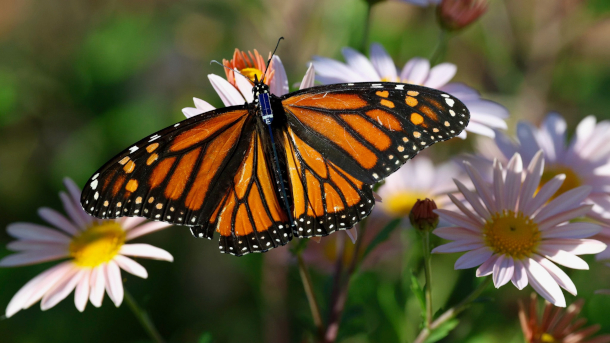
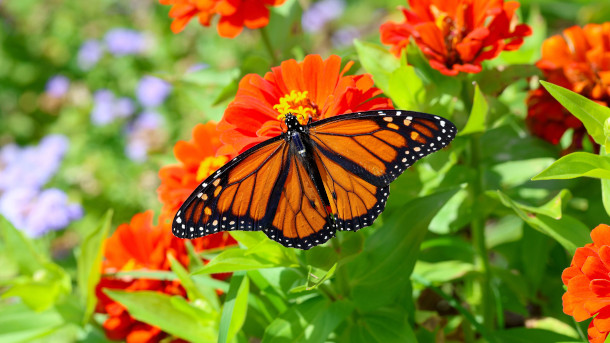
Tags from Cellular Tracking Technologies of Cape May, New Jersey, allow scientists and butterfly enthusiasts to follow the journey of monarch butterflies as they fly south for the winter. (Photo: Sheldon Blackshire)
Monarch butterflies can travel thousands of miles each year between Mexico and North America in an epic relay race of multiple generations. And thanks to new technology, our phones and other Bluetooth devices can now tell us what paths these brave little insects take on this journey. Dan Fagin, who teaches environmental journalism at NYU and is writing a book about monarchs, talks with Host Steve Curwood about the tiny trackers and what it’s like to be among millions of monarchs where they overwinter in Mexico.
Transcript
DOERING: It’s Living on Earth, I’m Jenni Doering.
CURWOOD: And I’m Steve Curwood.
The amazing Monarch butterfly is as beautiful as it is mysterious. Every year successive generations of monarchs take part in an epic relay, with each generation playing a different but vital role. Monarch butterflies that hatch in the spring and early summer live fast and die young at only two to six weeks. But those that emerge in late summer can survive six to nine months. That’s long enough to migrate thousands of miles south for the winter and start the return north the following spring to breed. The precise paths these brave little insects take to get from North America to their winter colonies in Mexico have long eluded scientists and butterfly enthusiasts. But thanks to new technology, our phones and other Bluetooth devices can now tell us where these tiny creatures are traveling. Joining us now is Dan Fagin, who teaches environmental journalism at NYU and is writing a book about monarchs. Dan, welcome back to Living on Earth!
FAGIN: Thanks, Steve, nice to talk to you.
CURWOOD: And great to talk to you. Hey, let's talk monarch butterflies. Monarchs have this fascinating migration pattern. Several generations they fly north, and then one generation to get all the way back to the tropics. Please talk to me about the new way to track them.
FAGIN: Yeah, something really kind of amazing has happened to monarch science. And you know, monarch butterflies are this beloved butterfly that scientists have been studying intently, really, since the 1940s and you know, the most intriguing thing about them, they have a lot of intriguing habits, but the most intriguing thing, Steve, as you mentioned, is this amazing migration that they do, multiple generations, thousands of miles. And for a long time, people have been trying to understand where monarchs go and how they get there. And for many, many years, the only way that they could do that was by using paper tags or sticker tags. The Holy Grail forever in monarch science has been to develop some kind of radio tagging, which can work for bigger animals, but to figure out a way to make a tag so small that we can actually track the entire journey of a monarch butterfly. And sure enough, after all these years, a startup company called Cellular Tracking Technologies based in Cape May, New Jersey, figured out a way to do it, and now we know where these monarchs are actually going and how they get there.
CURWOOD: So what are some of the surprising places that monarch butterflies go?

Dan Fagin, director of New York University’s Science, Health and Environmental Reporting Program and the author of the Pulitzer Prize winning Toms River, is writing a book about monarch butterflies. (Photo: Dan Fagin)
FAGIN: Maybe the most amazing thing about how this technology works is that a monarch pings, they register if they pass within a couple hundred feet of any kind of device equipped with Bluetooth, whether that person realizes it or not, if their Bluetooth is turned on, they are helping with this data collection. So we can now see, Steve, that if a monarch is over the ocean and passes near a boat that has a cellular device turned onto Bluetooth, they will ping. And sure enough, some of these monarch tracks, which, by the way, people can see for themselves by downloading the app, pass over oceans, deserts, all kinds of unexpected places.
CURWOOD: Let me understand this for sure, the monarch tracking device transmits in Bluetooth, and anyone gets that signal, you have to have the app to get the signal? Where is the signal going?
FAGIN: No, anyone can contribute to the data set, whether they realize they're doing it or not. Their device will ping and the data will go back to the central data depository that will show up as one detection along the route. Anyone can see where these tagged monarchs are going by downloading the app and looking. That's not about detecting the presence of monarchs. That's about looking at the data that's already been collected.
CURWOOD: Talk to me for a moment more about the technology. I mean, how much does a monarch butterfly weigh and how much does this tracking device weigh? I imagine the numbers are small in both cases, huh?
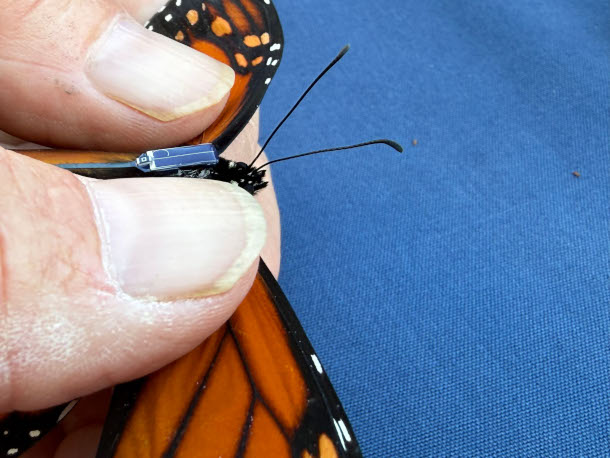
FAGIN: Yeah, really small. The way I like to analogize it is, a butterfly weighs about as much as half of a raisin, so it's very light, and the tags themselves are much lighter, still, little more than 10 percent of the body weight of the monarch, which is sort of like three uncooked grains of rice riding on half of a raisin.
CURWOOD: So Dan, what are we learning about the monarchs by tracking them? What are we learning about them through this tracking?
FAGIN: Yeah, a lot of things. You know, the monarch, you know, for reasons that we can talk about, is in trouble. We know that their populations are declining, especially the migratory population, they face all kinds of problems. So it's really important to figure out, well, how do we know what are the most popular routes that they take? And so we can think about how to help them in those particular places, and now we have a better idea about that, and after another few years of radio tagging, we'll have a better idea still. And another thing, Steve, is we can tell how affected by weather they are, because you can watch what happens to one of these monarchs when a big cold front comes by or there's a storm, and we can now see in real time that these monarchs are getting blown way off course. So now we know that weather is a very, very big deal for these guys. That they're stronger than we think, but they're not strong enough to resist a huge storm. But the flip side of that is they have these fantastic navigational abilities.
Tracking devices are about 10 percent of the weight of the monarch butterfly, the equivalent of three uncooked grains of rice on half a raisin, according to Dan Fagin, who is writing a book about monarch butterflies. (Photo: Sheldon Blackshire)
CURWOOD: How do they navigate? How do they know where they're going?
FAGIN: Yeah, it's really quite amazing, Steve. Over millions of years, they've evolved two different biocompasses, and they need two, because one of them tracks the sun is sort of anchored to the sun, but that's a problem when it's cloudy out. So they also have another biocompass that is attuned to the Earth's magnetic field. And you know, there's so many amazing things about this that they have these abilities at all. But what's especially amazing is that the sun compass actually compensates for the sun's journey across the sky, at least as we perceive it. We're the ones who are moving, not the sun, but as we perceive it. That could be a real problem for monarchs. If they just track the sun, they would constantly go off course. But this bio compass they have adjusts for this. It's called the time compensated sun compass, and it's quite miraculous. A few other insects have them too.
CURWOOD: Uh huh. Wait a second, you're telling me that monarchs can tell time essentially.
FAGIN: Yeah, they can. They can. You know, they they have a much more naturalistic way of doing it. They don't look at digits, but yeah, they adjust based on where the sun is and where south, or sometimes southwest, is their general journey direction in the fall. And they adjust for that all day long, and it keeps them going. So even when they're blown way off course, by these storms, they can adjust and get back on track, and this new data shows us this.
Digital tags on monarch butterflies ping off Bluetooth devices and send back data to scientists to map the path of monarch butterflies as they journey south for the winter. Data has shown that cold fronts and storms blow monarchs off course, but their navigational skills help them reach their overwintering place. (Photo: Courtesy of Cape May Point Arts and Science Center)
CURWOOD: So talking about the southern journey that single generation monarch might make, say from eastern Canada all the way to Mexico, I'm guessing most of them don't make it all the way. So how is climate disruption and loss of habitat making things harder for them? What's the survival rate?
FAGIN: Some people think that, you know, less than 5 percent of the monarchs that start the journey in September actually make it through the winter and then reproduce successfully in the early spring. That it's less than 5 percent. Some people think it's a little higher than that. That it might be, you know, more like 10 or 15 percent. These new tags will help us figure that out, once we get a nice, big, robust data set. But they face so many potential risks along the journey, and really at every stage of their year-long multi-generational life cycle. Climate change is an obvious one, because climate change creates problems for them at every stage of their yearly journey. They definitely when they're migrating in the fall, they need access to nectar plants, or they'll never make it. They need to fortify themselves along the way, and climate change is wreaking some havoc with where and when these plants are available in the fall and also in the spring, when they're moving north and they need nectar plants, again. In Mexico, climate change is creating all sorts of problems for them. They have a very narrow temperature range that they are comfortable with and that means that for winter, that's why they migrate in the first place. And for winter, they need to find a place that's not too cold and not too hot. And it turns out that's a few Mexican mountaintops, typically around 10 or 11,000 feet high. And the problem is that as the climate gets warmer and moisture patterns change and drier, the monarch colonies on these mountains keep moving up, and essentially they're going to run out of mountainside. It's going to get too warm, and they're already, I can see, just from my own journeys, the trips I've taken down there over the last 10 years, we can see the monarchs moving up the mountain and, and they're running out of mountain. So that's a problem. There's also problem that things are getting much drier all along their journey, including in Mexico, and that has caused all kinds of disease problems in Mexico. Beetles, beetle infestations are a really big problem on their overwintering grounds. So this is a problem. And honestly, Steve, you know, climate change is only one of the big issues that they face. There are other critical problems too.
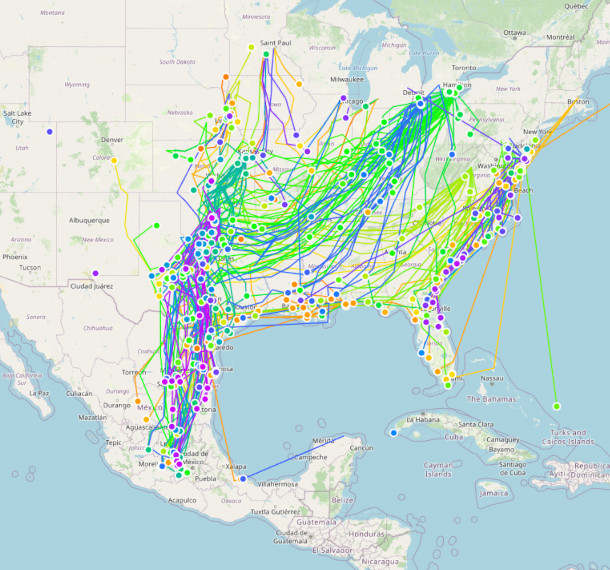
As tagged monarch butterflies travel south for the winter, they ping off Bluetooth devices such as cellphones, which send the data to scientists tracking the monarchs’ journey. The data set shows where the monarchs are located at a point in time. (Photo: Project Monarch Collaboration)
CURWOOD: Yeah, I imagine we use a lot of chemicals that aren't good for insects.
FAGIN: Yeah.
CURWOOD: And I imagine that the habitat is not exactly expanding.
FAGIN: Yeah, that's definitely true. There's a lot of recent research about neonic pesticides, neonicotinoid pesticides, that suggest they're a real problem for monarchs as well as other insects, but the biggest problem that affects them during the summertime is that monarchs coevolved with milkweed plants. They will only lay eggs on milkweeds. And it turns out that in their main summer breeding grounds, which is the upper Midwest, it coincides with the Corn Belt, with the huge corn and soybean raising areas of the Midwest. And anybody can tell you who is familiar with farming in the Midwest, something has changed fundamentally with the way that corn and soybeans are raised over the last 25 years, and that is the rise of genetically engineered seeds that are resistant to herbicides, which means that you can use a lot more herbicide, Roundup, Glyphosate is the most famous one on your crops, and that has wiped out the most important refuges of milkweeds in the upper Midwest. There's still milkweed in the Upper Midwest, but there's so much less than there used to be. And this is a big problem for monarchs.
CURWOOD: Now you've visited the tropical or perhaps subtropical monarch butterfly colonies. Talk to me about this experience. What is it like?
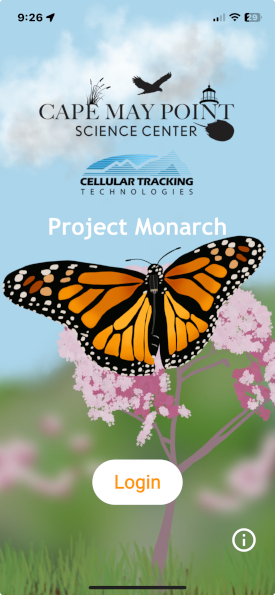
The Project Monarch Butterfly App allows users to see the path taken by monarch butterflies as they fly south. (Screenshot: Andrew Skerritt)
FAGIN: There's really no phenomenon quite like it on Earth. You go to these very isolated locations, in Michoacán and the State of Mexico, where there have been overwintering colonies most years, and you're already pretty high elevation. And then you start walking even higher in these park areas, and you're walking up the mountain, and you start to see more and more monarchs. And then after, you know, another half hour, 40 minutes, depending on where you are, you're hiking and hiking, you're getting tired, and then all of a sudden, you just see teeming hordes of Monarch butterflies circling overhead and in the fir trees, by the millions. It's just impossible to describe how many there are.
CURWOOD: So Dan, tell us about your interest in monarch butterflies. Where did the fascination begin?
FAGIN: Well, I think it was two different things. After I finished my last book, you know, I was very proud of that book, but it was about an emotionally difficult topic, children with cancer, and I wanted to do something different, and I was really just starting to realize that this concept of a human dominated planet is even bigger than climate change itself. Climate change is just one manifestation of this bigger question of humans essentially taking control of the future of this planet. We're living in uncontrolled experiments, and we don't know how it will end. So I was really interested in that. And then right about that same time, I had read stories about monarchs, and a neighbor was raising monarchs, and I just started to learn more. And then we decided, hey, let's put some milkweeds on the front lawn. And we waited and waited, and then monarch showed up. And it was amazing. It was such an enchanting, amazing thing. And so on a very human level, my wife and I really loved it. But it also got us thinking about, what exactly are we doing here? Are we creating? Is this a natural environment? Not really. We're creating an environment that's optimized for this species. And to me, that is a really interesting thing to think about, because it's really the future that we will all face, and our footprint is all over this planet, and there's no going back. And so as an environmental journalist, this is really the central question, and that is, what are we going to do with our power? So this is a Pottery Barn situation. We broke it and we own it, right? You break it, you buy it, and, and, and we own this planet. And so the question is, can we manage it in a way that meets human needs and also maximizes biodiversity? This is a, you know, a big question that our kids and our grandkids are going to face in all sorts of different ways. And as an environmental journalist, I want to encourage that conversation.
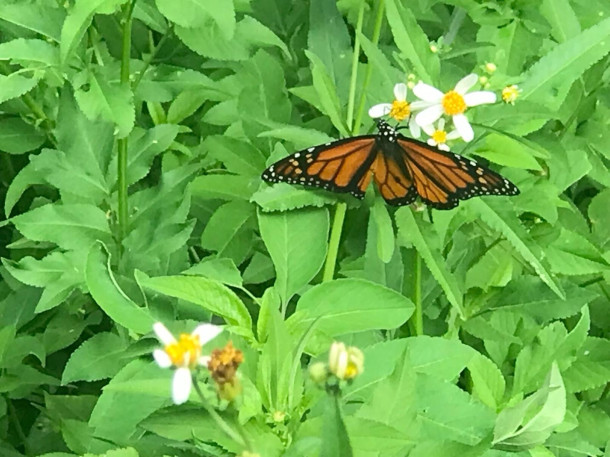
Each fall monarch butterflies fatten up on roadside weeds ahead of their fall migration south. A monarch feasts on dandelions along the road in Tallahassee, Florida, which is on the path toward the Gulf of Mexico. (Photo: Andrew Skerritt)
CURWOOD: Pulitzer Prize winner Dan Fagin is a journalism professor at New York University, where he directs the Science, Health and Environmental reporting program, and he's working on a book about monarch butterflies that both he and his editor are waiting anxiously for. Dan Fagin, thanks so much for taking the time with us today.
FAGIN: It was a pleasure talking to you, Steve.
Links
Living on Earth wants to hear from you!
Living on Earth
62 Calef Highway, Suite 212
Lee, NH 03861
Telephone: 617-287-4121
E-mail: comments@loe.org
Newsletter [Click here]
Donate to Living on Earth!
Living on Earth is an independent media program and relies entirely on contributions from listeners and institutions supporting public service. Please donate now to preserve an independent environmental voice.
NewsletterLiving on Earth offers a weekly delivery of the show's rundown to your mailbox. Sign up for our newsletter today!
 Sailors For The Sea: Be the change you want to sea.
 The Grantham Foundation for the Protection of the Environment: Committed to protecting and improving the health of the global environment.
 Contribute to Living on Earth and receive, as our gift to you, an archival print of one of Mark Seth Lender's extraordinary wildlife photographs. Follow the link to see Mark's current collection of photographs.
 Buy a signed copy of Mark Seth Lender's book Smeagull the Seagull & support Living on Earth
© Copyright World Media Foundation. All Rights Reserved
Home | Contact | RSS | Donate | Newsletter