

May 15, 2026
Air Date: May 15, 2026
FULL SHOW
SEGMENTS
Blocking New UK Oil and Gas
View the page for this story
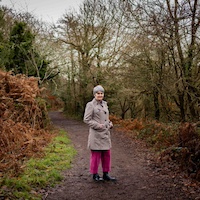
Great Britain is Europe’s third largest oil and gas producer, even with a commitment to a net-zero economy by 2050. A small group of climate activists is helping the UK meet that target by winning a Supreme Court decision that’s blocking any new UK oil and gas projects that don’t assess climate impacts. Sarah Finch of Surrey, near London led the fight against proposed oil and gas drilling in the region known as the Weald, and she’s been recognized with the 2026 Goldman Environmental Prize for Europe. She joins Host Steve Curwood. (13:04)
White House Accuses NCAR of "Climate Alarmism"
View the page for this story
The federally funded National Center for Atmospheric Research, or NCAR, in Boulder, Colorado has been a leading agency for decades assessing the risks and possible responses to the changing climate. But in November, the Trump administration declared it was dismantling NCAR, citing its contribution to what the administration calls “climate alarmism.” University of Colorado - Boulder Professor Waleed Abdalati talks with Host Steve Curwood about the role of NCAR and why its parent organization has filed a lawsuit alleging a “campaign of retaliation against the State of Colorado.” (10:29)
China Making Green Aluminum
View the page for this story
As China rapidly builds out renewable energy, it’s using some of that clean energy to power industrial activities like making aluminum, which is in high demand from data center and electrification projects. China produces 60% of the world’s aluminum, and smelting the metal uses massive amounts of electricity. Energy and climate journalist Alexander Kaufman joins Host Aynsley O’Neill to explain how Chinese aluminum is going green. (07:46)
The Quest for Green Steel
View the page for this story
Just outside of Chicago, the country’s largest complex of steel mills faces an uncertain future. Air pollution, climate change and the preservation of union jobs are affecting the industry, as are the Trump administration’s stances on coal, steel, and tariffs. The Allegheny Front’s Reid Frazier reports on efforts to get big steelmakers in the region to switch from coal to natural gas or hydrogen, but overhauling existing infrastructure isn’t easy or cheap. (06:06)
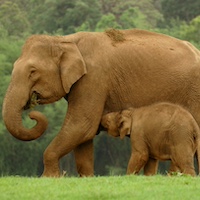
Elephant Elder Wisdom
View the page for this story
Elephants are social animals like us and pass down to their young knowledge and skills crucial to living a successful life. Researchers have found that elephant youths conduct themselves differently if they were raised without elders. Orphaned elephants have been seen struggling to integrate into broader social groups and inaccurately assessing threats from predators. Lucy Bates, a lecturer with the Center for Comparative and Evolutionary Psychology at the University of Portsmouth, speaks with Host Aynsley O’Neill about how this important role of elephant elders can help shape conservation priorities. (09:44)
Show Credits and Funders
Show Transcript
260515 Transcript
HOSTS: Steve Curwood
GUESTS: Waleed Abdalati, Lucy Bates, Sarah Finch, Alexander Kaufman
REPORTERS: Reid Frazier
CURWOOD: I’m Steve Curwood.
O’NEILL: And I’m Aynsley O’Neill.
Concerned residents of the most wooded part of England secure a Supreme Court win that is blocking new oil and gas developments in the United Kingdom.
FINCH: I was actually shocked when I saw that notice. I couldn't believe it. I thought, what oil wells in Surrey? We're in a climate emergency. You know, this is not a time to be opening up new sources of oil anywhere, not in the Weald, but not anywhere else either.
CURWOOD: Also, China is cleaning up power-hungry aluminum with renewable energy.
KAUFMAN: China has very short supplies of natural gas and oil, so its shift toward greener production is something that is really for their own national security and their own energy security.
CURWOOD: We have That and more, this week on Living on Earth. Stick around!
[NEWSBREAK MUSIC: Boards Of Canada “Zoetrope” from “In A Beautiful Place Out In The Country” (Warp Records 2000)]
[THEME]
Blocking New UK Oil and Gas
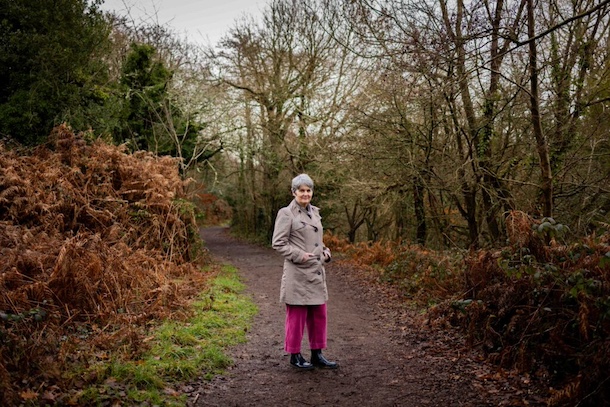
Sarah Finch and the Weald Action Group have fought successfully against oil and gas drilling in the Horse Hill area of the Weald and secured a ruling that will force planners to consider the downstream environmental impact throughout the United Kingdom. (Photo: Goldman Environmental Prize)
O’NEILL: From PRX and the Jennifer and Ted Stanley Studios at the University of Massachusetts Boston, this is Living on Earth, I’m Aynsley O’Neill.
CURWOOD: And I’m Steve Curwood.
Great Britain was the birthplace of the Industrial Revolution back in the 18th century, and into the 20th century it burned some 30 gigatons of coal as it built a massive empire. Coal is no longer king, but Britain is still deep in fossil fuel, extracting oil and gas from the North Sea as Europe’s third largest oil and gas producer, even with a commitment to have a net-zero economy by 2050. A small group of climate activists is helping the UK meet that target by winning a major court decision that’s blocking any new UK oil and gas projects that don’t assess climate impacts. Sarah Finch of Surrey, near London led a group of local activists in a fight against proposed oil and gas drilling in the region known as the Weald. The Weald Action Group eventually appealed all the way to the UK Supreme Court to win a major victory based on climate concerns. On the line now is Sarah Finch, and she's winner of the 2026 Goldman Environmental Prize for Europe – Congratulations!
FINCH: Thank you
CURWOOD: And welcome to Living On Earth.
FINCH: Oh, thank you for inviting me.
CURWOOD: Today, you live in Surrey, England, near Weald. What makes this area so special to you and your neighbors there and the local action group?
FINCH: Okay, well, so the Weald, it covers three counties in southeast England. It's close to London, so it's a very developed, densely populated area, but it's also very wooded. It's the most wooded county in England. There's lots of small villages, small towns, isolated farms, with woodland all around, but as well as being kind of rural and beautiful, we're also sitting on top of a huge oil field there. So there's tensions between the rural way of life and the desire to industrialize it.
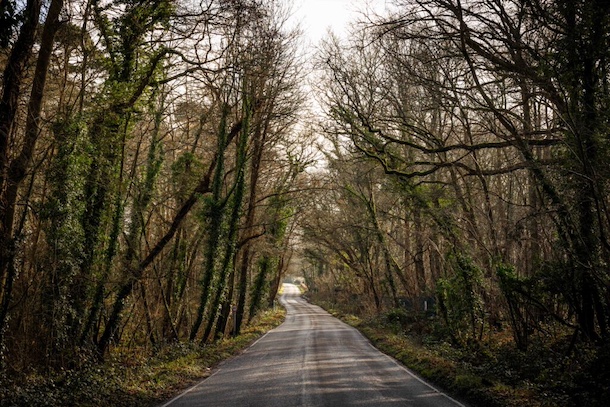
The Weald is a 500-square-mile, heavily wooded region in southeastern England. The basin is estimated to contain several billion barrels of oil. UK Oil and Gas has shared a vision for “back-to-back” wells across the Weald, approximately 2,400 oil wells in 100 locations, in order to transform the region into a “new Texas.” (Photo: Goldman Environmental Prize)
CURWOOD: Imagine that oil field underneath you there is related to what's out in the North Sea, huh?
FINCH: It's a particular kind of tight geology that we have. So it's not easy to extract the oil from the Weald by conventional means. It requires kind of fracking type technologies. So it's very small scale compared with the North Sea. So I think 98 percent of British oil comes out of the sea. It's only 2 percent comes from these small onshore sites dotted around the countryside. So it's not really very significant in terms of energy security, but it is significant in terms of the damage that it potentially can do.
CURWOOD: Yeah, I don't imagine that one would want a fracking well right in your neighborhood.
FINCH: Nobody does. So it's in the 2010s when these new technologies sort of became available coming from America, that there was a rash of applications for fracking type operations across the Weald and so in all of the towns and villages where there was a prospect that locals got organized to resist it, and then we came together, and that's when we formed the Weald Action Group.
CURWOOD: So Sarah, in 2010 in fact, you see a newspaper notice about a company planning to explore for oil. What, just six miles from your home there in Surrey? There have been some gas drilling nearby before that. What made this project so alarming in your mind?
FINCH: So I was actually shocked when I saw that notice. I couldn't believe it. I thought, what oil wells in Surrey. It just seemed really strange, but then looking into it, I did find out there were similar applications all around the area.
CURWOOD: Hmm. Now, UK Oil and Gas has touted a vision to transform your region into a new Texas. What does that vision look like to you?
FINCH: Well, yeah, they published this brochure setting out the many billions of barrels of oil that were in the area, and the fact it would need several thousand wells all closely packed together to exploit it all. So they were painting a vision of a very industrialized operation. It would have meant very large numbers of tankers on our narrow, kind of winding country roads, potentially huge local air pollution, water pollution, noise at night, light at night would be 24-hour drilling. So the prospect was alarming. And over and above all that, all of those local impacts, of course, there's the climate issue that we know now that it's the burning of fossil fuels like oil, gas and coal that have led to the rising temperatures that we're experiencing that are causing, you know, extreme weather dangers and threats to us. So over and above, all of the local industrialization issues with the knowledge that we just don't need to be drilling for new oil at this time. We're in a climate emergency. You know, this is not a time to be opening up new sources of oil anywhere, not in the Weald, but not anywhere else either.
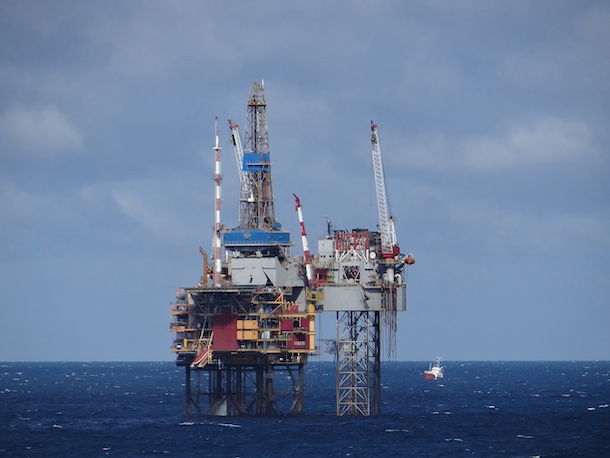
In August 2024, citing the Finch Ruling, the UK government pulled its support for two major North Sea oil developments. The UK is the third largest producer of oil and gas in Europe thanks to its vast reserves in the North Sea. (Photo: Gary Bembridge, Wikipedia Commons, CC BY 2.0)
CURWOOD: So in the fight to stop oil and gas exploration in the Weald, your group lost a number of court decisions along the way. What kept you going?
FINCH: Yeah, so I have to say we did have some successes in the Weald as well. There were a number of sites that we did manage to get turned down or the operators withdrew their applications. But this one site nearest to my home, Horse Hill, they applied for successive planning permission. So they got two permissions approved for exploratory drilling. And then in 2019, they got permission for 20 years of production, so they already had two wells by that stage. And then they applied for four more wells and 20 years of production, and at that point, when that was approved, we just thought, no, we can't accept that this decision was right. And we went to court and yeah, it was a long battle. We got our application to have a decision refused twice, but we persisted, and then we had a court case and lost it. We went to the Court of Appeal, lost again. But we were powered all the time by just the conviction that we were right. That the particular argument we were making was that when Surrey County Council approved this plan, they didn't look at the climate impact of burning the oil that was to be produced. They looked at the small amount of greenhouse gas emissions that would be produced on the site itself, but not when the oil was taken off elsewhere, refined and burnt. And we argued that under our Environmental Impact Assessment Law, they needed to have looked at those emissions. And it was just the conviction that we were right, and then also that it didn't just apply to this one site, but this was a bigger problem of other oil and gas and coal operations that had been approved across the country, so including a new coal mine that had been permitted. You know, it would have been the U.K.'s first new deep coal mine in 30 years, but it had been approved without any assessment of the climate impact of burning the coal. Similarly, two large oil fields in the North Sea approved without any consideration of their climate impact. And so we knew that this case, we were fighting over one relatively small site in Surrey actually would affect the whole of the U.K. oil and gas and coal sector.
CURWOOD: So this is interesting that you were looking really at the whole nation. What was different about the local judges that said, no, no, no, this is we don't have to worry about this. And then the highest court says, Oh, wait, we do. What made the difference, do you think?
FINCH: As we climbed higher up the court system, the judges were looking at it in a different way. So the first judge in the High Court treated it very much as a planning matter, and sort of looked at planning law, which planning policy, at that time we felt was out of date and out of step with climate policy. But when we got to the Supreme Court judges, they were just looking at as a very simple matter of, you know, the common sense reasoning, they understanding the scale of the climate emergency and looking at the wording of the law that the decision makers have to look at the full, all of the expected direct and indirect impacts of their development. And it all really came down to whether or not these greenhouse gas emissions from burning oil are an indirect effect of producing it, which we always argued that they were. And I think the Supreme Court judges took a very common sense approach to that decision. And we felt so vindicated when we won in the Supreme Court. Just thought, yes, this is exactly what we've been saying for five years, and now the highest judges in the land agree with us.
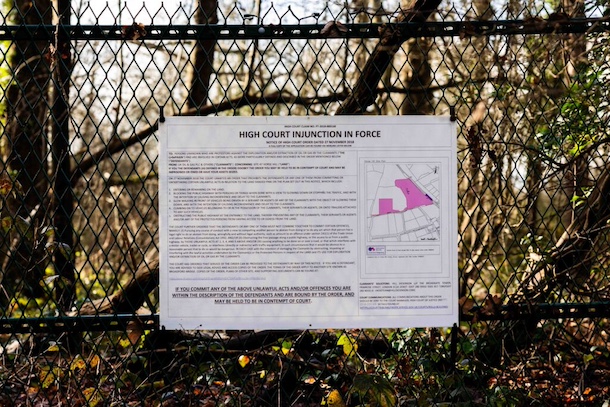
In December 2018, HHDL applied to the Surrey (UK) County Council for planning permission to begin producing oil from two existing wells at Horse Hill and drill four additional wells, projecting more than 24 million barrels of oil from six wells over 25 years. The development was viewed as a test case for the expansion of drilling across the Weald, employing unconventional methods of extraction, like acid fracking. In 2024, the UK Supreme Court blocked the proposal on the grounds that authorities must consider the downstream impact of burning coal, oil and gas when they decide whether to approve projects. (Photo: Goldman Environmental Prize)
CURWOOD: So let me see if I have this right. The decision you got which, by the way, the first named party in the decision is a Finch, so you're named, I guess, in British law, going forward from today. What exactly is the national implication of this decision? Does this mean that can't drill for oil anymore in the North Sea, can't extract coal from Newcastle or any place else?
FINCH: No, it doesn't mean that, because it's a procedural matter rather than a decision making one. So it means that when plans are being considered to drill for oil or gas or coal, before the decision can be made, there has to be a full assessment of the climate impact of the use of the end product, not just of the production process itself. So that's a big change. And so after we won that case, immediately, sort of like knocking over dominoes, a number of other big sites were found unlawful. So the coal mine that I mentioned, the Rose Bank oil field, which is the biggest undeveloped oil field in the North Sea, and several other projects as a result, were then found unlawful and sent back to the drawing board, and the government realized it had to rewrite the guidance for developers to tell them exactly what they had to do to comply with this, yeah, the Finch Ruling, as it's called. And just to be clear, it's not a new law. The Supreme Court didn't create a new law. They just clarified what the existing law said that hadn't been being followed properly.
CURWOOD: So just to make it clear, what the U.K. Supreme Court ruled is that the downstream impact of burning coal and oil and gas must be considered in the process of any sort of approval.
FINCH: Yeah, exactly.
CURWOOD: And that makes it pretty tough, if you look at the downstream effect of burning fossil fuels and what's going on with the climate emergency. I mean, how does a company get around the climate emergency?
FINCH: Well, we have yet to see if they will, but the arguments they've been making are that if you look at the climate impacts of any one development in isolation, then of course, it is a drop in the ocean of all of the emissions that are being produced around the world all the time. So they try to argue that it's insignificant because it's small in comparison with total emissions. But the government, in its new guidance to developers, has said that they can't do that. They have to look at it in conjunction with all other existing and planned projects. Another argument that the industry uses is that, well, if you open a new oil field here, another one's going to close down. But that's not the way it happens. So they're not allowed to pretend that there's a ways of mitigating a new oil field. If they want to say that the emissions will be captured by carbon capture and storage, as some do they, they are now required to actually say where and when this will happen and where precisely that infrastructure is to capture those emissions, which, in reality, doesn't actually exist at scale anywhere in the world now. I'm optimistic that this ruling has made it effectively impossible for anyone to approve new oil and gas in the U.K., but we have to wait and see and there are arguments being made by pro-fossil fuel forces, and it has become something of a culture war, with politicians on the right of the divide being very pro-new UK oil and gas and others against. So yeah, although it seems to many of us a matter of kind of logic and morality that you don't produce more oil and gas in a climate emergency, there's always politics getting in the way that we have to deal with too.
In June 2024, nearly five years after the initial county council decision, the United Kingdom Supreme Court handed down a 3-2 decision in the Weald Action Group’s favor. The decision stated that the Surrey County Council had acted unlawfully in approving the development at Horse Hill because the project’s environmental impact assessment failed to consider the climate impacts of burning the oil to be extracted there. (Photo: Goldman Environmental Prize)
CURWOOD: Tell me, what's the most important lesson that local communities can learn about trying to stop fossil fuel exploration that threatens their quality of life, that threatens the planet?
FINCH: Well, I think our story is just very encouraging in that basically we were a small group of concerned ordinary people, and we spent years fighting those oil fields in the Weald through various means, through protest and other means. And then eventually we won through a legal challenge. We're just ordinary people, and we managed to achieve a huge change, even against something as big as climate change. So change is possible. And I think what I've seen along the way is we have far more allies than I realized. The oil and gas industry is very powerful. You know, it has friends in high places, but it's not invincible.
CURWOOD: Sarah Finch is an environmental activist, and right here from Surrey, England, part of the Weald Action Group, and she's the 2026 Goldman Environmental Prize Winner for Europe. Sarah, thanks so much for talking with us.
FINCH: Thank you.
Related links:
- Sarah Finch’s profile at The Goldman Environmental Prize
- The Goldman Environmental Prize
- Watch The Goldman Environmental Prize video profile of Sarah Finch
[MUSIC: Spare Parts, untitled waltz #105 in a manuscript tune book by Michael Turner (1796-1885) on The Regency Ballroom: English Country Dance Music from the era of Jane Austen, by Michael Turner, bfv music]
O’NEILL: Coming up, in the US, the Trump administration is trying to dismantle a key research institution, citing “climate alarmism.” Keep listening to Living on Earth.
ANNOUNCER: Support for Living on Earth comes from the Waverley Street Foundation, working to cultivate a healing planet with community-led programs for better food, healthy farmlands, and smarter building, energy and businesses.
[CUTAWAY MUSIC: Spare Parts, untitled waltz #105 in a manuscript tune book by Michael Turner (1796-1885) on The Regency Ballroom: English Country Dance Music from the era of Jane Austen, by Michael Turner, bfv music]
White House Accuses NCAR of "Climate Alarmism"
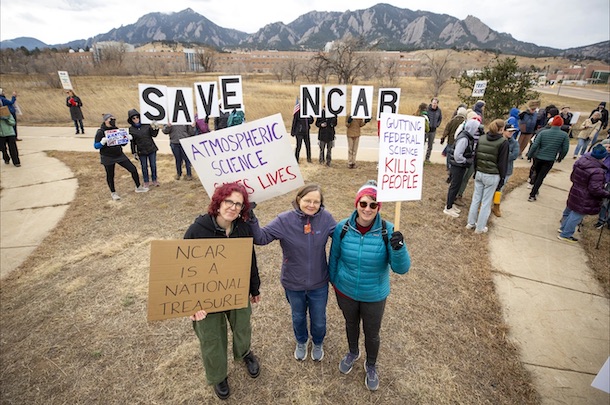
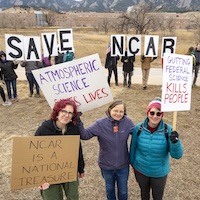
Protestors gathered in Boulder late last year to show support for NCAR in the midst of calls for its dismantling. (Photo: Kevin Beaty, Denverite)
CURWOOD: It’s Living on Earth, I’m Steve Curwood.
O’NEILL: And I’m Aynsley O’Neill.
When word came of the current Hantavirus outbreak on a cruise ship, there were no rapid response investigators dispatched by the CDC, no CDC news conferences and no health alerts quickly sent to doctors and the health care system. That’s because when President Trump came into office for a second time, he shredded the workforce of the US Centers for Disease Control and Prevention, and the firings included all of the full-time staff devoted to public health concerns related to cruise ships. Ostensibly, the moves were intended to slim the federal budget, but some saw them as retribution against the CDC, punishing officials, including Dr. Anthony Fauci, who had confronted Trump’s dubious science and delayed Covid-19 pandemic response. And the CDC is not the only agency vital for public health that’s under fire from this administration.
CURWOOD: Yes, and understanding the growing climate emergency is also a matter of public health protection. The federally funded National Center for Atmospheric Research, or NCAR, in Boulder, Colorado has been a leading agency for decades assessing the risks and possible responses to the changing climate. But in November, the Trump administration declared it was dismantling NCAR, citing its contribution to what the administration calls “climate alarmism.” So, NCAR’s parent organization is suing the Trump government, claiming it is “waging a campaign of retaliation against the State of Colorado,” by trying to scuttle NCAR after Colorado’s governor refused to pardon an official convicted of election interference on behalf of Trump.* (see update at end of this transcript) As NCAR scientists have been muzzled, we turn now to Waleed Abdalati, a former NASA chief scientist who is now a professor at the University of Colorado, Boulder. Waleed, welcome to Living on Earth!
ABDALATI: Thanks for having me.
CURWOOD: Briefly, please describe for us what exactly the National Center for Atmospheric Research, or NCAR, does.
ABDALATI: So NCAR carries out all aspects of atmospheric research and environmental research related to weather, climates, drought, fires, basically how the earth system works, how it moves energy, what the implications are for weather and the way we live, from our day to day lives to our longer-term planning.
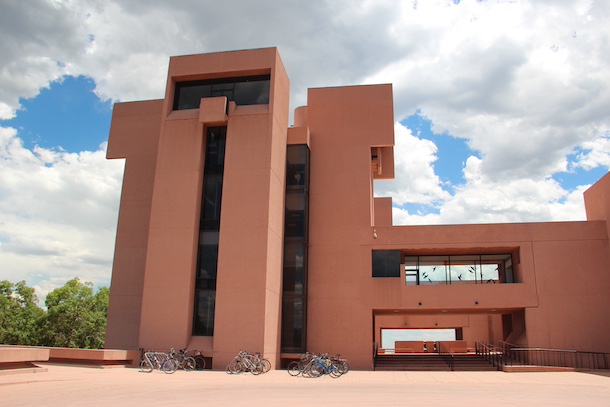
The National Center for Atmospheric Research in Boulder, Colorado. (Photo: Thomson M, Wikimedia Commons, CC BY 3.0).
CURWOOD: So the University Corporation for Atmospheric Research, the holding company, if you will, of NCAR, has filed a lawsuit arguing that dismantling NCAR would threaten national security, public safety, the economy. How well-founded are these claims, do you think?
ABDALATI: Well, I don't have the legal expertise to make judgments on the merits of the case, but as a scientist, I can certainly say that our economic and strategic interests are closely tied to how well we understand the environment and its evolution, and so efforts that compromise that do put us at risk of not being as successful as we otherwise would or could be. You know, one good example is, you know, the Arctic is changing rapidly. It's changing more rapidly than other places on Earth, and understanding the processes that govern that change will help us understand what kinds of investments we should make. What are the economic opportunities associated with an Arctic where the ice cover is shrinking? When will it shrink? What does that mean to have an exposed border that we've historically relied on being ice-covered? These are the kinds of questions that the work at NCAR and other related research can help us with and it is, in my view, detrimental to our interest to not be pursuing that understanding.
CURWOOD: So the lawsuit also suggests that the move by the Trump administration is part of the Trump administration's campaign of retaliation against the state of Colorado, and that's a direct quote from the suit. In the past year or so, the administration has blocked hundreds of millions in federal funding for states, vetoed an urgently needed water pipeline, threatened to withhold food stamp benefits from residents. So why does President Trump seem to have it out for Colorado?
ABDALATI: [LAUGH] Well, I'm not going to put myself in the mind of officials that make these kinds of decisions. What I will say is a lot of people believe that this is retaliation. Colorado in particular, being singled out because the governor of the state of Colorado has not pardoned or shown leniency to Tina Peters, the county clerk who has been accused, actually convicted of tampering with ballots in her county.* (see update at end of this transcript) And so this gets back to sort of the current administration's commitment to advancing the idea that the 2020 election was rigged, and the governor of Colorado is, I wouldn't say, pushing back on that. He's simply not agreeing to undo what a court has determined or has decided. And that, again, I'm not saying this myself, but many believe that has put the states in bad favor with the administration, and this is apparently an effort to retaliate against that.
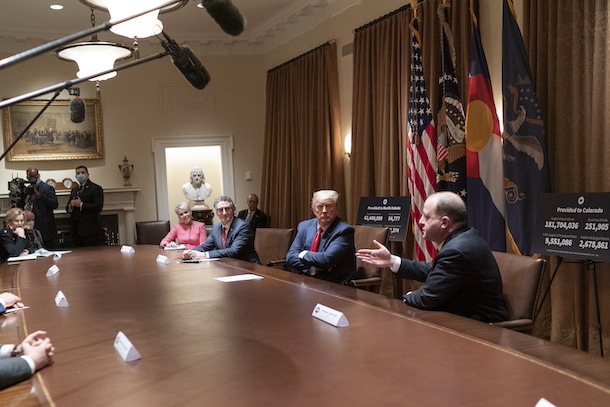
Colorado Governor Jared Polis has clashed with President Trump who wants a pardon of Tina Peters, the Mesa County clerk who was convicted in state court of tampering with 2020 election results on behalf of the president. Above, Trump (center) and Polis (right) meet at the White House. (Photo: The White House, Wikimedia Commons, Public Domain)
CURWOOD: Tina Peters was convicted for tampering with the election results in 2020 on behalf of President Trump, but of course, being a state conviction, he has no power to pardon her.
ABDALATI: That's correct.
CURWOOD: So how are others in the world of climate research and weather reacting to the prospect of NCAR getting dismantled and the lawsuit itself?
ABDALATI: I don't know how people are reacting to the lawsuit. I do think people are hopeful that they'll prevail, because the issue from the science perspective is this is a tremendous capability that at best will be compromised, at worst, would be destroyed. The administration did seem to single out NCAR's climate work and climate alarmism, as they call it. You know, one, NCAR does so much more. And two, I don't think there's alarmism by the scientists at NCAR. They do research and they report, through peer review, what they find. The fact that some of it is or can be alarming doesn't make the alarm the goal of the work. I think there's a great loss for the wrong reasons. I mean, there's no good reason for dismantling this or tearing it down, but I do think the allegations that are made are off the mark.
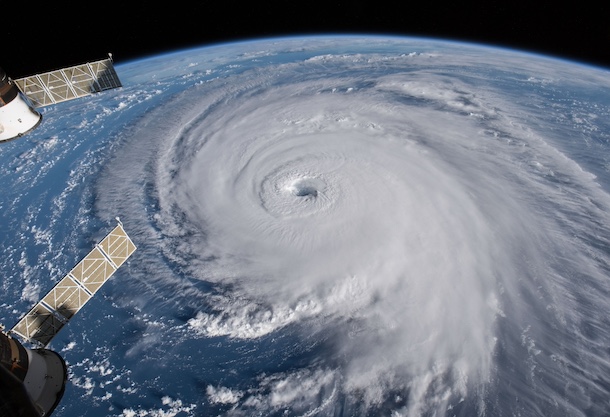
Shown above is Hurricane Florence in 2018. Abdalati warns that a lack of understanding about atmospheric science puts us at greater risk when climate disasters strike. Tools like weather satellites are used by NCAR to forecast and track storms to reduce their impact. (Photo: NASA/Goddard Space Flight Center, Wikimedia Commons, CC BY 2.0)
CURWOOD: By the way, to what extent do you believe that we should all be very concerned, indeed, alarmed about the climate emergency that seems to be advancing?
ABDALATI: I think we should be very concerned. But I would frame it a little bit differently. I would hope that everyone in this country, everyone in the world, would appreciate the importance of doing our best to understand what the future holds, so we can be best positioned to manage the challenges that come with it and capitalize on the opportunities that may come with it. So to be critical of the research itself is a tremendous disservice to the country. Speaking individually, I'm not speaking on behalf of the science community or anyone else, I'm very concerned, because the physics are pretty basic. If you put heat trapping gas in the atmosphere, it will trap heat. More heat in the atmosphere has certain implications for the environment we've lived in for centuries, and so I'm very concerned about the challenges that may lie ahead, but my concern is much further exacerbated when we try to avoid understanding what those challenges may be. And I see this effort and others that I'm seeing as compromising our ability to know what lies ahead, and as a result, I think it greatly compromises our national interests.
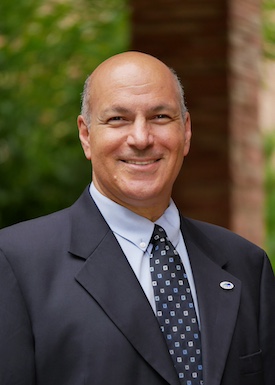
Professor Waleed Abdalati is a former chief scientist at NASA and the director of the Cooperative Institute for Research in Environmental Sciences at the University of Colorado, Boulder. (Photo: Courtesy of Waleed Abdalati)
CURWOOD: You know, by the way, federal funding for climate and environmental research has faced a lot of uncertainty recently, including some impacts on your own lab there. How has that uncertainty affected your team, both in terms of functionality and morale?
ABDALATI: Well, that uncertainty has had a tremendous impact on morale, and when morale is low, people don't function as well as they otherwise would. So I think the environment, the removal of a huge percent of the workforce on the federal side, the challenges to grants and so funds are not flowing, really takes a toll on our people, and in some cases, a real financial toll, and they're unable to do the work that they've dedicated their careers to. And I just want to say people don't do this work for the glamor or for the money. People do this work because they care. And I think when a person has dedicated their careers to something like that, and all of a sudden there's kind of a, you know, it's not worth doing. We don't support it anymore. That really is a challenge, and it has a huge, huge impact on morale and ultimately, I think the work that people are able to do.
CURWOOD: Waleed Abdalati is the director of the Cooperative Institute for Research and Environmental Sciences at the University of Colorado, Boulder. Waleed, thanks so much for taking the time with us today.
ABDALATI: Of course. Thank you so much for covering this important story.
*After this story went to air and was published, we received word that Gov. Polis commuted Tina Peters' sentence and plans to release her early, on June 1, 2026.
Related links:
- Nature | “World-Leading Climate Centre Takes Trump Administration to Court”
- Visit the National Center for Atmospheric Research website
- Read the full lawsuit here
- Learn more about Waleed Abdalati
[MUSIC: New York Philharmonic, Leonard Bernstein “Grand Canyon Suite: III. On the Trail” on Bernstein Century - Gershwin, by Ferde Grofe, Sony Classical (2017 Remastered Version)]
China Making Green Aluminum
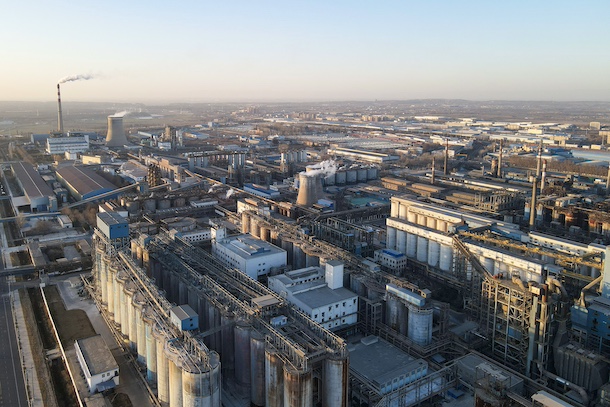
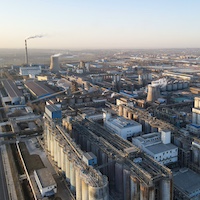
Pictured above is a CHINALCO Mining Co. Ltd. plant in Shangjie District, Zhengzhou. According to a report by Fitch Ratings, Aluminum Corporation of China (Chinalco) is a major Chinese state-owned enterprise, serving as the world's largest producer of alumina and the third-largest provider of primary aluminum. As a country, China is responsible for about 60% of the world’s aluminum output. (Photo: Windmemories, Wikimedia Commons, CC BY-SA 4.0)
O’NEILL: During the recent summit meeting of US President Donald Trump and Chinese President Xi Jinping in Beijing, the two leaders looked for common ground on trade, the war in Iran and more. But when it comes to green tech, the US and China still seem to be moving farther and farther apart. While the US has opted out of reducing global warming emissions on the federal level, China has committed to reductions of at least seven percent by 2035 and is already greening its economy. An analysis from Carbon Brief showed that in 2025, solar power, electric vehicles and other clean-energy technologies powered more than a third of China’s GDP growth. And one field next in line for decarbonization is China's aluminum production, which accounts for around 60% of the world’s aluminum output, and smelting the metal uses notorious amounts of electricity. Alexander Kaufman is an energy and climate journalist who wrote about this for Canary Media, and he’s here to discuss. Alexander, welcome to Living on Earth!
KAUFMAN: Thank you for having me.
O'NEILL: So starting with the basics, how much demand is there for aluminum in today's modern society? Where do we see it being used the most?
KAUFMAN: Demand for aluminum is soaring right now, in particular because of electrification projects. This is both from data centers that are building out a lot of infrastructure and need the power to keep them supplied, and this is from the general electrification that we're seeing in a lot of economies as countries in Europe and in China move away from fossil fuels and embrace more renewables, but we are seeing record demand right now, in particular in China, even as demand for things like steel sank to a seven year low.
O'NEILL: And now, as I understand it, one of the ways that China is looking to make its aluminum production more eco-friendly is through mandating that aluminum smelters run on a clean energy source, like a hydropower or a solar. So how exactly would that switch work? How easy is it? How fast is it for China to make something like that happen?
KAUFMAN: So China has an unrivaled ability to swiftly move things from a central government edict to changes on the ground. What's happening in this case is there are incentives for these smelters to move to provinces with high volumes of excess clean power. And so this means looking at provinces such as Sichuan, where there is a large amount of hydropower, Northwestern states in China, where there might not be large amount of hydropower, but where you're seeing huge arrays of solar panels and wind turbines being put up.
China’s aluminum production is hitting new records — just as policies start steering the industry away from coal.https://t.co/wgeig09sF7
— Canary Media (@CanaryMediaInc) March 4, 2026
O'NEILL: To what extent do you think this effort to green aluminum production is driven by, say, China's own climate goals versus an interest in meeting international trade standards? Where do you think the motivations lie?
KAUFMAN: You know, as with so much of Chinese industrial policy, it's difficult to ascribe the intent to just one thing. China has very short supplies of natural gas and oil, so its shift toward greener production is something that is really for their own national security and their own energy security. At the same time, the Chinese Communist Party gains a lot of its authority to rule in uncontested way by the steady improvement of lives in China, and for many decades, that was this historic project to lift hundreds of millions of people out of poverty successfully. Now, really, for the last decade and a half, it's been focused on improving some of the living conditions that really degraded amid that industrial build-out that we saw in the late 20th century. So the scene of smog-choked Beijing is, if you've been to Beijing anytime recently, no longer the case. It's really quite clean, enviably clean, from my perspective as a New Yorker. And lastly, you're right that there is a push to respond to global trading conditions we have seen also at the beginning of this year, the implementation of the world's first carbon tariff in the European Union, the carbon border adjustment mechanism, and we saw already last summer, China schedule its first shipment of green steel. Makes perfect sense that they would seek to do the same thing with aluminum.
O'NEILL: And there's a factor here that we haven't talked about yet, which is that the Chinese government caps their aluminum production. What is the situation there?
KAUFMAN: So the Chinese government does cap its aluminum production. This is part of a concern over overcapacity. There are questions about whether there's a possibility China could raise its cap. But in the meantime, what this signifies is that China is indeed looking to clean up its industry with some of these pushes into green aluminum, as opposed to augmenting its demand with more green aluminum, while maintaining the existing incumbent production.

China is “greening” its aluminum production by shifting to the use of renewable electricity sources, producing fewer carbon emissions compared to traditional coal-powered smelting. (Photo: Whoisjohngalt, Wikimedia Commons, CC-BY-SA-4.0)
O'NEILL: And there's a possibility, right, that China would start exporting aluminum production overseas, so to places that might not be using these same green standards. What do you make of that?
KAUFMAN: That's right. Because of the cap that's in place, there could be an incentive for Chinese manufacturers to shift their production instead of to a Chinese province with a lot of hydro power, to a rural province in Indonesia, for example, where there is plenty of coal and plenty of room to build another coal plant alongside a smelter. And so this could be the real downside of Chinese policy, that it creates this loophole whereby you may see Chinese companies simply shifting some of that dirtier production to countries that would welcome it.
O'NEILL: And now I want to zoom out here. How does all this fit into the overall global landscape of metal production? How close are we to greening the production of other metals? How does this all fit?
KAUFMAN: Greening aluminum production is a unique process insofar as aluminum is so dependent on electricity as its main feedstock, and so you are maybe able to make those changes faster as long as you have the available supply of green electricity. Keep in mind, for example, that a lot of aluminum historically was, in fact, green simply because the steadiest and cheapest forms of electricity were hydroelectric dams. So it's not a terribly difficult process, but it is a process that requires a lot of investment and planning. At the same time that all of this is happening, you have a massive shift in global supply chains for all kinds of different metals and minerals. There is a push to reclaim some of the supply chains of critical minerals like rare earths and lithium and copper away from China and its allies, and it can be difficult to prioritize the cleanness and the carbon intensity of production if your biggest issue is wanting to find a cheap source of domestic supply and reduce the leverage that China or another competitor has over your supply.
O'NEILL: Alexander Kaufman is a journalist writing about energy and climate. Alexander, thank you so much for taking the time with me today.
KAUFMAN: Thank you for having me.
Related links:
- Canary Media | “China Could Be on the Cusp of a Green Aluminum Boom”
- Financial Times | “China’s Aluminum Smelters Embark on Green Long March”
- Learn more about Alexander Kaufman on his website
[MUSIC: Wu Man, “Night Thoughts” recorded live for All Songs Considered: NPR Music, Tiny Desk Concert, April 27, 2011, original composition]
CURWOOD: Just ahead, the push to clean up steel mills near the Great Lakes. Stay tuned to Living on Earth!
ANNOUNCER: Support for Living on Earth comes from the estate of Rosamund Stone Zander - celebrated painter, environmentalist, and author of The Art of Possibility – who inspired others to see the profound interconnectedness of all living things, and to act with courage and creativity on behalf of our planet. Support also comes from Sailors for the Sea and Oceana. Helping boaters race clean, sail green and protect the seas they love. More information @sailorsforthesea.org.
[CUTAWAY MUSIC: Stan Samole, “Inch Worm” on Childish Dreams, Public Domain/arr. Stan Samole and David Antonacci, MCA Records/Jazz Inspiration]
The Quest for Green Steel
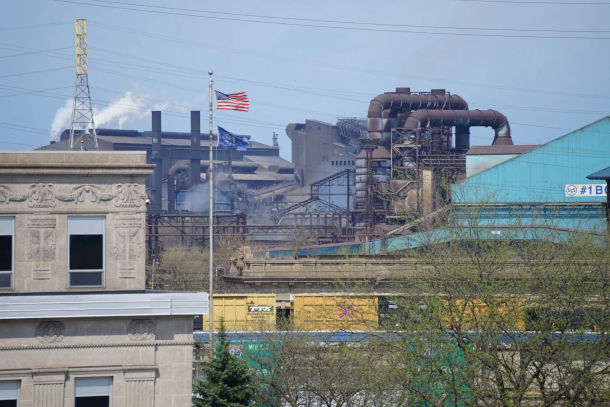
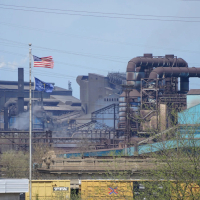
Shown above is US Steel's Gary Works, the largest steel mill in the United States, located in Gary, Indiana. (Photo: Reid Frazier / The Allegheny Front)
O’NEILL: It’s Living on Earth, I’m Aynsley O’Neill.
CURWOOD: And I’m Steve Curwood.
Just outside of Chicago, the country’s largest complex of steel mills faces an uncertain future. air pollution, climate change and the preservation of union jobs are affecting the industry, as are the Trump administration’s stances on coal, steel, and tariffs. The Allegheny Front’s Reid Frazier recently got a tour of the area while attending this year’s conference of the Society of Environmental Journalists.
FRAZIER: On the shores of Lake Michigan, Megan Robertson stands in front of a group of journalists at a park in Whiting, Indiana. To the north, is Chicago.
ROBERTSON: You look over here and you've got this beautiful shoreline, you've got nature, you see Chicago. It's great. People are walking around, going on trails. And then you look over here.
FRAZIER: Robertson gestures over her other shoulder, toward a hulking mass of industrial buildings and smokestacks. This is Indiana Harbor, a massive tangle of steel mills and other industrial plants.
ROBERTSON: And I grew up here. It still shocks me when I drive through.
FRAZIER: Robertson’s grandfather worked in the steel mills here. She’s now head of Indiana Conservation Voters, and she’s come to talk about the future of this place. Robertson says these mills are still an important source of union jobs.
ROBERTSON: You can make a really good living for your family, but there's also physical and environmental sacrifices that come with that.
FRAZIER: Those sacrifices are largely due to the coal-based steelmaking process these plants are based on. For US STEEL’s Gary Works nearby, the process begins in Western Pennsylvania. The company processes coal at its Clairton plant near Pittsburgh into a refined product called coke. The coke is shipped by rail to Gary, where it’s put in a blast furnace and eventually becomes steel. This process creates several thousand tons of local air pollution; and makes Gary Works, Indiana’s top greenhouse gas polluter. That’s a problem, Robertson says.
ROBERTSON: We don't want people going without jobs. We don't what things shut down, but we have to start the transition eventually.
FRAZIER: Terry Steagall says Nippon Steel, US Steel’s new owner, should start that transition now. Steagall is a retired steelworker from the area and member of the group–Gary Advocates for Responsible Development.
STEAGALL: I've seen the history of the industry. And I want this industry to continue for future generations. And I also want the industry to clean up its act as far as environmentally. These things are important.
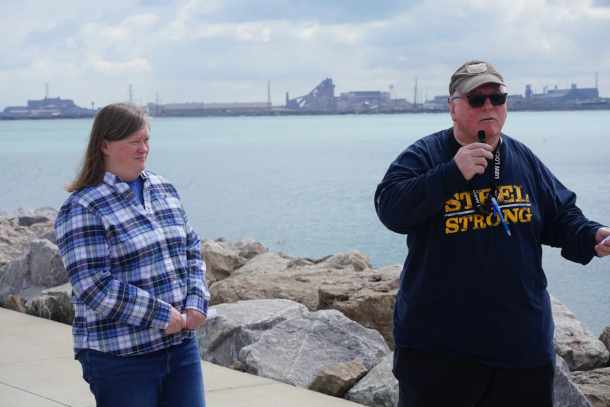
Megan Robertson (left), of Indiana Conservation Voters, and former union steelworker Terry Steagall (right), in front of the Cleveland-Cliffs’ Indiana Harbor steel mill. The two spoke against the environmental impacts of the steel industry at the annual meeting of the Society of Environmental Journalists in Chicago. (Photo: Reid Frazier / The Allegheny Front)
FRAZIER: The best way to clean up, Steagall says, is to adopt a process called direct reduction of iron–-or D-R-I. This uses natural gas or hydrogen instead of coal to turn iron ore into steel. It’s a lot cleaner, with much less carbon pollution. The company is putting DRI in at its newest plant in Arkansas. But the company said this would require a major overhaul to do at Gary Works, which has been in operation for over a century. US Steel has said this changeover to DRI would result in job losses and be “financially disastrous” for the company. Steagall says cost shouldn’t be a problem. Nippon has promised to invest $11 billion in US Steel’s plants, including $4 billion in Gary. The company said in an email those investments will help the plant make steel cleaner, more efficiently, and with less coke, but Steagall wants them to go further.
STEAGALL: We've been advocating for the DRI at Gary Works because they have the technology and they have the money, and that's the key. In the past, the industry would try to say, well, we don't have the technologies, we don't have the money. Well, U.S. Steel and Nippon don't have that excuse.
FRAZIER: But will Nippon Steel do it? As we get on a bus to continue our tour, Roger Smith of the environmental group, Steel Watch, addresses the question. Smith has studied Nippon –the world’s fourth biggest steelmaker–for years.
SMITH: This is a company that has built its global success on coal, on blast furnaces, and it's very reluctant to change course. So despite the fact that we're in a new era of decarbonization, Nippon Steel is actually acquiring coal mines around the world.
FRAZIER: The company has said it wants to ensure access to coal as countries move away from it as they address climate change. The company’s own climate goals call for “carbon neutrality” by 2050. As we pull into the city of Gary, Indiana, the plant comes into view.
SMITH: if you start looking to the left through the graffiti, that is the front gate, the main gate of Gary Works. You're gonna see the blast furnaces. You're going to see smoke coming out of it. If you come back at night, it's very lit up and pretty surreal.
FRAZIER: A few blocks away, we go to the roof of a nearby garage to get a better look. The plant has massive blue-walled industrial buildings. Smoke and steam waft out of smokestacks. Kianna Grant, Air Quality Control Manager for the City of Gary is on the roof with us. Her office is across the street from Gary Works, where she keeps a watchful eye on the plant’s emissions.
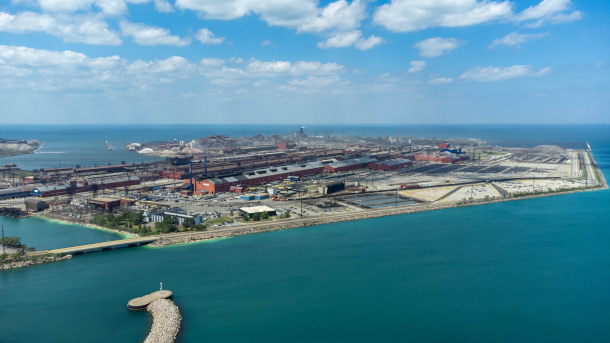
Cleveland-Cliffs’ Harbor Works in East Chicago, Indiana, surrounded by Lake Michigan. (Photo: Sea Cow, Wikimedia Commons, CC BY-SA 4.0)
GRANT: We're in communication with them very often about what they do to make sure that there's transparency.
FRAZIER: The company announced it would spend $350 million to refurbish one of the blast furnaces here–that would extend the life of its coal-based process another 15-20 years. The company says this will make the plant more energy efficient–and lower its carbon dioxide emissions–the main cause of global warming. Grant thinks the company will eventually have to decide whether the plant will switch to cleaner processes.
GRANT: I would love for our community to thrive in, you know, health and to thrive in economy. And so I think there might be a good balance of both. You’ll always have a fight between economy and public health, but I think there could be a healthy dose of both.
FRAZIER: The tour winds down and the group heads back to the bus. For now, people in Gary and other towns in Indiana wait to see what Nippon and other steel companies decide to do with the mills along their shore. For Living on Earth, I’m Reid Frazier.
CURWOOD: That story comes to us from the Allegheny Front.
Related links:
- The Allegheny Front | “Activists Want Mills Along Lake Michigan to Invest in Clean Steel”
- The Allegheny Front covers the environment in Pennsylvania and eastern Ohio. Sign up for their free weekly newsletter here.
[MUSIC: Michael Sembello, “Maniac (Flashdance Version)(Re-Recorded/Remastered)” single, Goldenlane Records]
Elephant Elder Wisdom
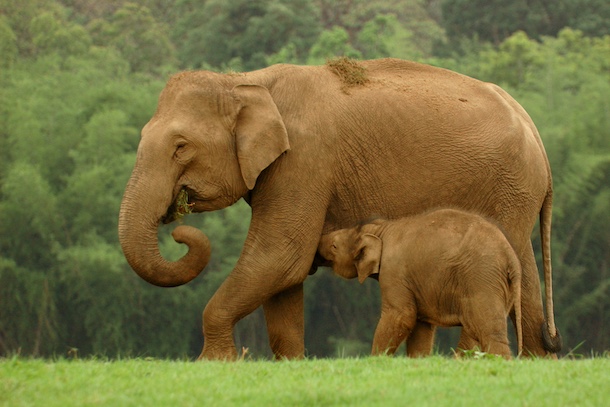
Strategies for calf survival is one of the skills researchers think elephants may be passing down through generations. (Photo: Kalyan Varma, Wikimedia Commons, CC BY-SA 4.0)
O’NEILL: In the 1970’s and 80s, officials in South Africa's Kruger National Park decided to thin their elephant herd, killing a number of adults, and eventually sending some of the orphaned young to a rewilding project in Pilanesberg. Now called Pilanesberg National Park, it is just a two-hour drive from Johannesburg with convenient access for tourists. But shortly after the animals were reintroduced to Pilanesberg, park rangers saw the orphaned elephants entering into abnormally early and long periods of musth, a bull elephant state of heightened testosterone and aggression. Now, decades later, researchers have found that elephant youths conduct themselves differently if they were raised without elders. Orphaned elephants have been seen struggling to integrate into broader social groups and inaccurately assessing threats from predators. Lucy Bates is the author of a 2025 paper about how the loss of experienced elephants stops knowledge transfer between generations. She is a senior lecturer with the Center for Comparative and Evolutionary Psychology at the University of Portsmouth in the UK, and she joins me now -- Welcome to Living on Earth, Lucy!
BATES: Thank you very much. I'm delighted to be here.
O'NEILL: So let's start with some of the basics here. Tell us a little bit about elephant communities. Why do we consider them a social species? What kind of social structures are in place that makes us think that?
BATES: Elephant society is really interesting, and I mainly work with African elephants, the savannah elephants and their social structure is, in a way, it's very like ours. Female calves stay with their mother for life. Then that builds up families of related females. So you can have a grandmother and her daughters and their daughters, and so cousins and aunts all living together in one very cohesive family. Those families are then led by a particular individual, who's called the matriarch. That is usually, almost always, the eldest female in the group. The males, the boys, it's slightly different. As they reach adolescence, they spend less time with their families, and they'll start to hang out more with other males the same age of them, and also older males.
O'NEILL: Now you wrote a paper about elephants passing down survival knowledge to future generations. What kind of survival skills are we talking about here?
BATES: The primary sort of area that we think knowledge is being passed down from elders is in calf survival, and that would involve things like finding food sources, finding water sources, but also just how to behave with a calf, how much time you should spend feeding it, for example, versus looking after yourself. And there's quite a lot of evidence now that families that are led by older females tend to do better in certain things, most importantly, calf survival.
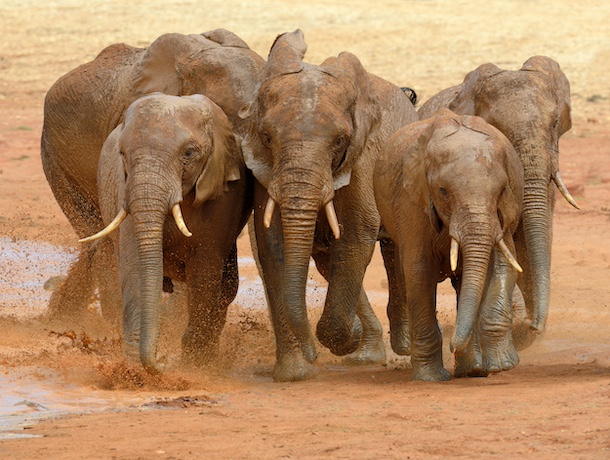
Lucy Bates' 2025 study suggests that elder elephants may teach crucial survival skills to their youth, and that the loss of these elders can have irrevocable effects on the lifetimes of the orphaned young. (Photo: Byrdyak, Wikimedia Commons, CC BY-SA 4.0)
O'NEILL: So Lucy, to what extent do we know that elephants are learning these skills from their elders or each other, rather than these being some sort of genetic or biological responses or some sort of individually acquired piece of knowledge?
BATES: Yeah, that's the million dollar question at the moment. We don't know for sure. We have very little direct evidence that elephants are learning socially. A lot of it is more circumstantial. There's probably in almost all behaviors that elephants engage in, I suspect there's some sort of combination of individual learning and social learning. In some ways, it would be impossible to imagine elephants living in this close-knit society and not learning from what the individuals around them are doing.
O'NEILL: And now in your paper, you also get into the fact that cultural knowledge and tradition is really crucial in elephant society. What defines a culture in the animal kingdom? How similar is it to the kinds that we understand in our human society?
BATES: Yeah, so within biology, we essentially define culture, perhaps a little bit more simply than we might consider human culture, but essentially, for us to think about culture, we need behavior that has been learned from observing others, rather than practicing yourself or learning something individually, which then sets up a tradition that you can then pass on to someone else, and that passes down as a behavioral tradition.
O'NEILL: What sort of would you see as like key differences between human and elephant culture?
BATES: There are really sort of two key differences, I would say, between human culture and animal culture. The first one is how information can be built upon in human culture. So for example, knowledge, really, we talk about ratcheting up. The knowledge that I acquired from watching you do something, I can add to that, and the person watching me can benefit from both parts. The information sort of improves over generations, which doesn't necessarily happen in animal culture. The other aspect that I think is really interesting, that's different is about how we use our culture. And I think one of the key ways we use our culture is to define our groups. We set up rules based on our culture, sort of normative behaviors, for example, so people in one culture might dress a certain way or listen to a certain kind of music. We essentially use those cues as definitions of belonging to a certain group. And those sort of normative rules don't seem to happen in animal culture.
O'NEILL: And so what does it look like when elephants grow up without elders or social groups that can teach them cultural knowledge and tradition?
BATES: There's a lot of evidence that suggests that elephants that grow up without elders make poor decisions, so things like responding appropriately to predators, but also how they respond to other elephant families. Families that grew up without elders, essentially waste time by being fearful of all other elephants and can't really recognize the difference between families that they know and are friends with and families that they don't, for example.
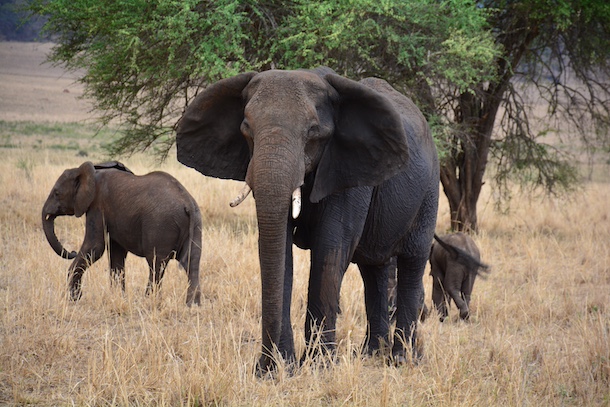
Elder female elephants, or matriarchs, are the leaders of elephant family structures. (Photo: Vincent Mugaba, Wikimedia Commons, CC BY-SA 4.0)
O'NEILL: A number of years ago, Living on Earth, we've actually done a story about a group of orphaned young elephants who were relocated to a National Park in South Africa. Researchers saw these relocated male elephants showing this particularly aggressive behavior. Could you tell us a little bit about what that behavior is in elephants?
BATES: Yeah, so all male elephants, as they mature and start to enter, usually about once a year, into a phase called musth, which is a period of extremely heightened testosterone, essentially, usually in a normal sort of structured elephant society, males don't start entering into these musth phases until mid to late 20s. This population that you're referring to in South Africa, where these elephants were sort of taken in without having any elders present in the society, the males in that group, as they matured, they started coming into musth extremely early, with no role models and no behavioral understanding of what was happening or how they should respond to it, but also very few females in the population that were available for them to mate with. So they had to find alternative outlets as it were, the levels of aggression that were associated with this heightened testosterone. Essentially, one of the key behaviors that they were then engaging in was killing rhinos.
O'NEILL: So obviously we've been talking about the importance of culture and society to these elephants. To what extent is that culture and that society at risk right now?
BATES: It's probably more at risk now than it has been for a long time. There have been various waves of poaching. Individuals obviously come in and kill elephants so they can remove the ivory, the elephant tusks and elephant tusks grow throughout their lives. So it stands to reason, obviously, that the older, larger individuals have the largest tusks. So it's typically the older individuals in a community, in a society, that poachers will be targeting. The other issue that elephants are facing at the moment is just extremely rapid changes to their environment. As human populations grow, the sort of wild habitat available to elephants is decreasing. So there's a competition for space and also a competition for resources, and I think a lot of that is driven by changes in the climate.
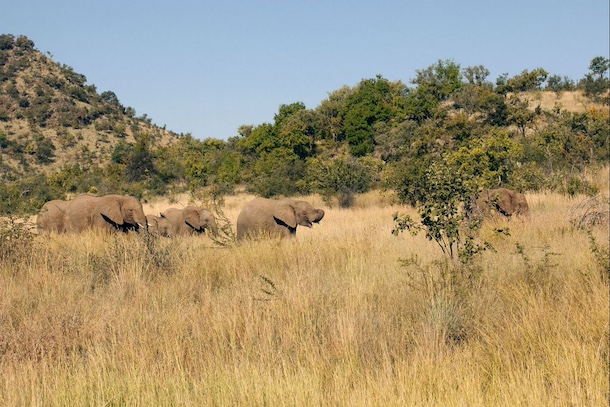
Elephants in the Pilanesberg National Park & Game Reserve. After a group of young, orphaned elephants were moved there in the late 20th century, they were seen developing aggressive behaviors. (Photo: South African Tourism, Wikimedia Commons, CC BY 2.0)
O'NEILL: What are the implications of all of these things that we've found out on, say, our conservation efforts when it comes to protecting these species of elephants?
BATES: Yeah, I think this is the really important question. To me the takeaway from all of this is that if we accept that knowledge and the information of elders being passed down is important for elephant society, then conservation becomes not just a question of conserving elephant numbers. It's about conserving the social structure, and that means particularly conserving the elders and protecting the elders or protecting the knowledgeable individuals. But there's actually an increasing emphasis, I think, on the importance of elder individuals, not just in elephants, but across a whole host of different animals, from even from invertebrates, birds as well. You know, evidence that this sort of life knowledge and these acquired skills is really becoming accepted as important and as a conservation priority.
O'NEILL: Lucy Bates is a Senior Lecturer with the University of Portsmouth Center for Comparative and Evolutionary Psychology. Lucy, thank you so much for joining us today.
BATES: Thank you for having me.
Related links:
- The Royal Society Publishing | “Knowledge Transmission, Culture and the Consequences of Social Disruption in Wild Elephants”
- National Geographic | “How Elephants Pass on Crucial Survival Skills to Next Generations”
- Learn more about Lucy Bates
- See our story on Pilanesberg’s orphaned elephants
[MUSIC: Piano: Peter Donohoe, Northern Sinfonia, Conducted by Howard Griffiths, “Eclogue for Piano and Strings Op. 10” composed by Gerald Finzi, A Naxos Recording]
CURWOOD: Living on Earth is produced by the World Media Foundation. Our crew includes Naomi Arenberg, Paloma Beltran, Jenni Doering, Swayam Gagneja, Mark Kausch, Mark Seth Lender, Don Lyman, Ashanti Mclean, Sophia Pandelidis, Jake Rego, Andrew Skerritt, Bella Smith, Julia Vaz, El Wilson.
O’NEILL: We say goodbye to intern Hedy Yang this week – thanks for all your hard work, and congrats on graduating! Tom Tiger engineered our show. Alison Lirish Dean composed our themes. You can hear us anytime at L-O-E dot org, Apple Podcasts and YouTube Music, and like us please, on our Facebook page, Living on Earth. Find us on Instagram, Threads and BlueSky at living on earth radio. And we always welcome your feedback at comments at loe.org. I’m Aynsley O’Neill.
CURWOOD: And I’m Steve Curwood. Thanks for listening!
ANNOUNCER: Funding for Living on Earth comes from you, our listeners, and from the University of Massachusetts, Boston, in association with its School for the Environment, developing the next generation of environmental leaders. And from the Grantham Foundation for the protection of the environment, supporting strategic communications and collaboration in solving the world’s most pressing environmental problems.
ANNOUNCER 2: PRX.
Living on Earth wants to hear from you!
Living on Earth
62 Calef Highway, Suite 212
Lee, NH 03861
Telephone: 617-287-4121
E-mail: comments@loe.org
Newsletter [Click here]
Donate to Living on Earth!
Living on Earth is an independent media program and relies entirely on contributions from listeners and institutions supporting public service. Please donate now to preserve an independent environmental voice.
NewsletterLiving on Earth offers a weekly delivery of the show's rundown to your mailbox. Sign up for our newsletter today!
 Sailors For The Sea: Be the change you want to sea.
 The Grantham Foundation for the Protection of the Environment: Committed to protecting and improving the health of the global environment.
 Contribute to Living on Earth and receive, as our gift to you, an archival print of one of Mark Seth Lender's extraordinary wildlife photographs. Follow the link to see Mark's current collection of photographs.
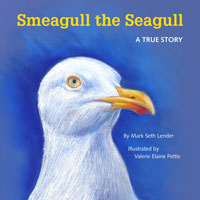 Buy a signed copy of Mark Seth Lender's book Smeagull the Seagull & support Living on Earth
© Copyright World Media Foundation. All Rights Reserved
Home | Contact | RSS | Donate | Newsletter