
Pesticide Atrazine Contaminating 25% of US Rivers
Air Date: Week of October 16, 2026
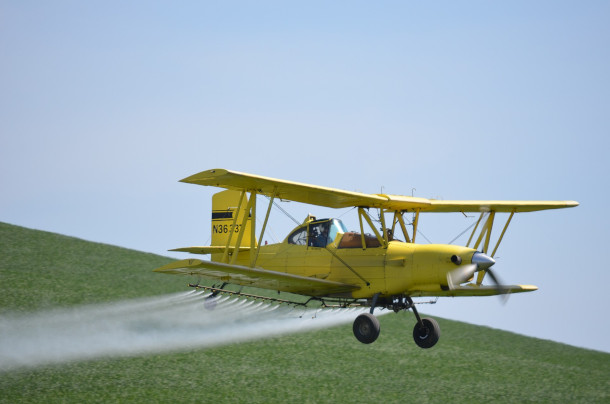
Atrazine is the second most used weed killer in the U.S., where 70 million pounds of the herbicide are deployed each year. Above, a crop duster sprays a wheat field in the Pacific Northwest. (Photo: Carolyn Parsons, Wikimedia Commons, CC BY-SA 4.0)
Atrazine is the second most widely used weed killer in the U.S. after glyphosate, which you might know from RoundUp. Much like glyphosate, atrazine can disrupt hormones and has been linked to serious health impacts, including cancer. Atrazine is also wreaking havoc on aquatic ecosystems, and a recent report from the Center for Biological Diversity finds nearly a quarter of all river miles in the US contain harmful levels. Nathan Donley, the Environmental Health Science Director at the Center for Biological Diversity, speaks with Host Aynsley O’Neill.
Transcript
BELTRAN: It’s Living on Earth, I’m Paloma Beltran.
O’NEILL: And I’m Aynsley O’Neill.
Atrazine is the second most widely used weed killer in the U.S. after glyphosate, which you might know from RoundUp. Much like glyphosate, atrazine can disrupt hormones and has been linked to serious health impacts, including cancer. In early October, California’s Office of Environmental Health Hazard Assessment announced that it plans to list the herbicide as a known carcinogen. Atrazine is also wreaking havoc on aquatic ecosystems, and recent research from the Center for Biological Diversity has been tracking the extent of the contamination. Nathan Donley is the Environmental Health Science Director at the Center for Biological Diversity, and he joins me now. Nathan, welcome back to Living on Earth!
DONLEY: Yeah, thanks for having me. Glad to be here.
O'NEILL: So, for listeners who aren't familiar, what exactly is atrazine, and what are the known consequences on human health?
DONLEY: Right. So, atrazine is an herbicide, so it targets unwanted plants or weeds. It's a pesticide, and it is the second most widely used pesticide in this country. We use about 70 million pounds each year, year after year, which starts to add up pretty quickly. It's used mainly on corn and sorghum and sugar cane. Those are the main crops it's used on. And atrazine is a carcinogen, and atrazine is linked to multiple cancers like certain lymphomas and breast cancer. Atrazine is also linked to reduced fertility. Things like decreased sperm counts, irregular menstrual cycling, multiple birth defects are associated with atrazine. So you know, really terrible things like that associated with this pesticide. We're talking about harms that can have really very tangible consequences and effects on people's lives.
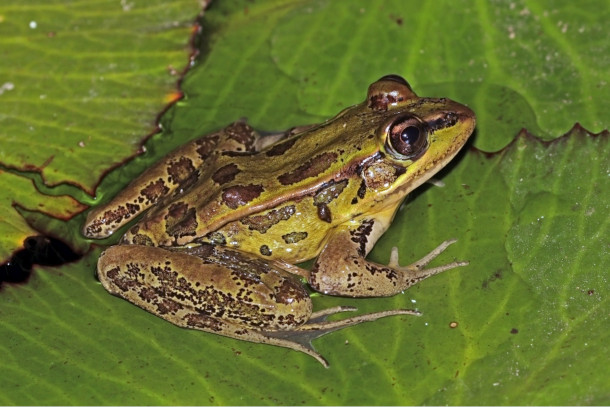
Previous studies have shown the adverse effects of atrazine on aquatic wildlife, such as endocrine disruption in the leopard frog, which is native to North America (above). (Photo: Charles J. Sharp, Wikimedia Commons, CC BY-SA 4.0)
O'NEILL: And now, a study out of the Center for Biological Diversity recently found that nearly a quarter of all rivers in the continental United States contain levels of atrazine that are found to harm wildlife and human health. So help us understand the scale of this. How much water are we talking about here?
DONLEY: Yeah, it's really a striking figure, and one that even as someone who studies pesticides, it just surprised the heck out of me. We're talking about nearly a million miles of rivers and streams have really harmful levels of atrazine in them. Keep in mind these rivers don't just contain some level of atrazine, they have levels that the EPA identifies as high enough to destroy aquatic ecosystems. So that is striking. You know, we have tens of thousands of synthetic chemicals that are manufactured and released as pollution in this country, and to think that just one of those tens of thousands is single-handedly making a quarter of our rivers and streams dangerous to fish and amphibians and migrating birds is just outrageous, and it makes you just want to scream out the window because so many people live in these areas that are highly contaminated, and the water that they drink and bathe in and prepare food with comes from these highly contaminated rivers. About 20% of all drinking water intakes from surface water comes from these rivers that are highly contaminated, so this is is really an issue that hits on human health just as much as it does the health of our planet and our natural resources.
O'NEILL: And what regions of the country are seeing the most impact from this?
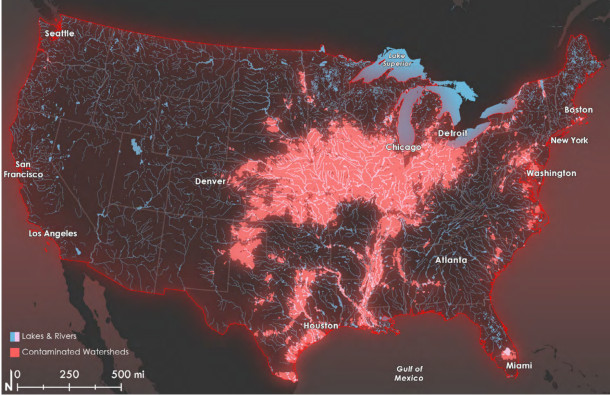
Atrazine is mostly concentrated in the Corn Belt, but smaller hotspots in the Chesapeake Bay, Mississippi River, Florida, and Texas also persist. Above, a map of atrazine contamination in the continental U.S., made by the Center for Biological Diversity using EPA data. (Photo: Center for Biological Diversity)
DONLEY: Good question. You know the thing about atrazine is it's not spread out evenly across the country. I live in Olympia, Washington, for instance, and I have almost zero exposure to atrazine because there's really none used around me. But I grew up in Kansas, where I was probably drinking gallons of this stuff every week during my formative years. So the big hot spot tends to be in the Corn Belt, states like Nebraska and Kansas, Missouri, Iowa, Illinois, Indiana, those places. That's really ground zero. But there are also smaller hot spots around the country. One of those places, for instance, is the Chesapeake Bay watershed. Not many people know this, but corn is very widely grown up there in the watershed of the Chesapeake Bay. The Mississippi River, you know where all the runoff from the Corn Belt goes to, is also very highly contaminated. Lake Okeechobee in Florida, which is the second largest freshwater lake in the U.S. happens to be surrounded by half a million acres of sugarcane plantations where a lot of atrazine is used, and then a place where I used to vacation as a kid, between Galveston and Corpus Christi along the Texas Gulf Coast, is also one of these really highly contaminated regions.
O'NEILL: And atrazine has now been banned in 63 countries, including the European Union. Yet it's one of the most widely used pesticides here in the United States, just after glyphosate. Why do you think the United States government is so reluctant to ban this pesticide?
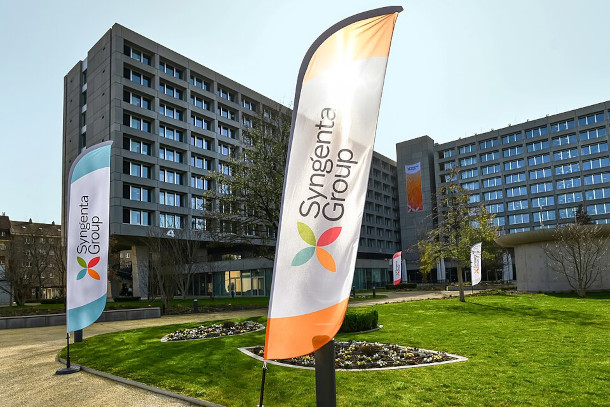
Syngenta, atrazine’s primary manufacturer, maintains that when properly applied the pesticide is not harmful to humans or the environment. (Photo: Syngenta Group, Wikimedia Commons, CC BY-SA 4.0)
DONLEY: We have a very powerful industry lobby in this country: the agrochemical industry, corporate agriculture. They want this pesticide because it lines the pockets of their corporate benefactors, so they lobby hard. They get lawmakers in their pockets, they get presidential administrations to turn a blind eye, and this has been happening for decades. And it's nearly impossible to get the government to do anything meaningful on atrazine because every time it tries this powerful lobbying arm comes down on them hard. You know, the sheer amount of money and power wielded by the corporate agriculture lobby rivals the oil and gas industry, and even when the will of the people want change, the levers, you know, remain seized and change never comes. So ultimately, what this does is it allows corporations to profit from the pollution that is harming people in this country.
O'NEILL: But there has been pushback. In 2020, the Center for Biological Diversity, alongside some other public interest groups filed a lawsuit against the Trump administration's EPA for reapproving atrazine. Where does this litigation stand today?
DONLEY: Right now, this litigation is on hold. Atrazine was reapproved in 2020 at the end of the first Trump administration. My group and others promptly sued, and that litigation was ongoing for a little while, and then when the Biden administration came in, they decided to say, "Hey, wait a minute! We recognize some things may not have been above board here," and they asked the court to put the litigation on hold while they went back and did some reanalysis. So that's where things stand right now. Their reanalysis, unfortunately, looks like it's coming up very short, but until they make a new approval or fingers crossed, hopefully decide not to reapprove atrazine, then our litigation will stay on hold until that time.
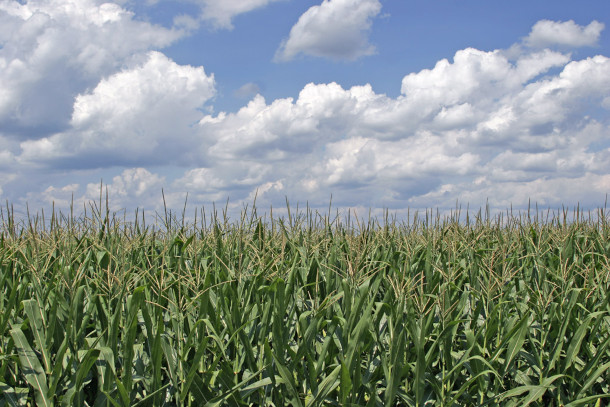
Donley emphasizes that a ban on atrazine would not affect our national food security, since the majority of crops that are sprayed with atrazine do not go directly to human consumption. Above, a cornfield in Ohio. (Photo: Graylight, Wikimedia Commons, CC BY 2.0)
O'NEILL: And tell me a little bit more about the Biden administration EPA response to this. As I understand it, there was a December 2024 atrazine mitigation plan, but this study suggests that that plan was insufficient. So, what's going on there?
DONLEY: Yeah. So, this was a really interesting study we just published, and what we did was we analyzed the Biden administration's proposal to reduce the amount of contamination of atrazine in rivers and streams. So this is pretty unique. Usually, you wait until a mitigation proposal is implemented until you find out whether it works or not. But we were able to ground-truth this proposal before it's actually even gone into effect. So what the Biden administration did was they put in place a few things that they believed would reduce the amount of atrazine contamination in rivers and streams in this country. We then analyzed that plan and found that it would actually only reduce atrazine pollution to safer levels in about 1% of the highly contaminated rivers and streams out there. Like I said, we have almost a million miles of rivers and streams that are highly contaminated with atrazine, and if we're just remediating 1% of those, that is an insufficient plan, right? You've got a 99% failure rate. That is not a good thing. So unfortunately, the plan came up incredibly short, but there is still time to turn this terrible plan around and come up with a plan that actually works for this country and brings down atrazine levels to much lower levels that aren't going to impact human health or aquatic wildlife.
O'NEILL: And Nathan, if atrazine is such a widely used pesticide, I'm sure there are concerns regarding the impact of a ban on farmers, on food, on the economy. What do you say in response to concerns along those lines?
DONLEY: Yeah. So the thing about atrazine is it's used on three crops, none of which are widely eaten by people. Corn is used mostly to make ethanol as a fuel additive, and to feed to animals in concentrated animal feeding operations. Same with sorghum, and then sugar cane, as well as some corn, is used mainly to make sugar for processed foods that many medical professionals say that we should be eating a lot less of, so there really isn't a food issue here at all. We're going to still produce the same amount of food with or without atrazine. Half of corn growers don't use atrazine, so you can grow corn in this country without atrazine just fine. And again, seeing as 63 other countries around the world have banned this pesticide and still produce an abundant amount of food and agricultural crops, this really is a pesticide that no one needs.
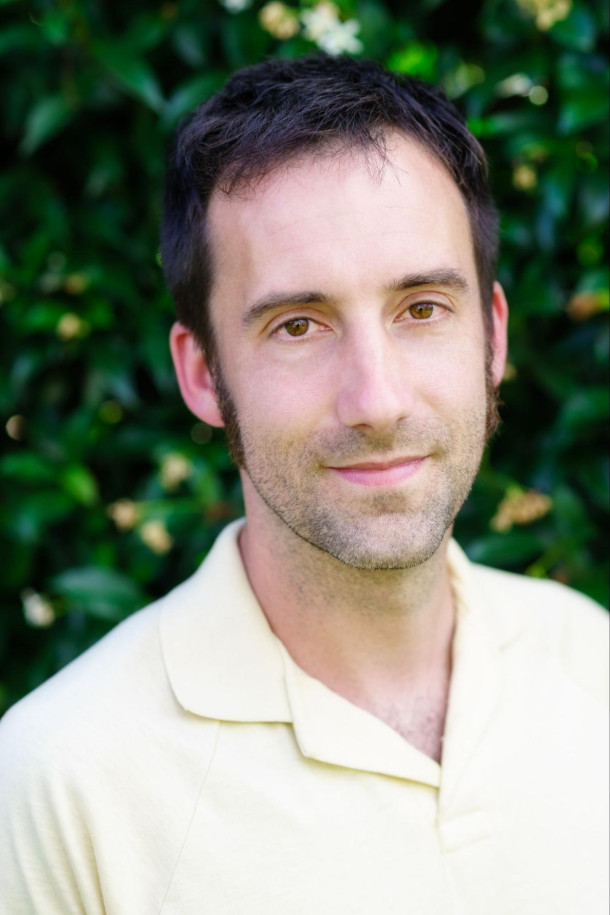
Nathan Donley is the Environmental Health Science Director at the Center for Biological Diversity and lead author of the October 2026 study on atrazine. (Photo: Nathan Donley)
O'NEILL: Nathan, what would be your hope in terms of a public response to this study, or more people finding out about the concerns with atrazine generally?
DONLEY: Yeah, that's a good question, and I would hope that people would see this report and these studies, and just absolutely be outraged and be like, "How on earth is it that a full quarter of the waterways in this country, the rivers and streams that we swim in, that we boat in, that we drink from, how is it possible that 25% of those are contaminated with a dangerous chemical, such that these waterways are no longer healthy?" But you know, I'll just say that that is hopefully changing. For the first time in my lifetime, some Republicans are talking about these issues with passion and fervor. I mean, that was not on my bingo card five years ago. The healthy food movement has gone from very niche to a political powerhouse, and there's a lot of momentum behind it right now, and that is getting many people very excited. So, the health of the next generation depends on us ultimately prevailing here, and that's what gets me out of bed every day. Our planet is not a dumping ground for the pollution of the billionaire class. It's ours, and it's time we take it back.
O'NEILL: Nathan Donley is the Environmental Health Science Director at the Center for Biological Diversity and lead author of this study. Nathan, thank you so much for joining me today.
DONLEY: Yeah, thanks for having me on.
O’NEILL: Syngenta, the main manufacturer of Atrazine, asserts in a statement responding to cancer concerns that the herbicide “is safe when applied in accordance with registered label instructions.”
BELTRAN: And on October 14, after the government declined to respond to their petition, the Center for Biological Diversity and co-plaintiffs filed an additional lawsuit against EPA over its alleged failure to protect waterways and drinking water from atrazine contamination. We did not receive a response from EPA in time for this broadcast, but you can find statements and more information on the Living on Earth website, loe.org.
Links
Living on Earth wants to hear from you!
Living on Earth
62 Calef Highway, Suite 212
Lee, NH 03861
Telephone: 617-287-4121
E-mail: comments@loe.org
Newsletter [Click here]
Donate to Living on Earth!
Living on Earth is an independent media program and relies entirely on contributions from listeners and institutions supporting public service. Please donate now to preserve an independent environmental voice.
NewsletterLiving on Earth offers a weekly delivery of the show's rundown to your mailbox. Sign up for our newsletter today!
 Sailors For The Sea: Be the change you want to sea.
 The Grantham Foundation for the Protection of the Environment: Committed to protecting and improving the health of the global environment.
 Contribute to Living on Earth and receive, as our gift to you, an archival print of one of Mark Seth Lender's extraordinary wildlife photographs. Follow the link to see Mark's current collection of photographs.
 Buy a signed copy of Mark Seth Lender's book Smeagull the Seagull & support Living on Earth
© Copyright World Media Foundation. All Rights Reserved
Home | Contact | RSS | Donate | Newsletter