

Maine Race for Senate, Climate and Environment
Air Date: Week of October 9, 2026
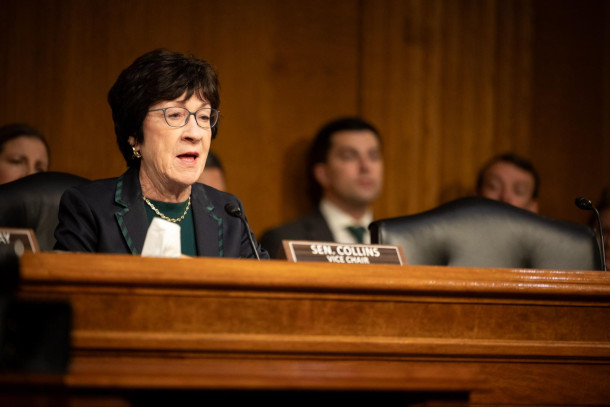
Republican Susan Collins has served as a Senator for Maine for nearly thirty years. She has also served as the Chair of the US Senate Appropriations Committee since 2025. (Photo: DHSgov, Wikimedia Commons, public domain)
The closely watched race for US Senate in Maine is pitting two environmentally concerned candidates against each other. Not only do they both have fairly similar green and climate views, they’re from the same rural county and both have roots in the lumber industry that’s so important to the state. Maine Public Radio’s veteran state house and environmental reporter, Kevin Miller, joins Host Steve Curwood to discuss incumbent Republican US senator Susan Collins and her Democratic challenger, Troy Jackson.
Transcript
DOERING: From PRX and the Jennifer and Ted Stanley Studios at the University of Massachusetts Boston, this is Living on Earth. I’m Jenni Doering
CURWOOD: And I’m Steve Curwood.
The closely watched race for the US Senate in Maine is pitting two environmentally concerned candidates against each other. Not only do they both have fairly similar green and climate views, they’re also both from Aroostook County, the sparsely populated and northernmost region in a state that is 90 percent forested. Incumbent republican US senator Susan Collins, seeking her sixth term in office, comes from a family that dates back five generations in the lumber business and is a political dynasty. Her father and uncle served multiple terms in the Maine state senate and both her father and mother were mayors of her hometown, Caribou. Democratic challenger Troy Jackson grew up in a working class family of loggers in the Allagash region, deeper in the woods and about 75 miles from Caribou. Jackson entered politics as a prominent labor activist in the logging industry and served six years as the president of the Maine State senate. He got into this US senate race late, as the winner of the Democratic primary had to drop out. Joining me now is Maine Public Radio’s veteran state house and environmental reporter, Kevin Miller. Welcome to Living on Earth!
MILLER: Hi, thanks for having me.
CURWOOD: So, give me a sense of these two candidates: Susan Collins, the Republican, and, and Troy Jackson, the Democrat.
MILLER: Yeah. So, Senator Collins has been in office for 30 years. She is one of the more senior Republican members of the Senate. She is a fairly moderate Republican and centrist Republican. There are some people who will probably be yelling at the radio right now, saying she's not a moderate, but when you look at her in the context of where the Republican Party is today, she's definitely kind of more to the center, and she also kind of describes herself as, as a deal maker. Troy Jackson, on the other hand, he was a state lawmaker for 20 some years. He's a logger from far northern Maine, and he's a fairly progressive candidate. He's been closely aligned with Bernie Sanders. He became candidate after our last progressive candidate, Graham Platner, his campaign kind of imploded because of rape allegations against him from a former girlfriend of his. But Troy Jackson, he's had a similar approach to policies as Graham Platner, so he was able to kind of step in and say, "I'm going to carry Graham Platner's progressive movement, which had a lot of momentum in Maine before Platner had to step down.

Democrat Troy Jackson served in the Maine legislature for over two decades, holding the position of President of the Maine Senate for six of those years. (Photo: Rebecca Conley of Maine Public)
CURWOOD: At one point, you worked as an environmental reporter, so talk to me about climate and environment as a priority for Maine voters in this race. Where does it fall on the list, so to speak?
MILLER: Well, it doesn't fall very high from what we're seeing from polls and hearing from voters. Environment and conservation issues are always fairly important in Maine, just because it's a big natural resource-based state. So much of our industries are tied to natural resources. But I think, like we're seeing in a lot of other places around the country, it's the other issues. It's affordability. It's, you know, inflation. It's gas prices. One of the big concerns I think headed into the election right now, or at least into winter, is Maine is the most heavily reliant state on heating oil. More than 50% of houses in the state use heating oil, and heating oil is diesel, pretty much. So when the price of diesel and heating oil are up above $6 a gallon, that's a big concern for people. So the affordability issues are probably top of mind for a lot of people.
CURWOOD: So how do these candidates come down on environmental issues? Let's talk about renewable energy to start with.
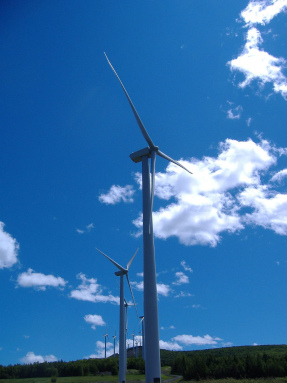
Both Maine candidates are fairly supportive of wind energy and criticize President Trump’s attempts to block renewable energy in the state. (Photo: Michael Surran, Wikimedia Commons, CC BY-SA 2.0)
MILLER: I guess they're fairly well aligned in some respects, at least on renewable energy. They're both known as being fairly prominent supporters of the push to convert Maine and other states to more renewable sources. They're both supporters of wind energy, especially offshore wind. The Gulf of Maine is a very windy place. There have been proposals that were in the works to build large offshore wind facilities there. They have now been kind of put on hold by the Trump administration, and I think Senator Collins has been critical of that. Troy Jackson has certainly been critical of that. We do have a significant number of land-based wind resources here, and Troy Jackson actually was key to, when he was the Senate president, key to kind of greasing the skids to helping build a large wind farm that would stretch from his area of northern Maine down and would be a major generator. That project's also been stalled for other reasons. One other issue that I think they're closely aligned is on biomass energy. Some people don't regard this as a renewable energy or it's a more controversial source because of its impact on the climate, you're burning wood, you're releasing carbon dioxide. So some environmentalists don't view this as a truly renewable source, but because we are such a heavily forested state, it's a big issue up here. On the broader climate issues, Senator Jackson was very prominently supporting our current Democratic governor's, her very ambitious climate agenda. He's not quite as progressive as some people would like him to be. Senator Collins has also been largely supportive of some of these climate issues, but I think it comes down to which candidate the environmental community feels is going to be a bigger advocate on environmental issues, and in this case, certainly hearing from the environmental groups, it's Troy Jackson.
CURWOOD: Now, why is that? Is it because it would be part of flipping the Senate to the Democratic majority, which would have a large impact, obviously, on environmental policy of the federal government? I mean, the Trump administration has rolled back almost everything, gotten out of the climate agreements, and in fact, doesn't believe that climate's a problem.
MILLER: Yeah, I think that's a key part of it is that a lot of the environmental community just looks at the Democrats as being more favorable to achieving their goals, certainly than Republicans, and, and compared to what the Trump administration has been doing, so they see flipping the Senate as as key to that.
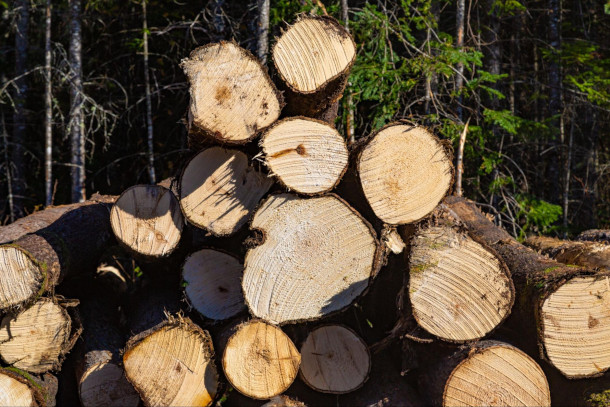
While some environmental groups raise concerns about Jackson’s identity as a logger, he has been critical of clear cutting, labor abuses, and pesticide use in the industry. (Photo: Tony Webster, Wikimedia Commons, CC BY 2.0)
CURWOOD: Now, Kevin, Troy Jackson is what a fifth generation logger from Allagash? You can't go any further north there in Maine than be it Allagash. What's his relationship to the industry?
MILLER: Well, he has a pretty complicated relationship, I'd say. He's been a logger his entire life, so he kind of grew up in the industry. But he actually got into politics because of that experience. Back about, I guess 30 years ago now, there was a lot of tensions between the forest landowners and the loggers from Maine because they believed that the forest landowners were hiring too many Canadian workers, which they could hire for cheaper. So Troy Jackson and a number of the loggers actually led a blockade of the logging road border crossings with Canada. This got a huge amount of attention, and he said that he was so frustrated with that experience, he didn't feel like the folks here in Augusta, the state capital, and in Washington were listening to him and were listening to the other loggers, and that's how he actually he ran for the state legislature a couple of years later. So he has kind of a complicated relationship, I think, with the landowners. He, you know, obviously he works in the industry, but he has always felt that the landowners are not respecting especially the labor rights of Maine loggers.
CURWOOD: What about the ecology? I mean, some of the land companies up there are clear cutting. How does he feel about that?
MILLER: Troy has been critical of land management in the past on that respect, and he also led the fight to try to ban the aerial spraying of glyphosate, which most folks probably know as Roundup. That is a herbicide that a lot of landowners use to try to eliminate the undergrowth that they don't want, so that they can encourage the trees that they want, but of course, glyphosate kills a lot of things. And Troy Jackson led the effort to pass a bill in the legislature to ban aerial spraying of glyphosate, but that was eventually vetoed by our Democratic governor Janet Mills because of the opposition from the forest industry.
CURWOOD: Interesting. So Susan Collins been in the Senate for quite a while at this game, what 30 years? What's her environmental record? Where does she stand?
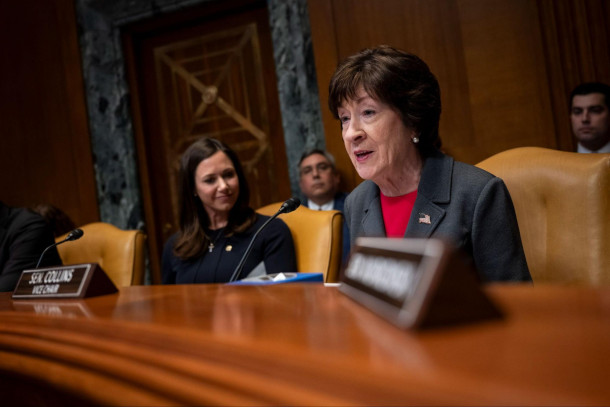
As Chair of the U.S. Senate Appropriations Committee, Collins has led efforts to reduce proposed cuts to the EPA from 55% to 5%. Some environmental activists maintain that she still does not push back enough against the Trump administration. (Photo: U.S. Department of Homeland Security (DHS), Wikimedia Commons, public domain)
MILLER: Well, like I said, Susan Collins is a fairly prominent supporter of the push towards renewable energy. She has also supported or helped pass legislation in the past to reduce greenhouse gas emissions. So she's looked at by some, or at least has been looked at in the past, as one of the environmental community's best allies when it comes to environmental issues in the Republican Party. I think that's changed to some respect under the Trump administration, and that some in the environmental community now view her as not doing enough to push back against the Trump administration, especially on these drastic cuts to some of the programs. So I think that's where we're seeing that disalignment now between the environmental community and Susan Collins.
CURWOOD: So she's chair of the Senate Committee on Appropriations, and between that and the House chair, they sit on money, and if you want it, you have to go through her committee. So, what's her record on how federal funds are allocated when it does come to environmental protection?
MILLER: She's only been chairwoman for a couple of years now under the Republican leadership. What we've seen in this most recent cycle with President Trump, he actually proposed a 55% cut to the EPA. What the Senate Appropriations Committee did, you know, under her leadership, and certainly working with Democrats, they actually reduced that to a 5% cut in the budget that eventually came out. The committee as a whole was, you know, applauded by some in the environmental community for lessening that impact, but again, there are still some folks on the left who feel like she's not doing enough to push back against the Trump administration.
CURWOOD: Now, Kevin, every year the League of Conservation Voters publishes the National Environmental Scorecard, which tracks and rates how members of Congress vote on environmental and climate issues. What is the LCV saying about Troy Jackson and Susan Collins?
MILLER: Yeah, it's interesting because the League of Conservation has actually endorsed Susan Collins in the past, going back to 2014, they endorsed her and called her as one of the leaders in the fight against climate disruption. This time around, they're endorsing Troy Jackson because they, again, they see him as being a more effective advocate on environmental issues than Senator Collins, and I think a big part of that is, as we talked about before, is that Democratic control of Congress. The environmental community sees that as key to being able to get done what they want to do, or at least stopping the Trump administration from doing what they want to do. But what I think is really interesting is if you go back to that same year, 2014, the League of Conservation Voters actually came out against Troy Jackson when he was running for one of our congressional seats, and I think they paid more than $150,000 in ads against Troy Jackson, and he ended up losing that Democratic primary in part because of the pushback from this group and from some of the abortion rights groups. So I think it's fascinating now to kind of see how even within that one group, how the dynamics have changed between these two people.

Kevin Miller is the State House Correspondent for Maine Public Radio. (Photo: Maine Public)
CURWOOD: Let's say that Troy Jackson wins, but the Senate doesn't flip. What does that do to the state of Maine's position in national politics?
MILLER: Well, I think that's a key thing that Senator Collins has been arguing, is that Maine would lose that influential voice in Washington, and it's going to affect the amount of money that's flowing back to Maine. Not only would they lose the Chairperson of the Senate Appropriations Committee, but they would lose somebody in Collins who has, she's frequently in the center of a lot of these hotly contested issues because, especially when the Senate is so closely divided, she's frequently a swing vote, which she says allows her to use her influence more than someone else would. That's a key part of her argument. Troy Jackson's argument is: Look, I'm going to be a better advocate overall for the working people of Maine, for the progressive policies that I've been pushing, and also for these environmental issues, than Susan Collins would be, especially if the Senate was in Democratic hands.
CURWOOD: Kevin Miller is a State House Correspondent for Maine Public Radio. Kevin, thanks so much for taking the time with us today.
MILLER: Thank you for having me.
Links
Maine Public | “Maine Revives Aroostook County Wind Power Project”
Maine Public | “Mills Vetoes Bill That Would Have Banned Aerial Herbicide Spraying In Woods”
Maine Senate Democrats | “Jackson Introduces Bond Package to Support Biomass Energy”
LCV endorses Susan Collins in 2014
LCV endorses Troy Jackson in 2026
Inside Climate News | “Susan Collins and Climate Change: ‘The Silence is Deafening’”
Living on Earth wants to hear from you!
Living on Earth
62 Calef Highway, Suite 212
Lee, NH 03861
Telephone: 617-287-4121
E-mail: comments@loe.org
Newsletter [Click here]
Donate to Living on Earth!
Living on Earth is an independent media program and relies entirely on contributions from listeners and institutions supporting public service. Please donate now to preserve an independent environmental voice.
NewsletterLiving on Earth offers a weekly delivery of the show's rundown to your mailbox. Sign up for our newsletter today!
 Sailors For The Sea: Be the change you want to sea.
 The Grantham Foundation for the Protection of the Environment: Committed to protecting and improving the health of the global environment.
 Contribute to Living on Earth and receive, as our gift to you, an archival print of one of Mark Seth Lender's extraordinary wildlife photographs. Follow the link to see Mark's current collection of photographs.
 Buy a signed copy of Mark Seth Lender's book Smeagull the Seagull & support Living on Earth
© Copyright World Media Foundation. All Rights Reserved
Home | Contact | RSS | Donate | Newsletter