
State Elections and the Climate
Air Date: Week of October 2, 2026
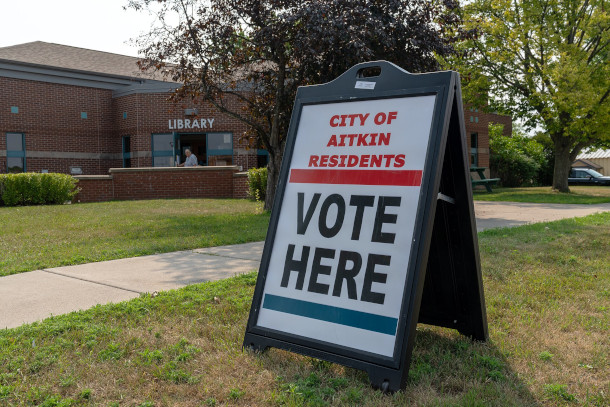
This year’s midterm elections could be pivotal in reshaping state climate and energy policy, Gearino says. Above, a “Vote Here” sign in Aitkin, Minnesota on Primary Election Day, August 11, 2026. (Photo: Lorie Shaull, Wikimedia Commons, CC BY 4.0)
Much is at stake for the climate and environmental protection when it comes to this fall’s Congressional and Senate races, in the middle of the second Trump presidency. But the often-overlooked elections for state legislatures and governors can also go a long way towards shaping the future of these issues. Dan Gearino, clean energy reporter with our media partner, Inside Climate News, joins Host Jenni Doering to discuss a few key states to watch.
Transcript
DOERING: The races getting most of the media attention in this busy midterm election season are the ones that could determine which party controls the US House and Senate. And in the middle of the second Trump presidency, it is hard to understate just how consequential those elections could be for environmental and climate protection. But the often-overlooked elections for state legislatures and governors can also go a long way towards shaping the future of these issues. Dan Gearino, clean energy reporter with our media partner, Inside Climate News, has been following a few key ones. So Dan, welcome back to Living on Earth!
GEARINO: Yeah, great to be here.
DOERING: So, just how important are state legislatures in shaping climate and energy policy?
GEARINO: You just have to look at recent history. You look at the 2018 election, and then several of the election cycles right after that, where you saw Democrats gain control of governors' offices and then gain control of the legislature, gain what we call a trifecta, which is both houses of the legislature plus the governor's office. When Democrats have complete control of state government, you are much more likely to see policies become law that address climate change and encourage clean energy. And this is not a partisan statement, it's just a reflection of the results. You saw this in both Minnesota and New York, where Democrats can just gain control of that chamber. All of a sudden, the amount of room that both chambers and the governor have to take substantive action grows substantially. And then you look at the opposite, where Republicans have control of the governor's office and both chambers of the legislature. You have a really hard time passing anything that will seriously address reducing carbon emissions and will find ways to increase adoption of electric vehicles, thus wind, solar, and other renewable energy.
DOERING: So when we look at this year's midterms, Democrats are looking to gain trifectas, or control of the governorship and both chambers of the legislature in about five key states. Tell us about the three that seem most likely to shift. Those are all in the upper Midwest.
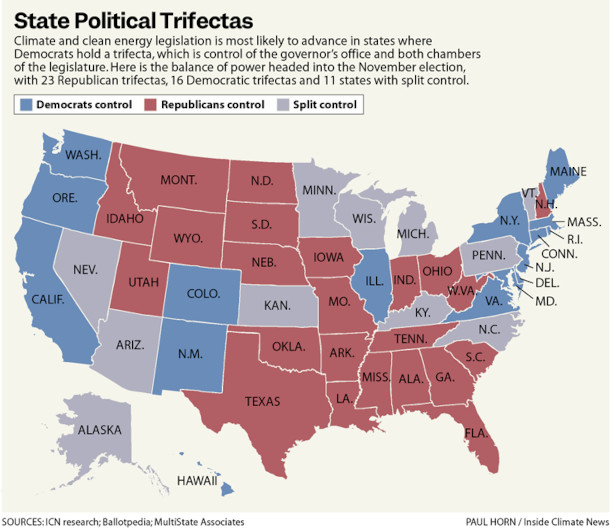
Gearino notes five key states that could be flipped to Democratic trifectas: Michigan, Wisconsin, Minnesota, Arizona, and Pennsylvania. (Photo: Paul Horn, Inside Climate News)
GEARINO: Yes, and they're actually right next to each other on the map. So let's take it from east to west. You've got Michigan, Wisconsin, and then Minnesota. A big asterisk there is that both Michigan and Minnesota had trifectas recently, and they used those trifectas to pass significant legislation. Wisconsin has not. The last time Democrats had a trifecta in Wisconsin was 2010. So if Wisconsin were able to elect a Democrat as governor and were able to flip both chambers of their legislature, the opportunity there is pretty substantial. That's a state that has a lot of wind energy, has a lot of opportunity for more solar, more battery storage, and the next governor and the next legislature, if they're kind of of one mind on this, there's a lot that they could do and a lot of untapped potential.
DOERING: Wow. And when it comes to the other two, Michigan and Minnesota, it sounds like just recently they did have trifectas, but then within the last couple of years they've become split.
GEARINO: Yes, and we're talking pretty narrow splits, so it would be pretty easy for Democrats to regain complete control. And I don't want to minimize the significance of those two states because it's important to pass the initial kind of landmark legislation saying our state will get to X point in the future on emissions or on renewable energy. Passing that initial bill in a lot of ways is easier than implementing that bill, and the implementation phase takes a long time, takes a decade plus, and you need to often pass subsequent legislation to stay on track. So it's not just that first landmark bill, it's the follow up, usually a couple years later, and then the follow up to the follow up a couple years later. It's an unending process, and if you have a period where the legislature can't take any action on this because it's just divided, it really is, is a challenge in terms of meeting long term goals.
DOERING: So Dan, you must be a big basketball fan because in your article you described those three states we were just talking about as free throws if they do pick up those trifectas. So that's Wisconsin, Minnesota, and Michigan. When it comes to Pennsylvania and Arizona, these two other states that maybe Democrats can pick up control of, you said it's more like a three-pointer. So why is it a little more tricky there, and what are the implications when it comes to climate and energy policy?
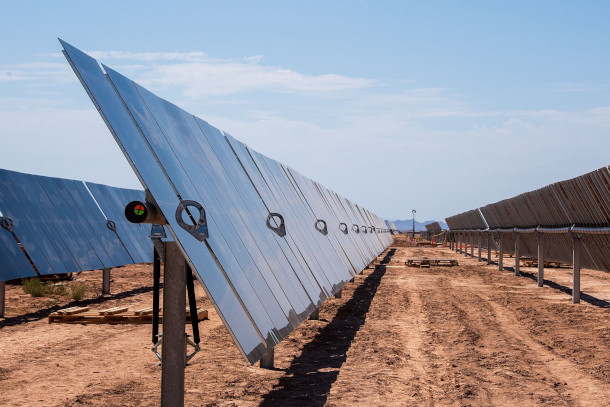
Arizona has huge potential for solar power as one of the sunniest states in the country, Gearino says. Above, solar panels in Yuma County, Arizona. (Photo: Bureau of Land Management Arizona, Wikimedia Commons, Public Domain)
GEARINO: So a big difference with Pennsylvania and Arizona is that the challenge to actually gain control of both houses of the legislature is substantial. These are just tough races. You need to be getting into the territory where Democrats have had a very good night, where they flip some seats that are really heavy lifts. But then, if you gain those majorities again, the opportunities are substantial. Pennsylvania has a very low level of renewable energy on its grid. It is a fossil fuel state, a major gas producer. You don't even need to encourage renewable energy a lot. You can just do it a little, and it would make a big difference in a state where there's not that much on the grid. Arizona is a different story. They are one of the sunniest states in the country. Arizona could have, if they could get in a time machine and go back about 20 years, invest like crazy and shift state policy to really encourage solar power. The clean energy economy in Arizona could be substantially larger than it is. So you look at that state and you say, well, there's a lot of solar power there already. Arizona's utility scale solar was 13% of their total last year. So 13%, that's a lot. That's more than most states, but it's not the national leader. California gets more than that. There are others that get more than that. So there could be a lot more. In both of those states there are just huge opportunities.
DOERING: And just give us a sense of the stakes here. I mean, what's happened in previous cycles when a Democratic trifecta has come in and passed clean energy legislation?
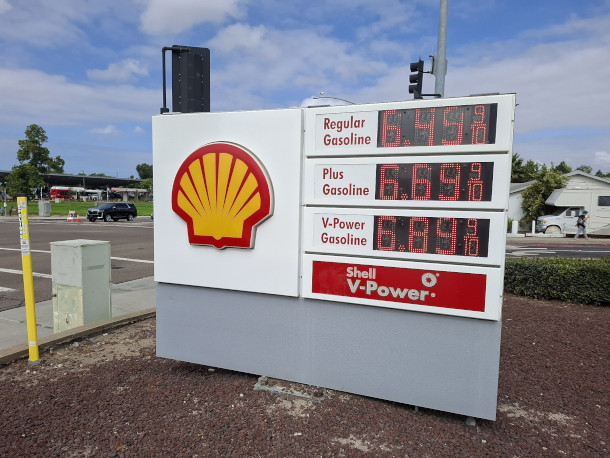
While climate change itself doesn’t usually drive people to the polls, rising gas and electricity prices are often big issues for voters, according to Gearino. Above, a gas price board in Chula Vista, CA, in September 2026. (Photo: Bnuuy, Wikimedia Commons, Public Domain)
GEARINO: Well, the key part of a trifecta is first electing a governor, and we saw in 2018 several states that had gubernatorial elections, in which the winner was someone who cared about climate and advancing renewable energy, and also the state was very close to being ready, if not ready already, to take action. In some states, it takes a few years, but you have a governor in place. You're kind of working on the legislation. You wait till that window of opportunity opens. Good example is like Michigan. Michigan, when Gretchen Whitmer was elected, she didn't have the legislature immediately that could pass kind of comprehensive legislation, and and eventually got it. But it's that electing the governor is, is a crucial step. And I also should say, in these kind of swing states like Michigan, the legislation that passes is always going to fall short of what a lot of environmental activists and clean energy advocates would like. They're going to kind of say it's weak tea. I've been writing about this stuff long enough to just know that it just always happens that way. They'll say, "Oh, this you know we had an opportunity to do something real and we did something that's inadequate." I suspect that these states passing comprehensive laws on the climate or clean energy, it's probably about as much as they could pass in terms of just counting the votes, and it was either pass that or, or pass something weaker. So, but if we do see these flips where we have these five states become controlled by Democrats, we can look forward to hearing that discussion again as well. Legislation passes, and it's considered kind of unsatisfyingly weak.
DOERING: So, looking beyond individual races, how much are climate and energy policies actually driving voters in these midterm elections?

Dan Gearino is a clean energy reporter who writes for Inside Climate News, covering renewable energy and utilities. (Photo: Dan Gearino)
GEARINO: What we're seeing is concern about energy prices. You're seeing pocketbook issues, and that's not surprising. Climate change is not an issue that people vote on. We've seen enough election cycles in this period where we're seeing substantial warming and the effects of climate change, but it doesn't seem to move the needle much in terms of voter behavior. But you have electricity prices rising a lot. You have diesel prices just really hurting farmers, really hurting truckers, making everything more expensive. Electricity rates going way up. These are all things that people really notice, and these are things that are kind of part of the bigger picture of the way we manage energy, and that ties into how we both adapt to climate change and also how we try to take action to reduce emissions to make it so that climate change isn't as severe. So while someone might say I'm voting this way because I'm just, I'm ticked off and I want a new set of leaders because diesel's way too expensive. Yeah, it's all part of a much larger picture.
DOERING: And Dan, speaking more broadly, in the middle of the second Trump presidency, how pivotal are this November's midterms overall?
GEARINO: I've now lived through several times in which the midterm elections were described as the most important midterms ever, so perhaps I'm getting desensitized to hearing this every midterm cycle. But this clearly is a very important election in terms of the U.S. House and U.S. Senate creating a check on President Trump's energy and deregulatory agenda. I mean, a lot of the things he's done, he's done through executive power, but having Democrats gain control of one or both houses would make a big difference, and then at the state level, having several states flipping to complete control by Democrats would also be really significant. So it matters a lot, and you can just look back at how much it mattered in hindsight. The results of say the 2018 election, and you know, and others like it, where there was a change in control, and substantial things flowed from that.
DOERING: Dan Gearino is Clean Energy Reporter with our media partner, Inside Climate News. Thank you so much, Dan.
GEARINO: Yeah, great to be here.
Links
Inside Climate News | “These State Elections Could Reshape Climate and Energy Policy”
Living on Earth wants to hear from you!
Living on Earth
62 Calef Highway, Suite 212
Lee, NH 03861
Telephone: 617-287-4121
E-mail: comments@loe.org
Newsletter [Click here]
Donate to Living on Earth!
Living on Earth is an independent media program and relies entirely on contributions from listeners and institutions supporting public service. Please donate now to preserve an independent environmental voice.
NewsletterLiving on Earth offers a weekly delivery of the show's rundown to your mailbox. Sign up for our newsletter today!
 Sailors For The Sea: Be the change you want to sea.
 The Grantham Foundation for the Protection of the Environment: Committed to protecting and improving the health of the global environment.
 Contribute to Living on Earth and receive, as our gift to you, an archival print of one of Mark Seth Lender's extraordinary wildlife photographs. Follow the link to see Mark's current collection of photographs.
 Buy a signed copy of Mark Seth Lender's book Smeagull the Seagull & support Living on Earth
© Copyright World Media Foundation. All Rights Reserved
Home | Contact | RSS | Donate | Newsletter