

Fighting Fracking in Colombia
Air Date: Week of June 26, 2026
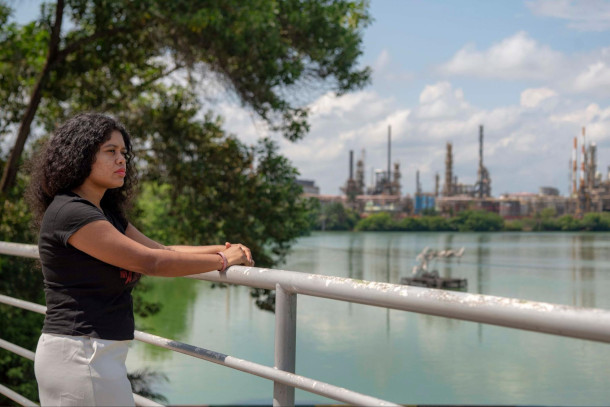
Yuvelis Morales Blanco next to the Miramar Swamp, by Ecopetrol’s main refinery. Ecopetrol’s new fracking project, the Comprehensive Research Pilot Project, is currently on hold. (Photo: Christian EscobarMora for the Goldman Environmental Prize)
Our sixth and final installment of interviews with the 2026 Goldman Environmental Prize winners features Latin American winner Yuvelis Morales Blanco, honored for fighting against fracking in Colombia. Living on Earth’s Paloma Beltran spoke with Yuvelis about her activism and the death threats she received. The recent presidential elections in Colombia put fracking back on the table, after four years of an administration that signaled a desire to transition away from fossil fuels.
Transcript
CURWOOD: And now we turn to Living on Earth’s Paloma Beltran to talk about the final in our series of six segments on the 2026 winners of the Goldman Environmental Prize.
Hi Paloma, so tell us about this year’s winner from Latin America, honored for fighting against fracking in Colombia.
BELTRAN: Hi Jenni, hi Steve!
So Yuvelis Morales Blanco is from the Afro-Colombian community of Puerto Wilches.
It’s one of the many fishing towns that rely on the Magdalena River which runs nearly 1,000 miles from the Andes to the Caribbean. The region is also home to oil and gas extraction as well as refining. And in 2018, as a teenager Yuvelis saw firsthand the risk of living near this industry when the Magdalena River was polluted by a massive oil spill at the Lizama 158 Well, operated by Colombian national company Ecopetrol.
DOERING: Huh. So, after this oil spill, what led Yuvelis to get involved in pushing back against fracking for oil and gas?
BELTRAN: Yeah, so in 2019 Yuvelis found out that Ecopetrol was pursuing 2 fracking pilot projects in the central Magdalena region where she grew up. She worked with the Colombia Free of Fracking Alliance to raise awareness and stop the potential fracking projects through testimony and peaceful protests. And in 2022, with fracking raised as a national issue and in the face of a presidential fracking ban, Ecopetrol suspended its contracts for the pilot fracking projects. In addition, in 2024 the Colombian Constitutional court ruled that Ecopetrol had violated the rights of the community of Puerto Wilches by denying them free, prior, and informed consent.
CURWOOD: So, it sounds like Yuvelis and her community secured some real, if temporary, wins. And Paloma, I believe you had a chance to talk to her.
BELTRAN: That’s right, and I started off by asking Yuvelis to describe the Magdalena River and where she grew up.
MORALES [WITH VOICEOVER]: Puerto Wilches is located on the banks of the Magdalena River—in the valley of the Magdalena River, to be exact. I always say that we’ve been blessed with a pretty nice spot in the world. We’re part of this valley.
Our day always ends with a beautiful sunset among the mountains, surrounded by lovely people and fishermen, with beautiful shades of orange and purple over the river and the valley.
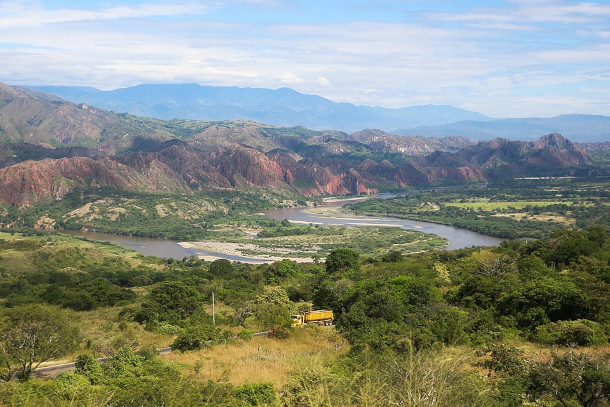
Pictured is the Rio Magdalena in Colombia, along whose banks lies Yuvelis Morales Blanco’s hometown of Puerto Wilches. The Magdalena River is the main waterway of Colombia and is home to a vast abundance of wildlife and biodiversity. (Photo: Bernard Gagnon via Wikimedia Commons CC BY-SA 4.0)
BELTRAN: And what kinds of animals live in that valley? Could you tell us a little more about the wildlife in the area?
MORALES [WITH VOICEOVER]: We’re very tropical here; there are many birds. We wake up with the birds and go to sleep with them as well. There are plenty of fish, and we have an incredible diversity of flora and fauna. We're part of the Jaguar Corridor—this jaguar that roams through Latin America, this great feline. But we also have panthers, monkeys, and marmosets. We have West Indian manatees; they’re part of our wildlife and our cultural identity. We have huge macaws—these large birds. So it really is a wonderful place to live.
BELTRAN: And in 2018, there was a spill at Well 158. How did that spill affect your life? What happened?
MORALES [WITH VOICEOVER]: Well, in 2018, the Lizama 158 oil spill resulted in an environmental and social disaster. The fishing community was one of the hardest hit. This historic spill, which spread over several kilometers, not only affected my life, my family’s life, and the lives of other fishermen, but also the very lives of the flora and fauna that inhabit the Magdalena Medio. We think of the river as an individual that is part of a great chain, and this chain is connected, of course, because at the end of the day, the river is alive—it’s something that flows, that runs through the communities that line its banks. So, when you think about an oil spill—in this case, from Lisama—you have to consider the short-, medium-, and long-term consequences. This means that compensation is sometimes not enough; it’s never enough. It affected me personally. Our family is part of the artisanal fishing community.
So, imagine—we couldn’t fish, we couldn’t sell fish. No one wants to buy fish or seafood when there’s an oil spill. We couldn’t harvest, and we couldn’t plant either, because this oil slick had spread to the riverbank—which is where most of the fishermen have their crops. In other words, this spill was part of a social, economic, and financial situation—however you want to look at it—that was far more significant than the spill itself, including, of course, the damage it caused. Oil spills, including the Lisama 158, mark a turning point in the lives of the communities and the flora and fauna where they occur.
BELTRAN: And more recently, there was a proposed hydraulic fracturing, or fracking project, in Puerto Wilches. How has the threat of fracking impacted your community?
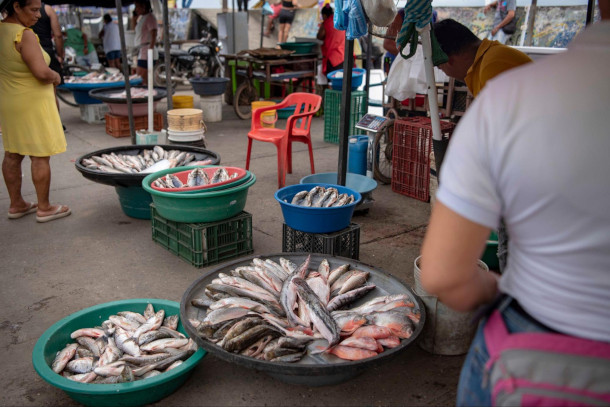
Fish for sale in Puerto Wilches. After the 2018 oil spill, the fishing communities along the Magdalena were among those most severely affected. (Photo: Christian EscobarMora for the Goldman Environmental Prize)
MORALES [WITH VOICEOVER]: Well, we’re fighting to keep fracking out of Colombia, which means fracking hasn’t taken place yet in our municipality. Puerto Wilches remains an anti-fracking zone today, a bastion of anti-fracking resistance. For those of you who don’t know about fracking—let me explain: it’s a fracturing process aimed at extracting the last drops of oil remaining underground. And to make this possible, they inject large quantities of water mixed with many chemicals that are harmful, contaminating underground aquifers, and there’s a high likelihood that they will seep into surface water sources. It arrives in the communities, imposes itself, of course, and then leaves us with environmental disasters, social disasters, and everything that occurs in an extraction chain like that of fracking. That is why we remain, to this day, a municipality and a region that opposes this practice, and for more than 10 years—through the Colombia Free of Fracking Alliance—we have succeeded in stopping this practice in our territory and throughout the country as well.
BELTRAN: Being an environmental activist can be dangerous, especially in Latin America. What kind of resistance did you face when you started protesting against fracking projects?
MORALES [WITH VOICEOVER]: Well, I am a daughter of this river; I am the daughter of fishermen. For me, defending this very river has been a constant thread running through my life. Right? So when a threat like fracking arises—and the government and state push to frack —I couldn’t take my time or delay on deciding whether or not to be involved. Colombia is still the most dangerous country in the world today for exercising social and environmental leadership. Almost every year, we hold the dismal distinction in a Global Witness report as one of the countries where the most environmental leaders are murdered. So it’s quite difficult, especially because we see young people facing this irony that comes with defending life itself. The fact is that in Colombia and the Global South, defending life can cost you your own. It’s a great injustice—a great injustice to current generations, to future generations, and to ourselves. And yet we continue, of course, to defend water and life in our territory. We demand justice; We, the social leaders, demand that the Escazú Agreement, to which several countries, including Colombia, have acceded and ratified—lead to justice and comprehensive protection for all of us, because we not only deserve it, we also need it.
BELTRAN: And Yuvelis, you experienced this danger of being a young environmental activist first hand. You were the target of harassment and intimidation, and those threats to your safety actually led you to relocate to France in 2021. Tell us what it was like to defend your home and your community from a distance.
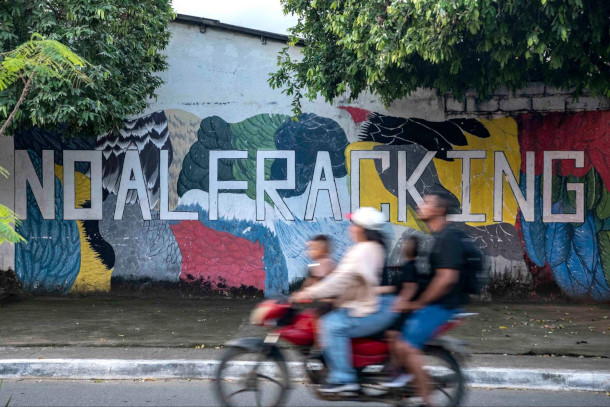
An anti-fracking mural located in Puerto Wilches, which remains an anti-fracking zone due in large part to the advocacy of those like Yuvelis Morales Blanco and the Colombia Free of Fracking Alliance. Puerto Wilches is a bastion of anti-fracking resistance. (Photo: Christian EscobarMora for the Goldman Environmental Prize)
MORALES [WITH VOICEOVER]: It was actually quite beautiful because it was a process of learning about myself, you know? When I arrived in France, I was 21 and feeling pretty down, very lost. I was going through feelings that I think all of us go through when we’re displaced for defending our territory. At first, it was like going into denial, right? About finding sadness in every corner of my heart, too. But then I found the sunrise, it was finding what you’re fighting for, right? Hope in the river, in the mountains, in the sunset, in the people, in myself—searching in those corners of sadness for what made me who I am. Then I learned in France about international territorial defense, about mechanisms of cooperation; I learned about international cooperation itself; I connected with other environmental and social struggles; I met many friends—definitely friends who are family today—I’m sending them a big hug.
BELTRAN: LAUGH
MORALES [WITH VOICEOVER]: In the end, what ended up kind of pushing me aside, making me think it was going to be the end of something, also turned out to be the beginning—discovering myself in other contexts where I hadn’t known myself before.
BELTRAN: And Steve, Jenni – Yuvelis Morales Blanco is now back in Colombia, and continues to fight against oil and gas in her community, newly invigorated from this Goldman Environmental Prize.
DOERING: Wow, well deserved, such courage! After all the threats she faced.
BELTRAN: Absolutely, and it actually looks like fracking may be back on the table.
Colombia recently held presidential elections and the apparent winner, by a razor-thin majority, is the “far-right” candidate Abelardo de la Espriella, the opponent of the candidate from the outgoing president’s party Pacto Historico or Historic Pact.
CURWOOD: So, Paloma what has the president-elect said about fracking?
BELTRAN: Well, Espriella’s party, Defensores de la Patria or Defenders of the Homeland supports fracking as a way to augment energy development and strengthen the country’s economy.
DOERING: So, it sounds like changes may be in store - now what might this mean for the fracking pilots near Yuvelis’ home?
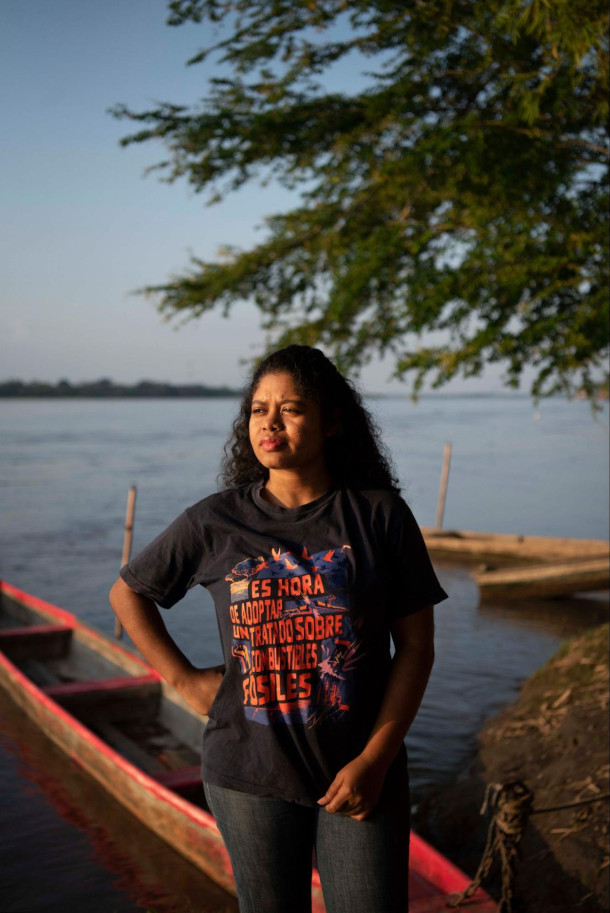
Yuvelis Morales Blanco is this year’s recipient of the Goldman Environmental for her work protecting the Rio Magdalena and her home country of Colombia from the threat of fracking. She is pictured here on the banks of the Rio Magdalena, the river she calls both home and ancestor. (Photo: Christian EscobarMora for the Goldman Environmental Prize)
BELTRAN: After Gustavo Petro’s decision to ban fracking during his presidency, those pilot projects were put on hold, but it now seems president-elect Espriella could reverse that pause. And that would mark a drastic change to Colombia’s efforts in phasing out fossil fuels.
CURWOOD: Right, and just this spring didn’t Colombia host the “first conference on transitioning away from fossil fuels" in Santa Marta, right?
BELTRAN: Yes, that's right, and it was a huge deal! Fifty-seven countries agreed to draft a “roadmap” for phasing out coal oil and gas, and they’re hoping to carry that momentum forward into the UN climate talks this fall.
DOERING: Well, there's a lot to keep track of, and we’ll definitely keep an eye on this -- thank you Paloma!
BELTRAN: No problem!
CURWOOD: Living on Earth’s Paloma Beltran.
Links
Yuvelis Morales Blanco’s profile at The Goldman Environmental Prize
Living on Earth wants to hear from you!
Living on Earth
62 Calef Highway, Suite 212
Lee, NH 03861
Telephone: 617-287-4121
E-mail: comments@loe.org
Newsletter [Click here]
Donate to Living on Earth!
Living on Earth is an independent media program and relies entirely on contributions from listeners and institutions supporting public service. Please donate now to preserve an independent environmental voice.
NewsletterLiving on Earth offers a weekly delivery of the show's rundown to your mailbox. Sign up for our newsletter today!
 Sailors For The Sea: Be the change you want to sea.
 The Grantham Foundation for the Protection of the Environment: Committed to protecting and improving the health of the global environment.
 Contribute to Living on Earth and receive, as our gift to you, an archival print of one of Mark Seth Lender's extraordinary wildlife photographs. Follow the link to see Mark's current collection of photographs.
 Buy a signed copy of Mark Seth Lender's book Smeagull the Seagull & support Living on Earth
© Copyright World Media Foundation. All Rights Reserved
Home | Contact | RSS | Donate | Newsletter