

AJR Rock Star Recruits for Climate Action
Air Date: Week of May 8, 2026
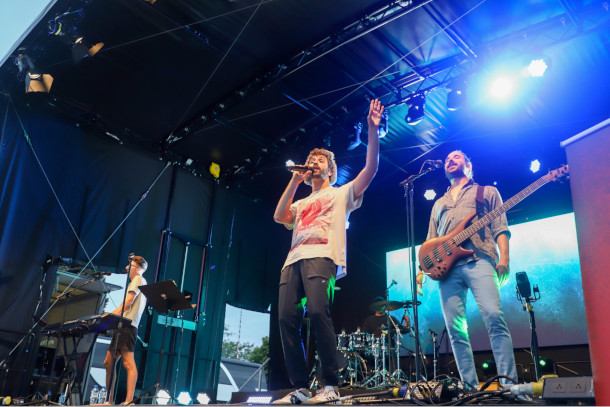
Adam Met (right) is the “A” in indie-rock band AJR, where he plays bass alongside his brothers Ryan (left) and Jack (center). (Photo: Elsi Delgado, Wikimedia Commons, Public Domain)
The indie-pop band AJR is known for its high-energy anthems and along with growing their fan base of mostly young adults, AJR is growing the climate movement. At sold-out concerts, they offer fans ways to plug in to climate advocacy. AJR bassist Adam Met also teaches sustainability as an adjunct at Columbia and is cofounder of the nonprofit Planet Reimagined, and he speaks with Host Jenni Doering about engaging fans to sign petitions, join local groups and, most importantly, vote.
Transcript
DOERING: The indie-pop band AJR is known for high-energy anthems like “Weak,” “Burn the House Down,” and the chart-topping “Bang!”
AJR: So put your best face on everybody
Pretend you know this song everybody
Come hang, let’s go out with a bang
Bang! bang! bang!
DOERING: Along with growing their fan base of mostly young adults, AJR is growing the climate movement. At sold-out concerts, they offer fans ways to plug in to climate advocacy, with tables set up for signing petitions, calling representatives and information about getting involved in local groups. AJR stands for Adam, Jack, and Ryan Met, brothers who founded the band together. Eldest brother and bassist Adam Met also has a PhD in human rights law and sustainable development, teaches sustainability as an adjunct at Columbia and is cofounder of the nonprofit Planet Reimagined. He joins me now – Adam, welcome to Living on Earth!
MET: Thank you so much for having me, very happy to be here.
DOERING: So how did you first become interested in raising awareness about the climate?
MET: Yeah, so when I was in high school, they offered a human rights class. During that class, we actually took a field trip to go see Mary Robinson speak. Mary Robinson is the former president of Ireland. She was the UN High Commissioner for Human Rights. She made that case for the relationship between climate and human rights, and ever since then, I was just a fan of hers, in awe of everything that she did. I studied this in undergrad, doing my master's, doing my PhD. So that was one piece of it, and the other side of it is being on the road as a musician. I'm in a band called AJR, and I see both the impacts of climate in many cities that I go to, but also fans coming up to me all the time, saying, I want to participate. I want to be part of this. What can I do?
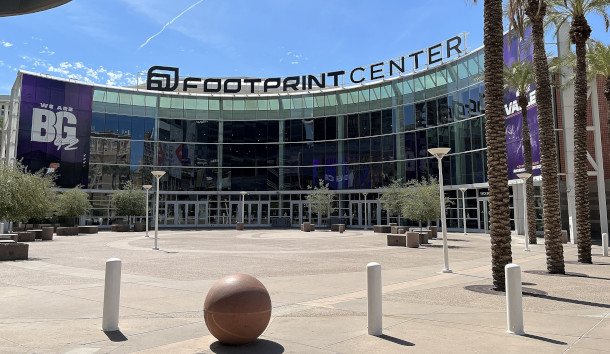
At a 2024 AJR concert at the Footprint Center in Phoenix, Arizona, unbearable temperatures motivated fans to petition the city to release funds to combat extreme heat. (Photo: Troutfarm27, Wikimedia Commons, CC BY-SA 4.0)
DOERING: So as a musician, what are some of the similarities that you found between starting a band and producing music, and building a successful climate movement?
MET: Yeah. So on the music side, if you think about building a fan base, it really is one fan at a time. You have all of these different strategies, whether it's music or social media or live shows or merchandise, marketing campaigns—all of these different ways in for fans. And as we were building that fan community with AJR, I started to think about how we could use those same strategies in order to build effective movements. And so I borrowed a lot of AJR strategies in order to do this. And then I said, okay, this is not just an AJR thing—a lot of bands, a lot of artists, use all different strategies. What if we could take all those strategies, bring them down to their first principles, and reapply them to social movements?
DOERING: So you often use your AJR shows to encourage fans to take action in the fight against climate change, such as by providing opportunities for phone banking, signing petitions. How have your fans reacted to this?
MET: Honestly, the fans have been incredible. I'll give you a couple of examples. You know, when we pulled into Phoenix on our last full tour, it was 109 degrees out. Like, literally, 109 degrees out. So when we pulled into Phoenix, the action on site was to sign a petition to get the city council to release funds to combat extreme heat. It was something direct, something they could understand, and something that would impact their city. Every single place, we had thousands of fans participating in these actions, and now they've come to expect it. There really is a demand from artists not to be shallow about this, and from fans not to be shallow about this, to give people real, concrete ways to participate civically or politically.
DOERING: What is it about music and the concert setting that you think can make this so effective?
MET: There are not a lot of settings that can do what music does. When people gather in person, there's something that happens that's a sociological term called collective effervescence---
DOERING: Oh, that’s a beautiful term.
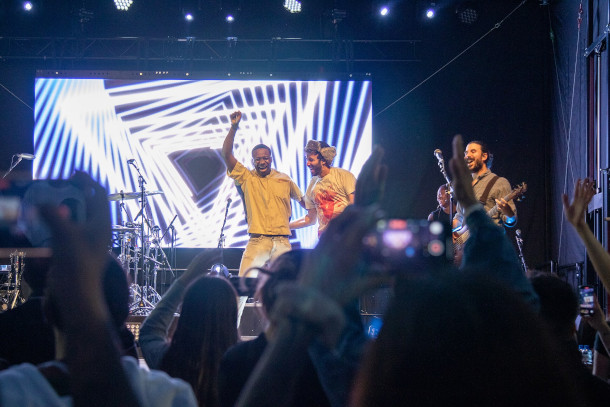
“Collective effervescence” is the intense joy and unity felt when people come together for a shared purpose. Adam says this feeling can be felt at concerts as well as when building social movements. (Photo: Caitlin Wilkins, Wikimedia Commons, Public Domain)
MET: Yeah, it's great, right? It was coined by the sociologist Emile Durkheim. And Durkheim wrote about this phrase in the religious context, and so when people were getting together to participate in religion. But it really does apply to music as well. You are there. You know almost none of the people that are in the same room as you, but you all have this shared vision and shared purpose and shared community when you're going to see a concert. You all sing along, dance along, etc. And I think one of the things that we've done really effectively is tap into that collective effervescence and apply it to other places. Most people use it for the music in and of itself, which is great, but there's real opportunity to apply it for social change.
DOERING: Tell us about the nonprofit that you also founded, Planet Reimagined. It seems like a large part of that group's work is centered around what you call "action research." Explain that term for us and how it's used to advocate for climate solutions.
MET: Yeah, so Planet Reimagined is an incubator. We incubate creative climate solutions, and we use this model called “action research.” We do academic-level research, hard-hitting research, peer-review level research, with an eye towards how can you implement it as fast as possible? So much research in the world is done, it's great, and it sits on a shelf for decades, and nobody uses it. A lot of the mRNA research around the COVID vaccine had sat on a shelf for forever, and it wasn't until it was actually needed for COVID that people went back to that research and started using it. Imagine if that research was done with an eye towards its usefulness, then we could have had so many health solutions over the last decades that are now being discovered today because we have that mRNA approach to healthcare. So that's very exciting. We have a large tech platform that can essentially take climate policies that work at the city level and help rewrite them for other cities, because there are so many cities that are doing amazing work because they can move a lot faster than the federal level. We have the concert work, like you said, and we have a handful of other projects that are being incubated as well..
DOERING: So hearing us talk, some people might think, all right, so, AJR's lyrics must talk a lot about climate, environment. That's not really the case. Is there a reason that you kind of avoid, or just don't want to go there with climate messaging in your music?
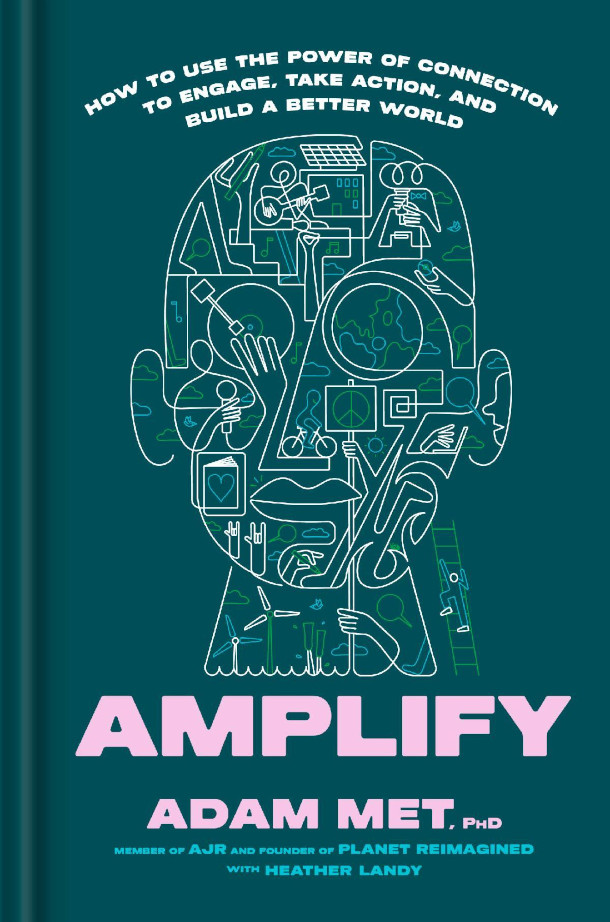
Adam’s latest book, Amplify: How to Use the Power of Connection to Engage, Take Action, and Build a Better World, is a field guide for activists that applies strategies from the music industry to social movements. (Photo: Courtesy of Shore Fire Media)
MET: So we've done all of the research, and injecting stories of climate, injecting information about climate into music, doesn't work. I've had so many people saying, oh, you need to write a climate anthem. That is so disingenuous, unless the artist is already so deep in that issue with their fans. The other piece of it is a lot of fans use music as an escape, and if you keep injecting social issues into music over and over and over again and all of these different types, it's not going to feel like an escape. However, there are ways to do it effectively. There are ways to do it that normalizes and creates almost a normative approach to climate action, or mental health, or any other issue that you want in music. Megan Thee Stallion does this really well. Doechii has done this really well, by just having it be a little piece of the song as part of your day-to-day. So we have a song called Inertia that was on our last album, and one of the lyrics in the song is, "I was gonna save the planet, but today I've got plans." And it's real, right? It makes sense, and it's something that other people are going through, and it just kind of is a little injection, but it's relatable, and it's something that people can understand. And it's not, "I was going to save the planet, but today I've got plans, but tomorrow I'm going to go recycle and buy an electric car and do all..." right? So it's it's really just injecting it in a way that fans see it as real, and not as trying to push them to do something.
DOERING: And that lyric is very self-aware, something we can relate to, of course.
MET: Exactly.
DOERING: So a large part of your fan base is youth. What role do you think younger generations have to play in the fight against climate change?
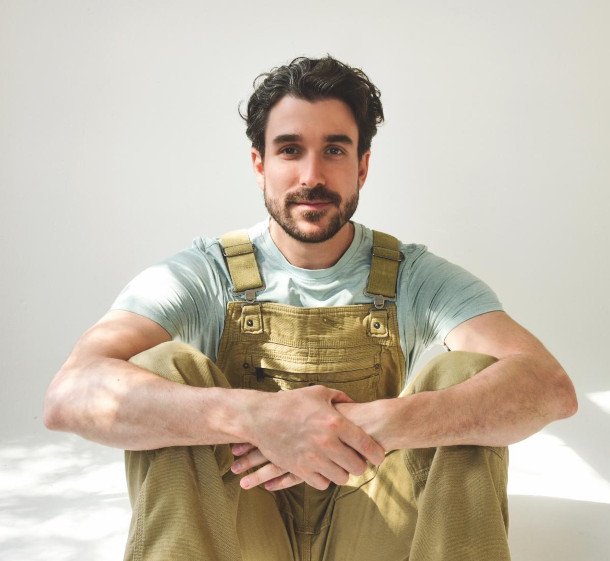
Adam Met is a climate activist, educator, and bassist of the indie-rock band, AJR. (Photo: Shervin Lainez)
MET: We've seen all different ways for young people to participate, both on our tours and off. If you are 18, the number one thing that you can do is vote in local elections. Yes, of course, vote in the presidential and national and federal elections around the world, but local elections are happening every week now, it seems. And there are elections that have happened in the last few months that have come down to a single vote. There are elections that have come down to seven votes. There are elections that have been around 20 votes that make the difference. Those are school board elections. Those are mayoral elections. Those are city councils. They are places that make the decision about transportation, about how waste is picked up, about parking on streets, about zoning. All of those things are climate issues. So that's the number one thing you could do right now is look up, literally, go look up when your next local election is, make sure you're registered to vote, and go vote in that election. It's much more than every four years, and every two years. If you are under that age, you need to bully your parents into going to vote in those local elections. We had some young children on our tour who couldn't sign petitions and couldn't call their representatives, but we had them with clipboards running around the concerts, getting other people to do it, so you have the power to push the people in your family to take these kinds of actions.
DOERING: Adam Met is a climate activist, educator, and bassist of the indie pop band AJR. He's also the author of Amplify: How to Use the Power of Connection to Engage, Take Action and Build a Better World. Adam, thank you so much for being here.
MET: Thank you so much. This was fantastic.
Links
Inside Climate News | “How a Rock Band Bassist Is Remixing Climate Activism”
Living on Earth wants to hear from you!
Living on Earth
62 Calef Highway, Suite 212
Lee, NH 03861
Telephone: 617-287-4121
E-mail: comments@loe.org
Newsletter [Click here]
Donate to Living on Earth!
Living on Earth is an independent media program and relies entirely on contributions from listeners and institutions supporting public service. Please donate now to preserve an independent environmental voice.
NewsletterLiving on Earth offers a weekly delivery of the show's rundown to your mailbox. Sign up for our newsletter today!
 Sailors For The Sea: Be the change you want to sea.
 The Grantham Foundation for the Protection of the Environment: Committed to protecting and improving the health of the global environment.
 Contribute to Living on Earth and receive, as our gift to you, an archival print of one of Mark Seth Lender's extraordinary wildlife photographs. Follow the link to see Mark's current collection of photographs.
 Buy a signed copy of Mark Seth Lender's book Smeagull the Seagull & support Living on Earth
© Copyright World Media Foundation. All Rights Reserved
Home | Contact | RSS | Donate | Newsletter