

How Oil Fuels Conflict
Air Date: Week of May 1, 2026
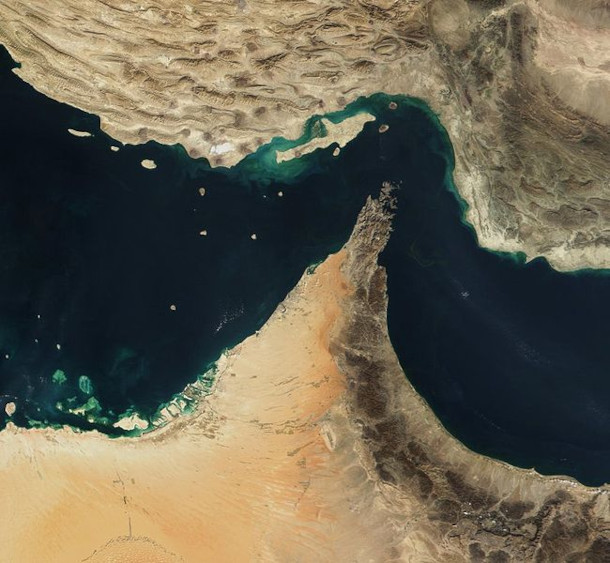
The Strait of Hormuz, effectively closed due to the US-Israel war on Iran, is a key trade route of global oil, natural gas, and critical mineral supplies. (Photo: eutrophication&hypoxia, Flickr, CC BY 2.0)
The US-Israel joint war against Iran has shaken global energy markets, closed the Strait of Hormuz and restricted the flow of oil and natural gas worldwide. It's the latest of conflicts over Iranian oil, though for the first time the growing emergence of fossil free energy sources is prompting visions of ending our decades of dependence on oil, with its pollution and inevitable wars. Michael Klare, emeritus professor of Peace and Security studies at Hampshire College and the defense correspondent for The Nation magazine, speaks with Host Steve Curwood.
Transcript
CURWOOD: It’s Living on Earth, I’m Steve Curwood.
The US-Israel joint war against Iran has shaken global energy markets, closed the Strait of Hormuz and restricted the flow of oil and natural gas worldwide. It's the latest of conflicts over Iranian oil, though for the first time the growing emergence of fossil free energy sources is prompting visions of ending our decades of dependence on oil, with its pollution and inevitable wars. Joining me now is Michael Klare, emeritus professor of Peace and Security studies at Hampshire College and the defense correspondent for The Nation magazine. Welcome to Living on Earth, Professor Klare!
KLARE: It's so pleasure to be with you.
CURWOOD: So the more things change, the more they stay the same. For years, you've written about the problems of war and the environment and such. What's new about this one?
KLARE: You know, what's so striking to me, I would have thought ten or fifteen years ago, I would have said by now, we would have been weaned off oil, or we would have been on a slide downwards from oil. We were talking that by 2025 we would have reached peak oil, meaning peak world oil demand, and be in decline, and renewables would be the dominant fuel. But it hasn't turned out that way. We find a world that's still terribly dependent on oil and natural gas for its energy supply. So when that's cut off with the closure of the Strait of Hormuz, there's a global energy crisis. It's hard to believe how dependent we remain on petroleum after all these years.
CURWOOD: So back in the 20s, the UK went to Kirkuk, it's part of Iraq now, I guess, and started, essentially the British Petroleum Company and worldwide petroleum sales. And of course, there was also a conflict then. To what extent does this planet go to war because we use oil?
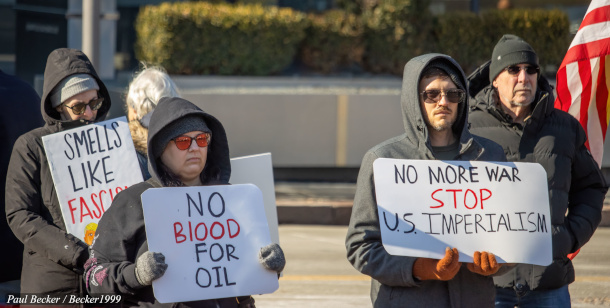
Residents of Columbus, Ohio protest the US invasion of Venezuela in January 2026. Our guest, Michael Klare, says the invasion was another example of oil’s influence on US military operations. (Photo: Becker1999 from Columbus, OH, via Wikimedia Commons, CC BY 4.0)
KLARE: I would say that historically speaking, if you look at the historical record, there's no question that the pursuit of oil has been a major factor in conflict since Churchill's era, when Churchill determined that the British Navy should be powered by oil instead of coal, and nationalized the British Petroleum Company. But as you noted, started out in the Middle East. Since then, oil has been a factor in most wars, one way or the other. And when I taught about this, I would go through this history at length, but turning to current times, the Trump administration's attack on Venezuela, that was directly about oil. Trump wants the US to be able to run Venezuela's oil industry. And now in Iran, Iran is the fourth leading oil producer, and the whole Persian Gulf area is the world's leading producer of oil. So you can't separate oil from the strategic equation. In this case, I would say, it's not that the US is attempting to seize oil in the sense of procuring it for our own use, but rather, this is about controlling the flow of oil around the world, because so much of it, a fifth of world oil every day and natural gas leaves the Persian Gulf. So whoever controls the Strait of Hormuz really controls the global oil flow and thereby controls the world economy. And I think it's the strategic control of the oil flow that's the critical underlying factor in the war with Iran. So oil is still a powerful factor in driving and sustaining warfare.
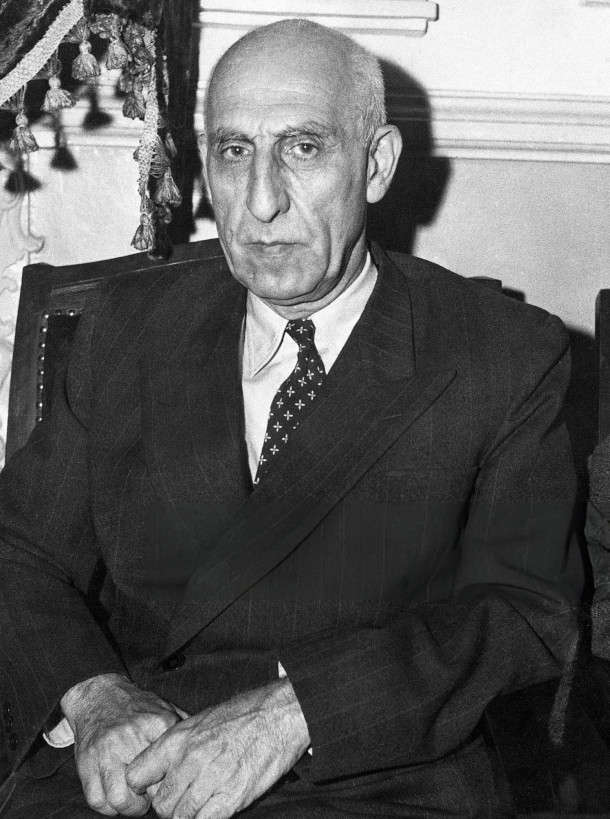
The United States CIA and the United Kingdom orchestrated a 1953 coup to overthrow Iran’s Prime Minister, Mohammed Mosaddegh (above), who had nationalized British Petroleum’s oil holdings in the country. (Photo: International News Photos, Wikimedia Commons, Public Domain)
CURWOOD: Some suggest that when there is conflict around oil, the fossil fuel companies make more money. When the price of gas goes up at the pump for oil that was already pulled out of the ground, it seems to make those fossil fuel companies richer. In fact, in some places there are so called windfall profit taxes. To what extent do you think the private profit-making interest of the fossil fuel industry is a driver of the wars that we are seeing?
KLARE: I would say historically, that was an important factor. But more importantly, it was about first the possession of oil fields. Historically, the United States was highly dependent on imported oil from Venezuela, from Mexico and especially from the Middle East, and those oil fields were owned by American companies. So at first, it was ownership of oil fields that drove wars. The US was unwilling to allow other countries to own those fields, control those fields, or for governments to nationalize them. The root of the crisis in Iran, for example, a very clear case of that is in 1951 when the Iranians elected a nationalist Prime Minister, Mohammed Mosaddegh, who nationalized the British Petroleum holdings in Iran. At that time, that was the leading oil producer in the world. And then the US conspired with the British to overthrow Mosaddegh and to install the Shah, the autocratic ruler who was brought in in 1953, 1954 by the CIA, and he ruled as a dictator for another 15 years or so, suppressing the Iranian clergy who then formed an opposition movement against him and finally overthrew the Shah in 1979, 1980. And that's the regime or their successors who now rule in Tehran, and because of this history of repression under the US backed Shah, they have a bitter, deep hatred of the United States. But this is all to do with the ownership of oil, the possession of oil. Now today, what the oil companies want more than anything is to slow the transition to renewable fuels. So I think they're less concerned with current profits, as you were suggesting, Steve, as with ensuring that governments do not adopt policies to wean us off our dependence on oil. And in the wake of this crisis we're in, there's going to be a lot of pressure in many countries around the world, hopefully in this one too, to say this dependence on oil has gotten us in this trouble that we're in now, and the rising gasoline prices, and so the sooner we transition away from oil, the better off we'll be. But that's where the fight is going to lie.
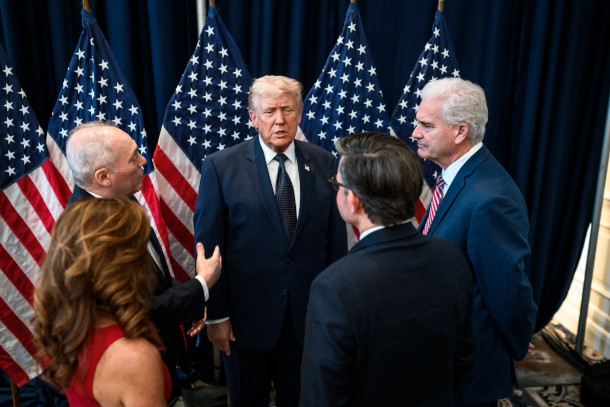
President Trump (center) with Republican House Leadership March 2026. Our guest Michael Klare says President Trump’s policy of discouraging renewable energy investment is a threat to national security. (Photo: Office of Speaker Mike Johnson, Wikimedia Commons, Public Domain)
CURWOOD: Well, in the previous oil choke points, the various embargoes, there was no alternative with renewable energy. But this time, it's different.
KLARE: Yes, indeed, we're very well aware that there are alternatives. Now in light of this crisis, hopefully people in countries around the world will say, maybe this is a wakeup call for us to accelerate that process.
CURWOOD: Now here in the United States, we have a federal government that is actively pushing against the advancement of renewable and clean energy technologies like wind and electric vehicles. And as you say, this war is revealing how disruptive relying on fossil fuels can be. I mean, how do you circle that square?
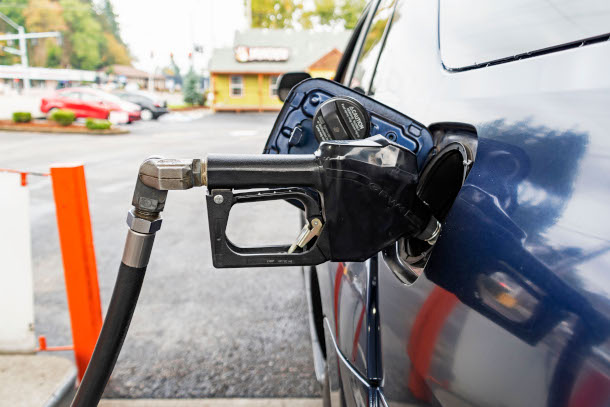
High gas prices around the world may have many questioning the persistent global reliance on fossil fuels, our guest Michael Klare suggests. (Photo: Oregon Department of Transportation, Wikimedia Commons, CC BY 2.0)
KLARE: You know, this is a predicament that our country has found itself in as a result of the Trump administration's reversal of moves that were being taken under the previous administration to accelerate the transition to green energy. President Trump has disrupted all of those efforts, has blocked wind power and solar power. So he's determined to perpetuate the oil age for as long as possible, and to perpetuate US reliance on coal, on a whole lot of measures he's taken, opening up federal lands to oil and gas exploration, keeping coal plants open. So the consequences for the world will be horrendous, in the sense that there will be higher carbon dioxide emissions coming from the United States, rather than a declining amount, as was the case previously. But on top of that, the United States is going to fall behind other countries like Germany and France and, of course, China, in the installation of renewable energy sources that will give us greater protection against the kind of energy shortages we're seeing right now. One of the ways I often talk about this myself is as a national security matter. Now Donald Trump speaks a lot about national security, and I think he's perverted the use of the term. If you look at what people in the military have been saying to me, they say that climate change poses an existential threat to the survival of the United States of America. It's going to burn our country, flood our country, and deprive our water supplies, and invade our country in ways that no foreign armies are capable of doing, and so switching away from fossil fuels that accelerate climate change is a national security matter.
CURWOOD: Okay, Michael, at this point, what gives you hope? You've been engaged in peace and security studies for decades. What gives you hope about future directions for the United States and the world based on knowing what we need to do?

Michael Klare is an emeritus professor of Peace and Security studies at Hampshire College and the defense correspondent for The Nation magazine. (Photo: Hampshire College, Courtesy of Michael Klare)
KLARE: I look for signs of hope all the time, and sometimes it's hard to do that, but I think the one positive outcome of the crisis we're in now, I do think is that people are scratching their head and saying, maybe getting an electric car next time around is a smart move. And I think that's happening around the world. And I think governments around the world are scratching their head and saying, maybe building another coal plant or natural gas plant isn't such a smart move, we should instead invest in solar and wind power. Now that's going to be a struggle, because the fossil fuel companies are going to push back against that, but I do think this is just going to lead people to think twice about their future investments in energy, and demand more reliable, less risky types of energy, and there's no more reliable source of energy than the sun and wind power. So I think people are really going to see more than ever the benefits of converting from fossil fuels to renewable sources of energy.
CURWOOD: Michael Klare is an emeritus professor of peace and security studies at Hampshire College and the defense correspondent for The Nation magazine. Thank you so much, Professor, for taking the time with us today.
KLARE: It's been a pleasure talking with you.
Links
Learn more about Michael Klare
Le Monde Diplomatique | “The Iran War Exposes a Fragile Energy System”
Informed Comment | ”How Trump’s Incompetence and Looming Global Catastrophes Intersect”
Living on Earth wants to hear from you!
Living on Earth
62 Calef Highway, Suite 212
Lee, NH 03861
Telephone: 617-287-4121
E-mail: comments@loe.org
Newsletter [Click here]
Donate to Living on Earth!
Living on Earth is an independent media program and relies entirely on contributions from listeners and institutions supporting public service. Please donate now to preserve an independent environmental voice.
NewsletterLiving on Earth offers a weekly delivery of the show's rundown to your mailbox. Sign up for our newsletter today!
 Sailors For The Sea: Be the change you want to sea.
 The Grantham Foundation for the Protection of the Environment: Committed to protecting and improving the health of the global environment.
 Contribute to Living on Earth and receive, as our gift to you, an archival print of one of Mark Seth Lender's extraordinary wildlife photographs. Follow the link to see Mark's current collection of photographs.
 Buy a signed copy of Mark Seth Lender's book Smeagull the Seagull & support Living on Earth
© Copyright World Media Foundation. All Rights Reserved
Home | Contact | RSS | Donate | Newsletter