

Artemis II Science and Awe
Air Date: Week of April 17, 2026
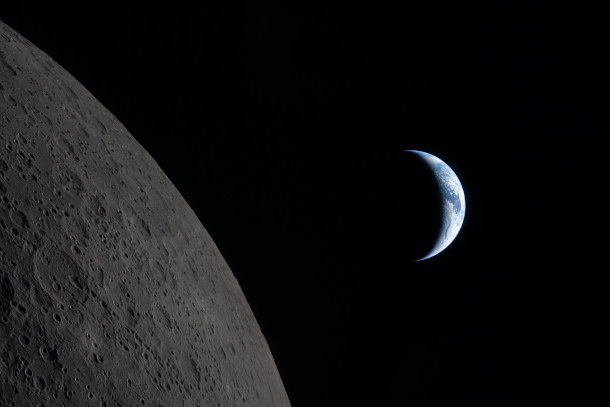
Artemis II astronauts captured an image of Earth as seen in a crescent phase. The dark section of the Earth would be experiencing nighttime, while the light section would be experiencing daytime. (Photo: NASA)
The four astronauts of the Artemis II mission that safely splashed down on April 10 were able to test out Orion spacecraft systems during their journey, a crucial step towards NASA’s ultimate goal of establishing a continuous human presence on the moon and embarking on future missions to Mars and beyond. They also made new scientific observations that are helping to expand our knowledge of the Moon, as well as the Earth itself. Artemis II Lunar Science Lead Kelsey Young talks with Host Aynsley O’Neill about the scientific goals and accomplishments of the mission and the unforgettable moments the crew shared with people back on Earth.
Transcript
O’NEILL: It’s Living on Earth, I’m Aynsley O’Neill
CURWOOD: And I’m Steve Curwood. This year as we look forward to Earth Day, once again we humans have been able to celebrate some special Moon Days. After all, as a species, we have an insatiable desire to turn our eyes skyward and gaze at the universe beyond our home planet. And when we think of space exploration, one of the things that captures our attention the most is our constant companion, the Moon.
O’NEILL: NASA’s Artemis program is organizing a series of complex missions with the end goal to establish a continuous human presence on the moon and set up the infrastructure and technology for future missions to Mars and beyond. And on April 1st, the Artemis II astronauts Reid Wiseman, Victor Glover, Christina Koch and Jeremy Hansen set out for a flyby around the moon, and there was a collective sigh of relief when a little over nine days later they landed safe and sound back on Earth. And on the science side of things, in addition to testing out Orion spacecraft systems, the crew was able to make some observations that are helping to expand our knowledge of our nearest neighbor, as well as the Earth itself. For more, I’m joined now by Kelsey Young, the Artemis II Lunar Science Lead, who was in the thick of space flight operations as part of the crew at Mission Control. Kelsey, welcome to Living on Earth!
YOUNG: Thanks for having me and for your interest in what we're doing.
O'NEILL: What were some of those standout observations that were made by the astronauts in the Artemis II crew that we from here on Earth had previously never seen before?
YOUNG: Our highest prioritized lunar science objectives, we had 10 objectives, and two of them were kind of binned as priority one. One was color and albedo variations and specifically crude observations of those variations, and then the second highest priority one was impact flash investigations, investigating kind of the modern lunar environment. And if we have new impact craters forming on the surface today, and we actually did have a couple Apollo crew members see impact flashes from orbit during their missions. But you heard the crew during the flyby, and you'll hear when all of the audio files get released, because they all will be released to the public, lots of descriptions of color and of course, I think the person who has spent time looking at the moon, which hopefully is a lot of people say, what color? You know, we see black and we see white and we see gray. But it turns out there are really, really subtle color nuances that you can see, especially when you're as close and have the view that, you know, the Apollo and Artemis astronauts had that really inform us scientifically about the evolution of the moon and what processes were active and how recently in the geologic history of the moon. So you heard, you know one thing that got the science team really excited, and this was read out loud on the loops real time. So if you tuned into the flyby, you'll hear it, is a few of them noting shades of brown, and then specifically Jeremy Hansen noticing green around this really neat feature called Aristarchus that is actually on the near side. You can see it, if you go up and look at the moon at night, you can see Aristarchus. He noticed green color, which tells us something about volcanic activity and how recently it might have been active in that area. It's a really high priority destination for future landed science missions, not crude, but robotic. So those observations had a lot of people in the science back room really excited.
O'NEILL: Well, and tell us about those impact flashes as well, because I believe that I saw you getting particularly excited about those.
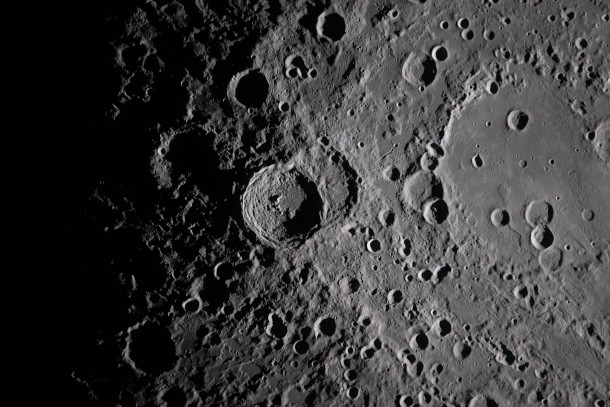
Vavilov Crater, seen here at the center of the photo, is an impact crater on the rim of the older and larger Hertzsprung basin to the right. (Photo: NASA)
YOUNG: Impact flashes are neat. What they are is micro meteoroids striking the surface of the moon and literally creating a flash, and that flash is formed when something that's moving really, really fast collides with the surface of the moon, and it literally, you know, like, melts and explodes when it hits the surface. Something that's actually really, really small can create a flash on the lunar surface because they have no atmosphere. So on our planet, if something that small were to get near to us, it would burn up in the atmosphere. But the moon doesn't have that atmosphere, so it will strike the surface and make a pretty bright flash. Apollo crews did see impact flashes, notably, there was one audio clip we played, actually, to the Artemis II crew in classroom training beforehand of Apollo 17 astronaut Jack Schmidt, giving an observation of the moon for something else. And you just hear him, you know, be totally excited "oh, I think I just saw a flash on the lunar surface" and he goes on to describe where he saw it. And so we were really excited about the opportunity for the crew to look for these, especially since we have a wonderful series of groups here on earth that look for impact flashes on the near side of the moon, which is, of course, the side of the moon that always faces our planet. We have citizen scientists all around the world looking. We have earth-based observatories looking, we have a group at the Marshall Space Flight Center who is really dedicated to looking for these impact flashes, but they don't see the far side, of course, because that side of the Moon always faces away from our planet. And so getting crude observations in support of these impact flash investigations and trying to track how dynamic the lunar surface is, was high priority. And I will be honest, I did not think we would see any. [LAUGH]
O'NEILL: You were a little doubtful. You were a little skeptical?
YOUNG: Yeah. I mean, you have to be looking in the right place at the right time. They only had a few hours, and you heard my shock, because not only did they see one, but they saw more than one. So, you saw my pure shock, which was, like, completely a genuine reaction.
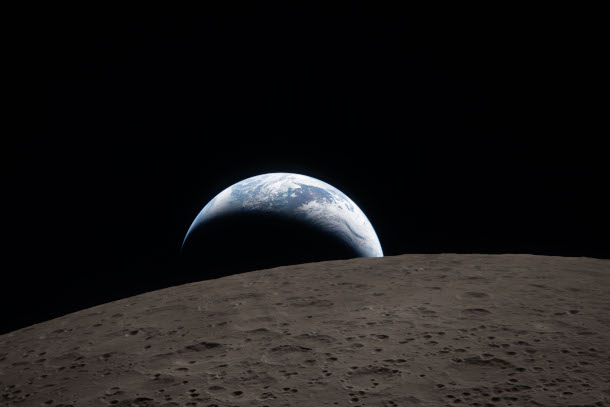
“Earthset,” taken by Commander Reid Wiseman, echos the iconic Earthrise photo captured by the Apollo 8 astronauts in 1968. (Photo: NASA)
O'NEILL: Well, of course, how cool is this genuinely?
YOUNG: It was very cool. I mean, I'm so fortunate to work as a part of Lunar Science Team. We have roughly 60 people pulled from all across NASA centers. And it's not just scientists, it's, you know, visualization specialists, communication specialists. We have people who work on the training materials. It really takes all walks of life to make this happen, but one scientist in particular was kind of the science theme lead for that investigation, and I missed it because I was having my own reaction at the time, but she apparently audibly screamed in the science back room. I wish I had heard it.
O'NEILL: Well so there's this incredible team that is all working together on this, but there's also the community that gets to benefit from all of this as well. So when we learn these things from these missions, what kind of impact do you think that has throughout the scientific community and even the community of lay people?
YOUNG: I really love and value that question, because I think it's really important. I mean, what do these missions bring to people that are not, you know, career lunar scientists who think about, you know, sending people to the moon. And I have so many answers. I think my top priority answer is inspiring the next generation and what I mean by that is, you know, I certainly, I was not alive during Apollo, but hearing from colleagues of mine now and people in my, you know, community that were alive to experience that, it helped them, in many cases, end up where they are now. It inspired them to pursue their passion and what they wanted to dedicate their life to. And in some cases, that was, oh my gosh, I want to do that, I want to go work for NASA, but in other cases, it was completely other relevant scientific disciplines, or even just, you know, other disciplines in general. And I've heard stories time and time and time again about the influence that Apollo missions played on people that I know well and respect, and so I'm really optimistic that the Artemis mission, starting with Artemis II, do that for the next generation, and to just allow them to see what happens when you pursue your passion and pursue the things that bring you joy, in this case, Moon joy. You know, I certainly have two young kids, and what I hope for them is that they do something that makes them as happy and fulfilled as this mission made me. And I know from what I've seen in kind of the public response to this mission, it certainly seems to have gotten off on the right foot, that people seem excited and motivated and inspired to look up at the sky and figure out where you might want to go, what path you might want to walk down.
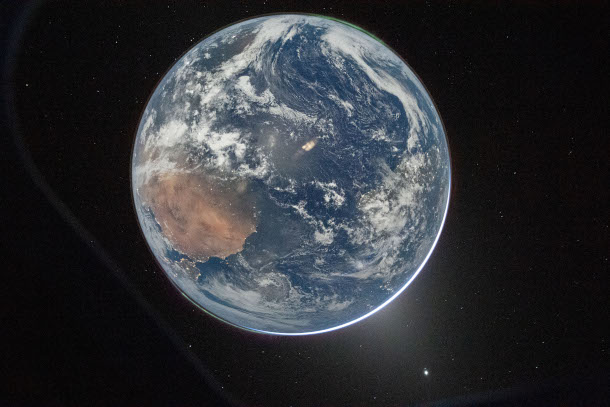
This photo, “Hello, World” shows Earth at night. It was taken on April 2, 2026, by Commander Reid Wiseman. (Photo: NASA)
O'NEILL: I feel like you can trace it one to one when you see the students who are able to interview the astronauts as they were up in space, or even the student who designed the I know the official term is the zero gravity indicator, but it was a cute little moon plushie. It was incredible to see the connection. You know, I think all of us felt a sort of childlike joy, but the children were really personally entranced by it.
YOUNG: I think part of that, first of all, desperate for a rise plushie. I'm told that they're coming soon, but I, you know, I like to say it's because I have kids, but really also I want one. [LAUGH]
O'NEILL: I want one, yeah.
YOUNG: But, you know, I think part of it is that these four crew members are so good at, you know, for lack of a more nuanced term, like saying words, you know, like communicating what they're experiencing and bringing, you know, bringing it closer to those of us watching at home. They I know they've said it publicly, and I've heard them say it, you know, in classroom training sessions and other training sessions I've had with them, they worked really hard to make sure that this was a mission for everybody, everybody all across the world. And they really threw themselves into making sure that we felt that, that everybody across the world watching at home felt that and that it was a unifying moment for everyone. You certainly heard those remarks during the mission and then during their kind of arrival event back at the Johnson Space Center on Saturday, the day after splashdown, oh my gosh, like such powerful messages of unity that are delivered so beautifully and in a way that a lot of people can access and understand. So I give them so much credit for not just how much work they put in, but who they are as people, that this is something that they felt so passionately about.
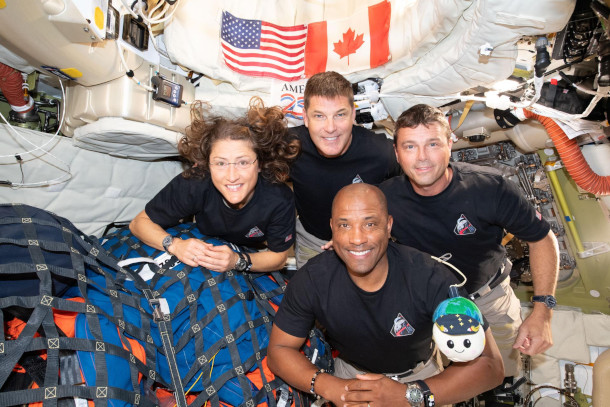
The Artemis II crew includes (clockwise from left) Mission Specialist Christina Koch, Mission Specialist Jeremy Hansen, Commander Reid Wiseman, and Pilot Victor Glover, shown here alongside their zero gravity indicator "Rise”. (Photo: NASA)
O'NEILL: Now, this mission really captured the attention and the love of so many of us around the world and I really do think that a lot of that is thanks to the human undercurrent that ran through even all of this science and technology and everything like that. You know, a couple of the really standout moments, there was the emotional weight of the naming of the Carroll crater after Commander Reid Wiseman's late wife, but there were also the lighter side of things like the morning wake up playlist and things like that. So what were some of the standout moments from the crew for you personally, Kelsey?
YOUNG: Certainly of course I mean, the number one moment has to be the Carroll crater moment. There was not a dry eye, that's for sure. That was just extremely impactful, just to have them share that with the world. I was fortunate to actually be in, you know, mission control at the time but I think even had I been watching it from home, it would have had the same impact and I think that's what makes it so powerful, right? So certainly, that, I think when they started getting closer to the moon, like, not on fly by day, but in earlier days, and they were able to get views of the moon out the window, the like, childlike excitement that we were hearing, like that's gonna stick with me a while. And you know, I'm fortunate to have spent a lot of time with these amazing people, and that was not a surprise [LAUGH] but hearing it for real, hearing how excited they were really will stay with me. My most anticipated moment prior to the mission, which bore out, it was really a wonderful moment, was the first time they started giving, like the real scientific descriptions of the moon on fly by day. We had trained them for so long and in so many ways, and they've come so far in giving those descriptions that to hear the real thing hit me, and I expected it to hit me, and it did, indeed. [LAUGH] But other than that, it was kind of just listening to them crush it like I knew they would, like the observations they were giving were impactful. They were, of course, inspiring from a human perspective, but scientifically impactful. And I swear, when they were, I think it was Victor and Christina that were having a conversation about how when they discussed with each other, they were able to elevate each other's observations, which is exactly what we wanted them to do. It was perfect. And like thinking about it later, it's just like, it just brought me so much joy that they experienced that because, of course, that's how the best science is done, is as a team. And the fact that in the middle of this moment, the middle of this several hour fly by where all eyes are on them, and they have the real thing out the window, and they've been training for three years, and they were still having like these scientific conversations with each other to elevate each other. They were asking questions about age relationships between lunar far side features to help inform what they were seeing. I mean, it was, come on, can't ask for anything more. It was incredible.
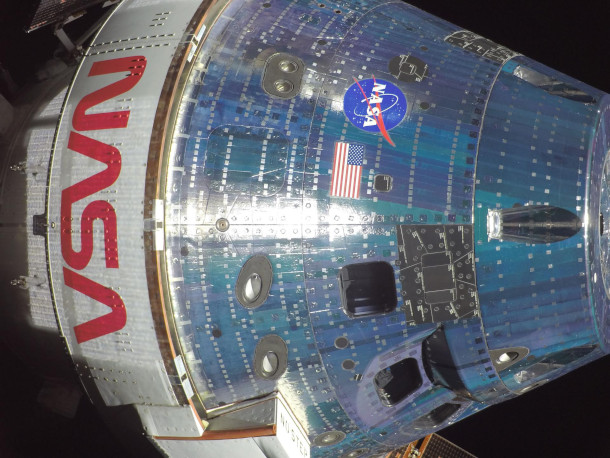
NASA’s Orion spacecraft, as seen by a camera mounted on the craft’s solar array wings. (Photo: NASA)
O'NEILL: So Kelsey, one of the images that I think resonated with a lot of us was the Hello World photo that Reid Wiseman took early on on the mission. It's this beautiful, full planet picture. It's got this great view of the Atlantic Ocean, some of Africa, some of South America and you can even see both the northern and, I think, the southern auroras as well. When we look at this, how can we compare this photograph from Artemis II to any of our other photographs of Earth, such as the blue marble from Apollo 17, or just any image that we've ever seen of our home before?
YOUNG: I adore that question and frankly, I mean, obviously, when we started getting the moon images down later, it was, like constantly, but that image that came down that you're referencing early in the mission, I mean, like, took our breath away. I mean, there's no other way to say it. I mean, it was just this spectacular symbol of what we had accomplished so far, which is getting people far enough away from our planet that they could take that picture in the first place. And then any time I looked closer at it, I saw something new that caught my eye that I hadn't seen before and I just started like, you know, squealing every time I saw something new. I mean, even just, of course, the Aurora popped out to me as well and then how, like, the thin line of the atmosphere, like came down at the southern end and the way that, like, the interaction that it had with the auroral features on the South Pole, took my breath away. You know, another thing I loved about that image is you could see zodiacal light in that image, and, you know, kind of down to, sort of, like the bottom right of the picture, and so zodiacal light is basically interplanetary dust. It's dust that's floating in the solar system that you can see in the darkness of space. And that was something we knew that they would be observing when they got to the moon. And so it was this really beautiful sort of like, here is our planet. Here's where we came from. We have this view in the first place because we accomplished something incredible. And here's this little ode to something we'll be seeing, you know, in a few days. So an extremely impactful image. And, you know, I think listening to the crew describe both in the mission and then in their event that they did when they got back to Houston, of seeing Earth suspended in like the blackness of space, it hit me in the moment when I heard them say it, but then they said it again and it just kind of took my breath away again, because, you know, three of those four people had spent months on the International Space Station taking beautiful pictures of Earth, and this was entirely new vantage point and an entirely new, like, literal view of our planet that was made possible because of reaching for something greater. And it just is emblematic of, I think, this new generation of exploration. It's emblematic of these four people and what they were able to accomplish and yes, you know, first of all, I'm a geologist. I study the Moon, but I also study Earth, so I think I'm excited for the moon pictures, but I was just blown away by that early image of our own planet and what it symbolized to me.
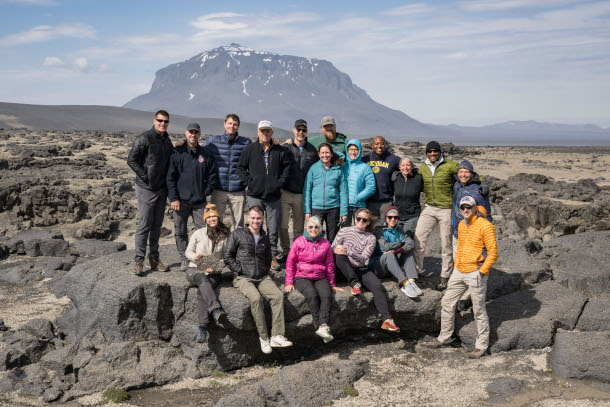
The Artemis II crew astronauts alongside their backup team and the geology training field team, shown here in Iceland’s Vatnajökull national park. From front left: Angela Garcia, Jacob Richardson, Cindy Evans, Jenni Gibbons, Jacki Mahaffey, back row from left: Jeremy Hansen, John Ramsey, Reid Wiseman, Ron Spencer, Scott Wray, Kelsey Young, Patrick Whelley, Christina Koch, Andre Douglas, Jacki Kagey, Victor Glover, Rick Rochelle (NOLS), Trevor Graff. (Photo: NASA)
O'NEILL: Well, and I want to make this connection here. You here as a Lunar Science lead, and also, obviously a geologist. I'm here as Living on Earth. What are we learning about Earth when we learn about the moon?
YOUNG: The answer that I love to give, because it inspires me every day when I go to work at NASA, is that the moon, we like to say, is a witness plate for the entire solar system and specifically for our own planet, here on Earth. And that is because we're essentially in each other's backyards. I mean, they're only a couple day flight away, right? So from a solar system perspective, we're next door neighbors and then some. And Earth has plate tectonics and oceans and vegetation that often obscures big parts of our history on Earth. We have very little really old crust from billions of years ago exposed on our planet because it has been recycled by plate tectonics, even if you go to you know the deepest parts of the ocean, you're not going to be able to access that early chunk of our own planet's history. But on the moon, if you know where to look and you know how to look, you can access that part of our own history by going to the moon to evaluate things like what the impact history looked like at that time, which had a lot of impact on how our own planet was developing at the time. And so the fact that you can go to the moon to learn about Earth in a way that you can't here on Earth is really inspiring for me. And I, you know, I think we have so many questions for lunar science in its own right, and those are obviously super critical but there is a lot of value as well in what lunar exploration can tell us about Earth. I think there's also the more human element of things, of stepping away from our planet to gain a new perspective, literally and figuratively, and you heard that just echoed over and over and over again by the crew. I mean, I think repeatedly, they just kept saying, we don't leave Earth, like we choose Earth and we choose each other, and I think that that message brought from basically the other side of the Moon is really impactful right now, and offers a new perspective, and brings the moon closer to home, but also brings us all here on Earth a little bit closer together.
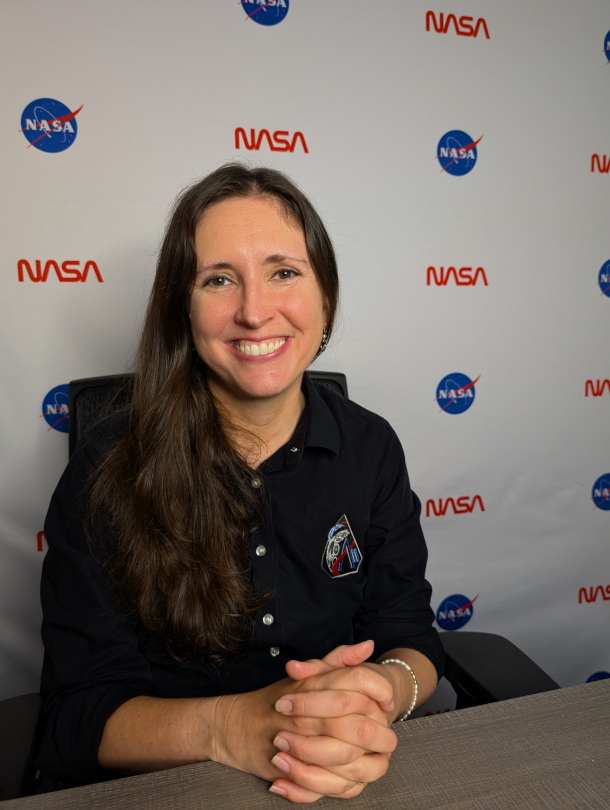
Kelsey Young, the Artemis II Lunar Science Lead and Research Space Scientist at NASA Goddard Space Flight Center. (Photo: NASA)
O'NEILL: Kelsey Young is the Artemis II Lunar Science lead. Kelsey, thank you so much for joining us today.
YOUNG: Thank you so much for having me and while we put out amazing images, you know, during the mission, more data will be coming out, more images will be coming out, new images even came out a few days after the mission, and NASA will continue to release them as we get them processed. So the journey does not end here for Artemis II, please do continue to follow along, and please continue to look at the moon. Thanks for having me.
O'NEILL: And you can find those images and more on our website, loe.org.
Links
NASA | “Artemis II News and Updates”
NASA | “Artemis II Crew Arrives at Launch Site, Shares Moon Mascot”
Wired | “Artemis II Astronauts Witnessed 6 Meteorites Colliding With the Moon”
Living on Earth wants to hear from you!
Living on Earth
62 Calef Highway, Suite 212
Lee, NH 03861
Telephone: 617-287-4121
E-mail: comments@loe.org
Newsletter [Click here]
Donate to Living on Earth!
Living on Earth is an independent media program and relies entirely on contributions from listeners and institutions supporting public service. Please donate now to preserve an independent environmental voice.
NewsletterLiving on Earth offers a weekly delivery of the show's rundown to your mailbox. Sign up for our newsletter today!
 Sailors For The Sea: Be the change you want to sea.
 The Grantham Foundation for the Protection of the Environment: Committed to protecting and improving the health of the global environment.
 Contribute to Living on Earth and receive, as our gift to you, an archival print of one of Mark Seth Lender's extraordinary wildlife photographs. Follow the link to see Mark's current collection of photographs.
 Buy a signed copy of Mark Seth Lender's book Smeagull the Seagull & support Living on Earth
© Copyright World Media Foundation. All Rights Reserved
Home | Contact | RSS | Donate | Newsletter