

Running Free from Pricey Gas--EVs
Air Date: Week of March 20, 2026
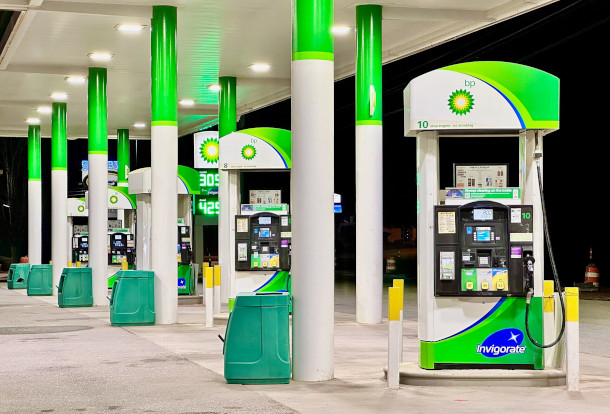
Rising costs at the pump resulting from the war with Iran could push consumers towards electric vehicles. (Photo: Harrison Keely, Wikimedia Commons, CC BY 4.0)
Facing pain at the pump, US drivers looking to buy an electric vehicle now have more and cheaper choices than ever. But with the $7500 federal tax credit for new electric vehicles now gone, you may be wondering whether EVs are the smart buy in 2026. Jim Motavalli, who writes about green transportation for Autoweek, Barron’s and the New York Times shares some insights about EV options, cost and the charging network with Host Aynsley O’Neill.
Transcript
O’NEILL: Pain at the pump might have you dreaming about filling up with electrons instead of gas. US drivers looking to buy an electric vehicle now have more choices than ever and they no longer have to cost you an arm and a leg. But with the $7500 (seventy five hundred dollar) federal tax credit for new electric vehicles now gone, you may be wondering whether EVs are the smart buy here in 2026. Jim Motavalli, who writes about green transportation for Autoweek, Barron’s and
MOTAVALLI: Great to be on.
O'NEILL: Well, so Jim in 2026, if there is a prospective car owner who has a gas car but is thinking that their next purchase might be an EV, what should they keep in mind?
MOTAVALLI: Well, I think there's a lot of reasons to consider an EV right now, and the offerings are probably more attractive than ever before. If you look at the main reasons consumers have had qualms about buying an EV, that had to do with range, and just about every respectable EV is now hovering at or beyond 300 miles of range, and all the EVs have switched to being able to access the Tesla charging network, and Tesla has the best national network of charging stations, and they're pretty much across the country now. You could easily drive an EV across America, or you drive it north or south. Doesn't really matter, there's Tesla stations everywhere, and fear of not being able to find charging has been a major drag on EV sales. Right now, EV sales are really down. They've really sort of cratered. Whether that will continue or not, I'm not sure, and I think we will see a spike in interest because of what people are paying at the pump right now.
O'NEILL: To what extent do you think this drop in EV interest comes from the removal of federal tax credits for EVs? How much did that have an impact on people going well, I'm not sure the money makes sense anymore.
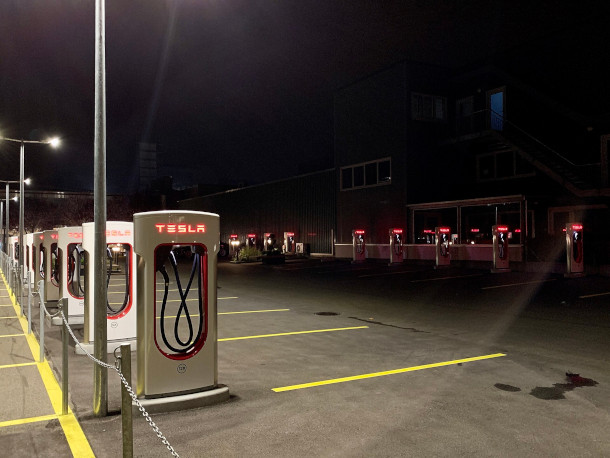
Most EVs are now able to access Tesla’s supercharging network, whose chargers allow drivers to charge their vehicles up to 200 miles in just 15 minutes. (Photo: Ank Kumar, Wikimedia Commons, CC0)
MOTAVALLI: Well, I think unfortunately, we saw a drop off even before that happened. Before Trump took office, one of the first things he did was remove that $7,500 federal income tax credit, but we were seeing a drop off in interest even before that. I also think the federal income tax credit is not as important as it was, because EV prices have come down. If you look at some of the newest options that are in some of the cars that are on the market now, they're actually priced lower than the average price Americans pay for cars. I mean, keep in mind that that price is around $50,000, that's the average price of a vehicle today, and there are a whole lot of EVs that, even without federal subsidies, are well below that. So I think we could actually say we're either close to or at price parity, maybe not all EVs, but there's certainly a lot of available EVs that are below the average of what Americans pay for a car anyway. So I don't think it's critical, that federal income tax credit. It was nice, and I'm sure some people decided not to buy because of that, but in many cases, automakers lowered their prices to sort of compensate for the loss of the federal income tax credit. I think if consumers were to really look at EVs now, they'd see that they're pretty fairly priced, and they could buy a really competent one at prices not exorbitantly more, or even more at all, than a gas car.
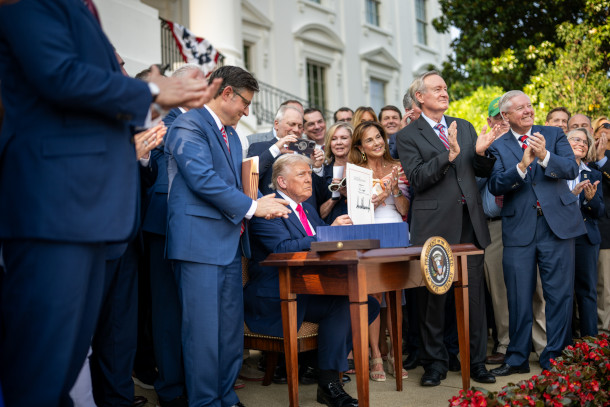
While Trump’s “One Big Beautiful Bill” removed the $7500 tax credit for electric vehicles, interest in EVs had already begun to drop off prior to the legislation’s passage. (Photo: White House, Wikimedia Commons, CC0)
O'NEILL: Well, let's talk a little bit more about the charging network as well. So not only has there been limited charging access, that's been a challenge for EV adoption, but also long charging times. Where does that stand at this moment?
MOTAVALLI: Well, I think the charging companies are doing their best to reduce the amount of time it takes to charge and BYD, which is now the biggest EV producer in the world, Chinese company, took over from Tesla as the biggest producer. They said they can charge an EV, I think it's maybe 10 to 80% in five minutes. And if you could do that in five minutes, then you're not taking appreciably longer than if you were filling up your gas car. Of course, you need a, what's called a DC fast charger. You need a, you can't have that kind of charger in your house. You're not going to be able to produce five minute charges in your home garage. But you don't really need to. Once the car is in the garage and you plug it in, you don't have to stand there waiting for it. At public charging, five-minute charges would be really great.
O'NEILL: Well, and so Jim, if somebody's looking right now and they are considering an EV, what would you say are particular standouts in terms of manufacturers or particular models even?
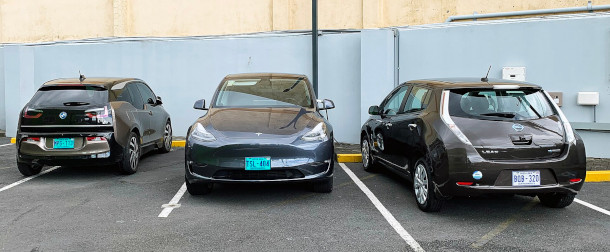
Many car manufacturers have begun to produce mid-range electric vehicles like the Nissan Leaf or Chevy Bolt, making EVs more affordable for the average consumer. (Photo: Mariordo, Wikimedia Commons, CC BY-SA 4.0)
MOTAVALLI: Well, I'm a big fan of the Hyundai IONIQ 5 and 6, which are reasonably priced EVs that will go 300 miles on a charge. And I just happened to borrow one, my brother owns one, I was using his IONIQ 5, and I think it's a terrific car. Another one to consider is the new Chevy Bolt, which has just come out, which is priced under $30,000, has almost 300 mile range, and, rather strangely, will only be offered for one year, as things stand now. But Chevrolet also produces the Equinox, which is a larger EV. That has many of the same specs. The new Nissan Leaf is another one that has finally enough range to be worthy of consideration. So those are some EVs I like, on the lower end of the spectrum. The problem has been there's too many luxury EVs priced at $100,000 or more, and companies like Lucid, for instance, just announced that they're going to be producing sub-$50,000 EVs, when everything they've had so far has been, you know, 80,000 to over 100,000. So, and Rivian also is producing cheaper EVs. That's their next phase after producing high priced ones. They're trying to get in on the, you know, Tesla Model 3 market. Everybody's aiming at that.
O'NEILL: Yeah, and we talked about the Chinese manufacturer BYD. As far as I understand it, they're not available in the United States, correct?
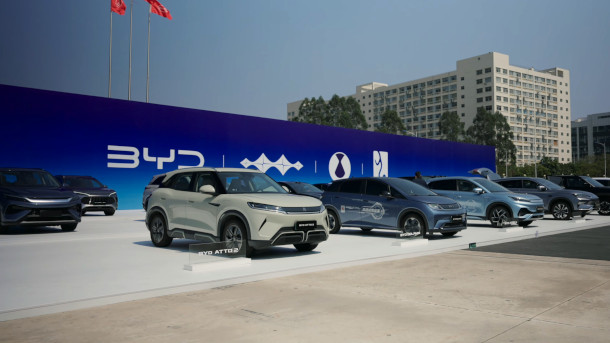
The Chinese electric vehicle manufacturer BYD has recently made a deal with Canada to establish dealerships in the greater Toronto area. BYD’s cars are currently unavailable in the United States because of the costs of tariffs. (Photo: iMoD Official, Wikimedia Commons, CC BY 3.0)
MOTAVALLI: Well, it's because of the tariffs that are put on Chinese-made vehicles. It would be pretty cost prohibitive to bring them in. It's interesting to point out that the Chinese automakers do seem to be making a deal with Canada, and I think we'll see widespread Chinese EV adoption in Canada. We've already seen it in Europe, all over Asia, Central America, Mexico. I mean, Chinese EVs are everywhere in the world but in the United States right now.
O'NEILL: I want to take a moment to talk about the used car market. How great of an option is a used EV for somebody?
MOTAVALLI: That is really something to consider, buying a used EV, because they're very inexpensive right now. It has to do with the fall off in demand for new EVs has also affected the used EV market. So you can get a very good deal on a two-year-old or a three-year-old EV with low mileage on it, maybe 30,000 miles, and loaded with options, a car that would have sold for 50,000 you could buy for 25. And I don't see any reason not to do that. I think that would be a very good idea. Of course, there was a subsidy on used EVs. It's another thing that Trump killed, but you won't be able to get that. But still, you can get a very good deal.
O'NEILL: Looking ahead, given the instability of gas prices from this war in Iran, as well as other future global conflicts, to what extent do you think people should be factoring in this volatility when deciding whether to stick with a gas car or switch to an EV?
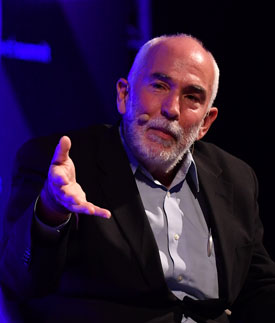
Jim Motavalli is a freelance environmental journalist and blogger for Autoweek, The New York Times, and Barron's. (Photo: Seb Daly, Web Summit, Wikimedia Commons, CC BY 2.0)
MOTAVALLI: I think they should definitely factor it in, because oil prices are very volatile. They go up and down, and it's not likely conflicts are going to go away. I don't know how long the one with Iran is going to last, but there's going to be conflicts over oil as well as the climate imperatives that are still there. It's not like the climate has decided to take a pause. It's like going on hold for this, and I think that will be a major reason. I think EVs are very worth considering right now, even if you're not as worried about the price at the pumps, I think it's exactly the right time to buy an EV, specifically because demand is down. Prices are lower than they have been. The EVs are also way more competent than they were in the past, and some of the early bugs we've seen in EVs have been ironed out. They're likely to be way more reliable than before. I think you'll find your dealership very anxious to make a deal with you on an EV, give you the best possible price, and I don't think you'd feel a whole lot of pain owning an EV now, with the extensive charging network we have, the public charging network. And way greater adoption of EVs, so there's network of support for them, parts availability, all that kind of stuff.
O'NEILL: Jim Motavalli writes for Barron's, Autoweek, and The New York Times. Jim, thank you so much for taking the time with me today.
MOTAVALLI: Always glad to talk to you, Aynsley.
Links
Reuters | “Gasoline Price Hike From Iran War Could Push Consumers Toward EVs, Hybrids”
International Energy Agency | “Trends in Electric Car Markets”
Consumer Reports | “Which Electric Vehicles Can Charge at a Tesla Supercharger?”
Bloomberg News | “China's BYD Open to Building Cars in Canada, Buying Out Rivals”
Living on Earth wants to hear from you!
Living on Earth
62 Calef Highway, Suite 212
Lee, NH 03861
Telephone: 617-287-4121
E-mail: comments@loe.org
Newsletter [Click here]
Donate to Living on Earth!
Living on Earth is an independent media program and relies entirely on contributions from listeners and institutions supporting public service. Please donate now to preserve an independent environmental voice.
NewsletterLiving on Earth offers a weekly delivery of the show's rundown to your mailbox. Sign up for our newsletter today!
 Sailors For The Sea: Be the change you want to sea.
 The Grantham Foundation for the Protection of the Environment: Committed to protecting and improving the health of the global environment.
 Contribute to Living on Earth and receive, as our gift to you, an archival print of one of Mark Seth Lender's extraordinary wildlife photographs. Follow the link to see Mark's current collection of photographs.
 Buy a signed copy of Mark Seth Lender's book Smeagull the Seagull & support Living on Earth
© Copyright World Media Foundation. All Rights Reserved
Home | Contact | RSS | Donate | Newsletter