

How Frogs Can Swim Under Ice
Air Date: Week of March 13, 2026
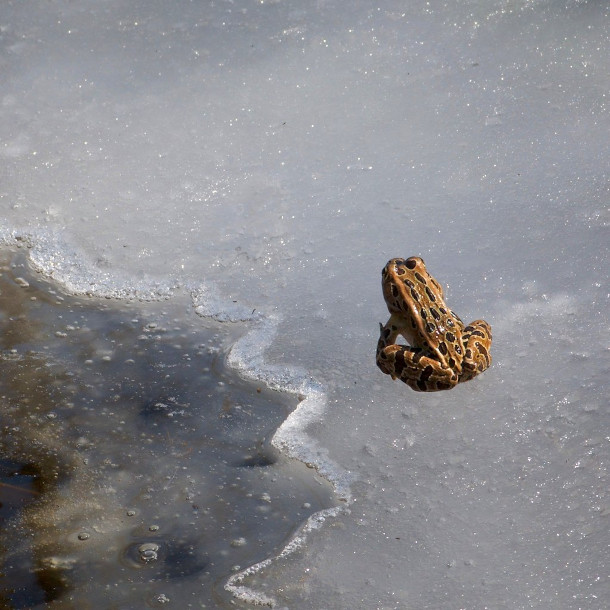
During the winter, aquatic frogs can survive under the ice by engaging in cutaneous respiration, or “breathing” through the skin. (Photo: Wayne MacPhail, Flickr, CC BY-NC-SA 2.0)
The recent story from Living on Earth’s Don Lyman about a childhood memory of being amazed to see a bull frog swimming along under the ice in his favorite stream sparked the curiosity of some of our listeners. Host Aynsley O’Neill called Don back up to learn how frogs survive under the ice of a frozen stream or pond -- using tricks like breathing through their skin and even in some cases freezing solid before thawing out in the spring.
Transcript
CURWOOD: Time for another creek now, one from a memory. If you tuned in last week, you may have heard Living on Earth’s Don Lyman share his story about “The Frozen Creek.” Don recalled a boyhood moment of seeing a bull frog swimming along under the ice in his favorite stream near where he grew up in Quantico Marine Base in northern Virginia.
O’NEILL: Since that day when he was just 12, Don’s passion for herpetology has blossomed and he knows a whole lot about amphibians. So, when we heard from some of you about how his story had sparked your curiosity, we knew we had to call him back. Hey, Don, thanks for joining us again!
LYMAN: Thank you, glad to be here.
O'NEILL: So your essay was all about this creek that you would spend time in in your childhood, and specifically about a midwinter walk where you spotted a bullfrog swimming under the ice. What about this moment stood out to you in the first place?
LYMAN: Well, I was just amazed. You know, I was a 12-year-old boy, I had never seen a frog swimming under the ice before, and I was just amazed. I was like, how can this frog even be alive under the ice, much less swimming? But it was one of those very vivid childhood memories that just stays with you for whatever reason. You know, I can still picture it.
O'NEILL: Well, you know, I think a lot of us might be thinking that. You know, frogs are cold blooded. It's freezing cold winter out here.
LYMAN: Right.
O'NEILL: So walk us through how a frog can keep swimming even in a body of water that's become iced over.
LYMAN: So basically, frogs are going to go down to the bottom of a pond or a lake or a stream during the winter, and they're going to kind of hang out, maybe on the surface of the mud or sand, and they might burrow a little ways into it. And the way they survive is through something called cutaneous respiration, which basically means they're breathing through their skin. They're absorbing oxygen through their skin. Frogs and other amphibians, such as some salamander species, have a very thin mucus covered skin with a network of small blood vessels underneath the skin, and those blood vessels can absorb oxygen directly from water or from air. And of course, frogs, when they're not in the water, would breathe through their lungs, but they can't do that when they're, when they're in the water. They can also open their mouths and absorb oxygen through the blood vessels and the linings of their mouths. And they can also sometimes open their cloaca, which is a multipurpose opening for excretion and reproduction. And they can absorb oxygen that way from the water as well, from the network of blood vessels in the cloaca, but mostly through the skin.
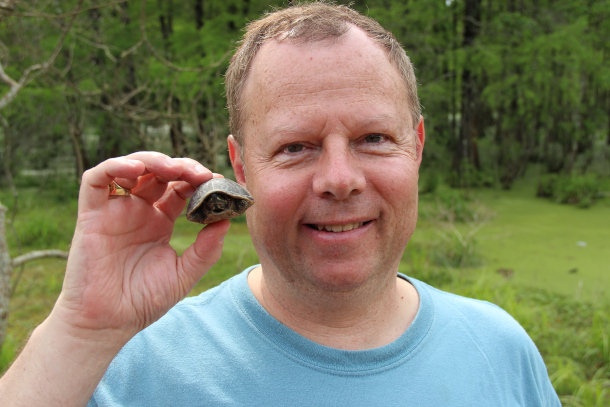
Don Lyman is a freelance journalist and adjunct professor of biology at Merrimack College. Pictured is Don holding a musk turtle at Lake Martin, Louisiana, in April of 2012. (Photo: Matthew Lyman, Courtesy of Don Lyman)
O'NEILL: And now we're talking about a bullfrog here, but how common is this in other frogs, toads, amphibians, generally speaking?
LYMAN: I think it's common with a lot of species of aquatic frogs, that spend a lot of time in the water, leopard frogs, green frogs, bull frogs. Some other frogs that only spend part of the time in the water, like wood frogs and gray tree frogs and spring peepers, they can actually go down underneath the leaf litter in the forest, but they can actually freeze solid.
O'NEILL: Wow.
LYMAN: And their heart will stop beating, they'll freeze solid. And their livers produce a large amount of glucose, and the glucose goes into the cells and prevents the cells from freezing. But the fluids between cells and between organs will freeze. You know, for all intents and purposes, it's almost like they're dead, and then in the spring, they'll thaw out and come back to life.
O'NEILL: Well of course, when people hear the term "hibernation," you know, I think a lot of us might think, oh, you know, it's almost like a bear just drops into a coma for the rest of the winter, or something like that. But it's, it seems to be a lot more nuanced than that, and especially with these frogs, as you mentioned.
LYMAN: Right. Their metabolism does decrease quite a bit. It drops to about 25% of normal and it allows them to survive on stored energy and a minimal, you know, amount of oxygen.
O'NEILL: You've made me want to start looking around at all these other bodies of water in my area. Keep an eye out. See if I can spot anything under the surface.
LYMAN: Yeah, yeah, that would be cool.
O'NEILL: Don Lyman is a freelance science journalist who brought us the essay, "The Frozen Creek," as well as an adjunct professor of biology at Merrimack College. Don, thank you for taking the time with us today.
LYMAN: You're quite welcome.
Links
Living on Earth wants to hear from you!
Living on Earth
62 Calef Highway, Suite 212
Lee, NH 03861
Telephone: 617-287-4121
E-mail: comments@loe.org
Newsletter [Click here]
Donate to Living on Earth!
Living on Earth is an independent media program and relies entirely on contributions from listeners and institutions supporting public service. Please donate now to preserve an independent environmental voice.
NewsletterLiving on Earth offers a weekly delivery of the show's rundown to your mailbox. Sign up for our newsletter today!
 Sailors For The Sea: Be the change you want to sea.
 The Grantham Foundation for the Protection of the Environment: Committed to protecting and improving the health of the global environment.
 Contribute to Living on Earth and receive, as our gift to you, an archival print of one of Mark Seth Lender's extraordinary wildlife photographs. Follow the link to see Mark's current collection of photographs.
 Buy a signed copy of Mark Seth Lender's book Smeagull the Seagull & support Living on Earth
© Copyright World Media Foundation. All Rights Reserved
Home | Contact | RSS | Donate | Newsletter