

PFAS Still at Pittsburgh Airport
Air Date: Week of March 13, 2026
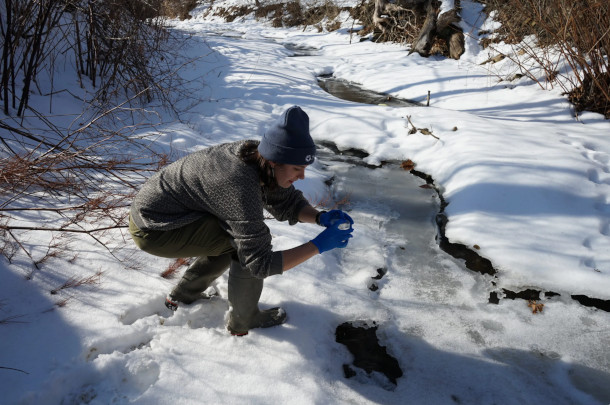
Three Rivers Waterkeeper’s Koa Reitz tests water from Montour Run for PFAS contamination. Montour Run is a tributary of Fishing Creek, located near the Pittsburgh International Airport. (Photo: Reid Frazier, Courtesy of The Allegheny Front)
Foams containing PFAS or “forever chemicals” are excellent at suppressing fires involving jet fuel and other oil products, but they leave behind a toxic legacy. And they have long been used for firefighting drills, including at a training facility based at Pittsburgh International Airport. Although the facility now uses PFAS-free firefighting foam, the Allegheny Front’s Reid Frazier reports that sampling is still showing high levels of PFAS being discharged into nearby streams.
Transcript
The Allegheny Front covers the environment in Pennsylvania and eastern Ohio. Sign up for their newsletter here.
--
O’NEILL: It’s Living on Earth, I’m Aynsley O’Neill.
CURWOOD: And I’m Steve Curwood.
When it comes to fighting fires, it turns out we’ve made a lot of missteps in recent decades, and one of them is using firefighting foam containing PFAS, or “forever chemicals.” These halogenated compounds can be excellent suppressors of fires involving jet fuel and other oil products, but once the fires are out, they leave behind a long-term toxic legacy.
O’NEILL: The foams containing PFAS were often used for firefighting drills, including at a training facility based at Pittsburgh International Airport. Although the Pittsburgh Airport now uses PFAS-free firefighting foam, the Allegheny Front’s Reid Frazier reports that sampling is still showing high levels of PFAS being discharged into nearby streams.
FRAZIER: Hannah Hohman and Koa Reitz stand on an old bridge looking down at the confluence of two streams. Homan glances back and forth between the iced over streams below and the GPS on her phone.
HOHMAN: I think that's unnamed trib. And then that's Montour, and they meet here.
FRAZIER: Hohman and Reitz are with Three Rivers Waterkeeper, a local environmental group. They're overlooking where Montour Run meets one of its unnamed tributaries. Since 2023 the group has been sampling the streams around Pittsburgh International Airport. They're looking for PFAs, a class of fluorinated compounds also known as forever chemicals, but Reitz says they haven't sampled here yet.
REITZ: And this is the tributary that the outfalls that we've seen them self-reporting really high levels of PFAs. This is the tributary that they are discharging into.
FRAZIER: After getting consistently high numbers in these streams, Hohman and Reitz decided to look at new, publicly available data. Since last year, the airport's been sampling its stormwater outfalls for PFAs and reporting it to the Pennsylvania Department of Environmental Protection. The highest levels recorded were nearly 63,000 parts per trillion for one type of PFAs. That's 15,000 times what the EPA considers safe in drinking water. Hohman said she was shocked.
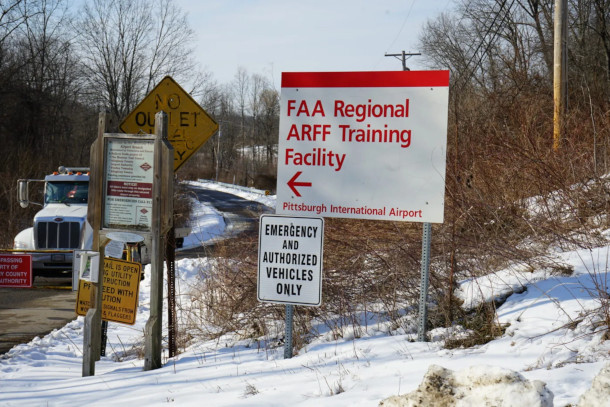
PFAS, also known as ‘forever chemicals’ due to their long-lasting polluting effects, were used for years in firefighting foam. Pittsburgh International Airport’s Aircraft Rescue and Fire Fighting (ARFF) training facility has stopped using firefighting foam with these compounds, but the contamination persists. (Photo: Reid Frazier, Courtesy of The Allegheny Front)
HOHMAN: It was alarming when we did pull that number, because I initially, I think all of us were like, this has to be a mistake. Like ...
REITZ: We thought it was a typo.
HOHMAN: Yeah, we were like, this has to be a typo. This, you know, that's a number that is pretty hard to fathom.
FRAZIER: Reitz dips a clear plastic cup into the stream, then closes a lid on top. The water drips through a filter, which will be tested for a few dozen PFAs chemicals.
REITZ: They are kind of the most common PFAs that we see. There are thousands of them, but we're testing for 55.
FRAZIER: The PFAs numbers submitted by the airport were highest near its firefighting training facility. For decades, these facilities used firefighting foam with high levels of PFAs in them. Kimberly Garrett is an environmental toxicologist at the City University of New York.
GARETT: For a long time, it was mandated that those fluorinated foams be used, not only in emergency response, but also in drills and so really spraying that concentrated PFAs.
FRAZIER: This was done for good reason. PFAs chemicals are really good at dousing oil fires, like those involving jet fuel. But there were two things about these chemicals that would present a problem. First, they last a very long time. That's because they're centered on the uniquely strong chemical bond between carbon and fluorine.
GARETT: They are the strongest, one of the strongest bonds we can observe in chemistry. Carbon and fluorine, they it's really a remarkable bond. And so they can persist for centuries.
FRAZIER: So when PFAs get inside the body, they don't break down and lead to a second big problem. Some pretty serious health effects.
MCDONOUGH: They're associated with kidney cancer, testicular cancer, immunosuppression, several other kinds of effects.
FRAZIER: Carrie McDonough is an associate professor of chemistry at Carnegie Mellon University. McDonough says the science around health impacts of PFAs weren't well known until recently.
MCDONOUGH: And, because for a long time, the risks associated with PFAs were not really well understood, these foams were basically treated like soap.

Studies show that PFAS compounds, like those found in Montour Run, can increase the risk of certain cancers, developmental conditions, or fertility complications in human beings. (Photo: Reid Frazier, Courtesy of The Allegheny Front)
FRAZIER: And because of this, many airports and military bases around the country now have PFAs contaminated soil and water. The EPA has since labeled two of the main PFAs chemicals as likely carcinogens. And in the past decade, states and federal agencies have begun the process of regulating PFAs in the environment. Pennsylvania established its own drinking water standard for two of the chemicals in 2023 and the EPA is on pace to set even tighter standards by 2031. Pittsburgh International Airport, in a statement, said it had stopped using firefighting foam with PFAs, but did not answer questions about what it would do to prevent future releases of the chemicals from its site. But PFAs is still present in nearby streams like Montour Run. After taking a few samples, Hohman is startled by a visitor flying over the stream.
HOHMAN: Oh, heron! Dang it.
FRAZIER: It's a great blue heron, a water bird with an outsized wingspan and recognizable long bill. That brings up another big concern for Reitz. What happens to PFAs once it's in the stream?
REITZ: PFAs is one of those things that bio accumulates majorly, and so that's one of the things we're most concerned about when we see people fishing. And we're, you know, I think pushing for some sort of regulation or fish consumption advisory in this area.
FRAZIER: The Pennsylvania Fish and Boat Commission stocks Montour Run with trout. In an email, a Commission spokesman said the cold water trout don't last long in the warm water stream much past the spring, so PFAs chemicals are unlikely to bio accumulate in the fish. The Commission samples fish tissues periodically in PFAs hot spots to determine how toxic they are. Only one stream in the state, Neshaminy Creek, in eastern Pennsylvania has a "Do Not Eat" advisory because of PFAs. For Hohman, PFAs in Montour Run looks like a long-term problem.
HOHMAN: If it's going into the Ohio River, that's source drinking water for millions of people. If people are recreating in the creek and they're eating fish from that creek, like there's so many points where impacts can be felt by the community and the environment.
FRAZIER: At press time, the Pennsylvania DEP didn't respond to questions about what it would do about PFAs levels around Pittsburgh International. Three Rivers Waterkeeper says it will keep sampling in the streams throughout the spring.
O’NEILL: Reid Frazier reported that story for the Allegheny Front.
Links
Living on Earth wants to hear from you!
Living on Earth
62 Calef Highway, Suite 212
Lee, NH 03861
Telephone: 617-287-4121
E-mail: comments@loe.org
Newsletter [Click here]
Donate to Living on Earth!
Living on Earth is an independent media program and relies entirely on contributions from listeners and institutions supporting public service. Please donate now to preserve an independent environmental voice.
NewsletterLiving on Earth offers a weekly delivery of the show's rundown to your mailbox. Sign up for our newsletter today!
 Sailors For The Sea: Be the change you want to sea.
 The Grantham Foundation for the Protection of the Environment: Committed to protecting and improving the health of the global environment.
 Contribute to Living on Earth and receive, as our gift to you, an archival print of one of Mark Seth Lender's extraordinary wildlife photographs. Follow the link to see Mark's current collection of photographs.
 Buy a signed copy of Mark Seth Lender's book Smeagull the Seagull & support Living on Earth
© Copyright World Media Foundation. All Rights Reserved
Home | Contact | RSS | Donate | Newsletter