
Wind Power Headwinds
Air Date: Week of February 13, 2026
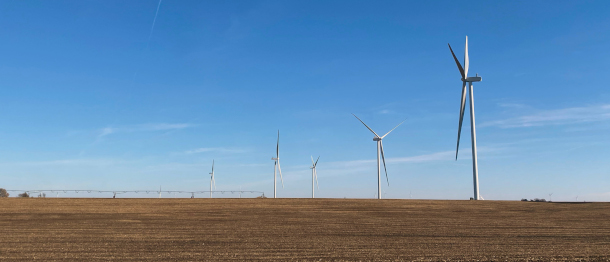
Wind turbines at the Shenandoah Hills wind farm. The project faced a lot of local opposition before going online. (Photo: Anika Jane Beamer, Inside Climate News)
Onshore wind in the US is hitting a cliff, even in the most wind-powered state, Iowa, which generates about 2/3 of its electricity from wind. Dan Gearino, clean energy reporter for Inside Climate News talks with Host Jenni Doering about how a combination of local opposition, anti-wind rhetoric and tax credit phaseouts has led to a steep decline in new wind projects.
Transcript
DOERING: As the Trump administration moves to scuttle clean energy, one target is wind. Offshore wind projects have faced shutdowns and onshore wind in the US is also struggling, even in the most wind-powered state, Iowa. As of 2024, Iowa’s grid was about 63% powered by wind, and the state generates more wind power than any other in the U.S. except for Texas, whose sheer size gives it the edge. Windfarms are common in Iowa, thanks in part to how compatible they are with another economic powerhouse in the state, corn and soy farming. But in recent years, a combination of local opposition, anti-wind rhetoric and tax credit phaseouts has led to a steep decline in new ventures. For more, we turn now to Dan Gearino, a clean energy reporter for our media partner Inside Climate News. Dan, welcome back to Living on Earth!
GEARINO: Yeah, good to be here.
DOERING: So the focus of your recent article is Iowa, which generates a huge amount of wind energy, and one project in particular called Shenandoah Hills. Why did you decide to focus on this wind farm?
GEARINO: So there were a total of three projects that were nearing the end of construction this year in Iowa, and it was striking just how little activity there was compared to just a few years ago. If I had gone there four or five years ago, you would have seen a dozen projects that were under construction. So basically, we wanted to find why is it so hard to do these projects? And the way we did that is showing one that barely overcomes all the hurdles. It's hard to develop a wind project, it's also hard to develop a solar project, but it seems especially hard to develop a wind project. So we wanted to see how the development kind of got started, which would have been, you know, about 10 years ago now, and how several years into this process, a whole bunch of opposition started to coalesce, and that very nearly stopped the project.
DOERING: Dan, what did local leaders initially see in the Shenandoah Hills wind farm? What benefits are coming to the area from this project?
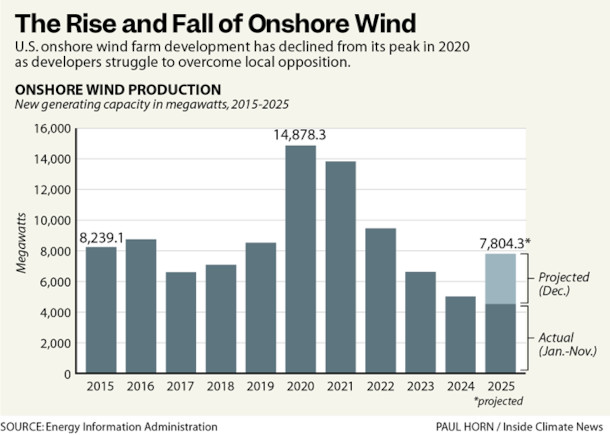
This graph, using data from the Energy Information Administration, shows the last decade of wind farm development in terms of generating capacity. After reaching a peak in 2020, the decline since then has been significant. (Graphic: Paul Horn, Inside Climate News)
GEARINO: So this is a lot of money for schools. It's a lot of money for the county government. Also, a whole bunch of money is going to landowners. This is an opportunity to just retire, or if you're already retired, have a much more comfortable retirement. So the host properties, the landowners where these turbines are built, are doing really well. And if they live in the community, that spending benefit happens in the community, and some of those people do live in the community, so if you're a farmer, then you have more money to buy a tractor, et cetera, et cetera. But I think the main thing in terms of what locals will see is how this creates a lot less pressure to raise taxes, because you're getting this gigantic source of taxes. These are small, in terms of population, there aren't a lot of people in these places. And if you have a project that's hundreds of millions of dollars, it's a lot. And the idea of a project giving a million dollars plus per year to the schools, that is transformative for a school district, a school district that is probably struggling with can it keep staff, it's probably struggling with declining enrollment, and it's just a question of how much do the people in the community value those local benefits? If this is a community where the median age is 45 which is true for Page County, a significant chunk of your population don't have kids in schools anymore, so that affects the debate. But for the places that have had a bunch of these projects go in, it has been an incredible amount of investment that has had a positive effect in so much of rural Iowa.
DOERING: So Dan, please walk us through the reactions that you heard from local Iowans when it came to this new Shenandoah Hills wind farm.
GEARINO: An important thing to remember when you're looking at new proposals for an onshore wind farm is that, in a place like Iowa that already has a lot of wind farms, people who live in rural areas have already seen wind farms all over the place. Certain parts of Iowa, like Adair County, you see hundreds of turbines from certain vantage points where it's just like, they're everywhere. Now those kinds of clusters are in the most wind rich area, so it isn't like that's all over the state, but there's this idea that maybe if a project was proposed 10 years ago, people didn't really know what this looked like. Now they very much know what the end result is like. They also know, for example, if you're driving at night near a wind farm, you see all these red lights, you know, to avoid airplane collisions, all blinking in unison, you know. And it's off putting to many of the people who live there. And a related issue, and I think an even larger issue, is that a lot of the people who are seeing these wind turbines, literally in their backyards, are not necessarily getting paid for them. A lot of the property owners in rural America are investment companies, or they're the heirs of a farmer that lived there two generations ago. It's different from maybe even 20, 30, years ago, when you had a lot more family farmers, and farms tend to be smaller. So that means that even a big project like this one, it isn't a huge number of owners, and a lot of the owners don't live there. It isn't like there are, you know, 40 people showing up and saying, "This is great. This is what I want to do on my property. You all know me. I'm a local person." It's a different dynamic, and I think that has a big effect too. This, like, "Wait a minute, this project means that somebody who lives in Chicago is going to get a check mailed to them every month. But I don't get anything, and I live three miles away?" So it is this sense of money is being made, but some of the residents just feel like it's not fair, the way it's being allocated.
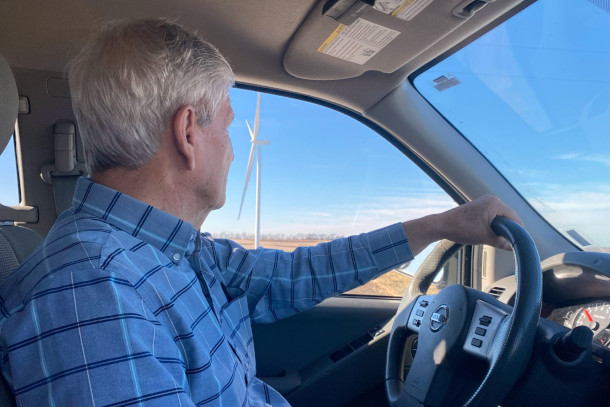
Former Shenandoah Mayor Gregg Connell looks out at the Shenandoah Hills wind farm. Part of the Shenandoah government’s intentions with building the wind farm came from a need to bring jobs and investment to the area. (Photo: Anika Jane Beamer, Inside Climate News)
DOERING: In your article, you mentioned a little bit about the role of anti-wind campaigns, even like on a national level. And websites that publish anti-wind information, some of it not factual at all, and to what extent has that played into some of this local opposition?
GEARINO: One of the things that happens if a community finds out that there's a proposed wind farm, they will go to social media, or they will just Google, and they will quickly fall into this kind of series of messages and photos and memes that are talking about wind energy as incredibly unreliable, incredibly expensive, incredibly dangerous. There was an incident in Iowa where a wind turbine caught fire. And, my goodness, you saw that photo everywhere. That photo was broadcast high and low. Evidence of a wind turbine not working is—it’s a megaphone. The people who are against it have thrown out so many objections, some of which don't necessarily have clear answers. There isn't a ton of body of research about this or that, and that's kind of the point, is to try to stop a project from happening by throwing everything at it, every single possible thing that could go wrong. You know, talking about threats to human health, threats to animal health, effects on farming, effects on, like the drainage systems in fields, effects on, “How is this going to affect my cell signal? My cell signal is really bad. What's going to happen when there are five wind turbines between me and the cell tower?” And all you need to do is get a couple of these local officials to say, “You know what? You've raised enough concerns. Let's research this. Let's do a moratorium, spend some time taking a look at this.” And then, once you pass a moratorium, there's just no development. So in Iowa now, so much of the state has some sort of restrictive ordinance, including many of the most wind rich portions of the state, and I really feel for the local elected officials, like, what are you supposed to do? A lot of these meetings, people don't show up often, and then there's this one issue where your room is full and people are ticked off at you. They're saying you're not answering the questions. They're saying that democracy has failed and they're going to run against you. It's like, this is what's happening, and this is what happened in Shenandoah.
DOERING: And by the way, what do we know about human health and wind?
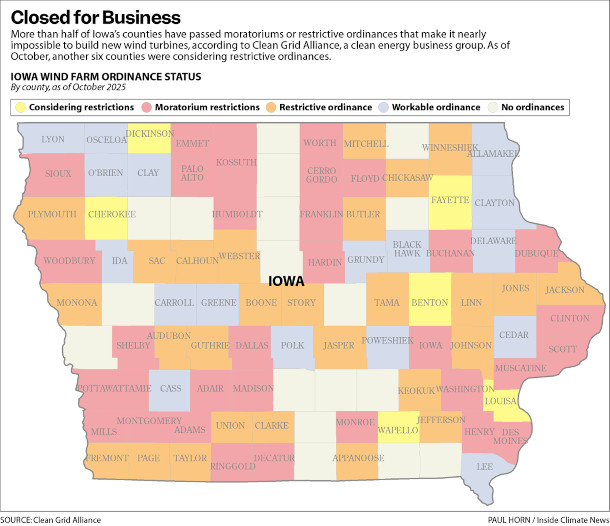
This map, using data from the Clean Grid Alliance, shows the Iowa counties that have restricted the building of new wind turbines as of October 2025. (Graphic: Paul Horn, Inside Climate News)
GEARINO: Well, that is a topic that is incredibly fraught, and it's one of these things where, when you look at peer reviewed research, you have a hard time saying, here is hard evidence that if you live near a wind turbine, these health effects happen. But we also know that if somebody lives near a wind turbine and there's like shadow flicker from a wind turbine blade, or the red light at night is blinking in their home, and some of the changes in air pressure around, having a wind turbine say, you know, a mile away, or something like that. It's not that these things have zero effect, and I don't think anyone would say they have zero effect. And if somebody is feeling stressed because they don't like this thing that is right outside their window that leads to real, measurable health effects, you could also have somebody who lives in the exact same spot and feels fine because they just they don't mind having that thing there. I suspect whether or not you're getting paid has a lot to do with the extent to which you're willing to adjust. But yeah, it's very difficult to say anything conclusively about health concerns related to wind, and I feel like the kind of blanket dismissal of all health concerns is not helpful. But at the same time, the way that opponents talk about health concerns is if they're proven and sure is also unfounded. So yeah, it's a very messy area.
DOERING: So Dan, you report on all sorts of clean energy for Inside Climate News. What would you say is wind energy's biggest draw?
GEARINO: In some of these windy areas in western Iowa, where it's extremely windy, wind power is strong at night. And if you want to get to a point where the grid is almost all renewable energy, or almost all carbon-free energy, where you have some sort of mix of, say, nuclear, wind, solar, one way you get that is a combination of solar and wind. Solar is super inexpensive on a per unit basis, but it's only available during the day, so you need to have some sort of energy storage to save that for off hours. Wind is something that could conceivably be going strong at three in the morning, and it's not like it's going the same all the time. There are ups and downs with wind, but there's weather forecasting that's pretty good, so that grid operators have a good sense of what to expect. And wind is generally going to be strong at times when solar is weak. So you have this ability through the combination of the two. If you go to almost no new onshore wind development, it just creates this big hole that you have to fill with something else, and what that something else is, at least in the near term, is going to be more expensive, and it's something that we don't necessarily have as much of a core competence with developing. So presents some real challenges.
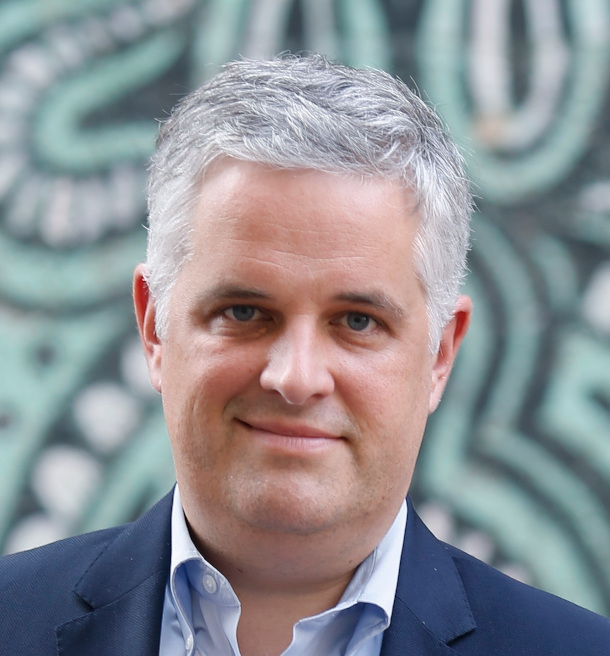
Dan Gearino is a clean energy reporter who writes for Inside Climate News, covering renewable energy and utilities. (Photo: Dan Gearino)
DOERING: What are we seeing overall, in terms of the trajectory of onshore wind?
GEARINO: If we look across the country, there were a pretty substantial number of projects that went online last year, and this current year will be pretty good in terms of the total number of projects. And by that, I mean it's not just dropping off a cliff. You're seeing some healthy development activity, but a lot of that has to do with what was happening 5, 10, years ago, when some of this development activity was starting. And it has to do with kind of the ebb and flow of tax credits. The concern is that once you get through the projects that are currently in the pipeline, that are currently in construction, or currently nearing the start of construction, there's almost nothing. There are very few projects. And also, when you look ahead, the projects that are getting built, we're seeing a few big projects, these gigantic projects that are hundreds upon hundreds of megawatts of capacity. And this idea of just seeing these smaller projects in more places, you're seeing less of that. So it's like, if you're going to kind of grit your teeth and get through the very contentious process, you want to do it with a project that is just absolutely huge. In 2028, 2029 we're going to see a severe drop off in project, just because the pipeline isn't there of stuff that's earlier in the development cycle, and that is, that's the real concern, because this is a time when electricity demand is going up by a lot. This is the absolute worst time to have the most prolific renewable energy resource in the country kind of just stumbling.
DOERING: Dan Gearino is a reporter with our media partner Inside Climate News, and he covers the business and policy of renewable energy. Dan, thanks so much for taking the time today.
GEARINO: Yeah, thanks for having me.
Links
Living on Earth wants to hear from you!
Living on Earth
62 Calef Highway, Suite 212
Lee, NH 03861
Telephone: 617-287-4121
E-mail: comments@loe.org
Newsletter [Click here]
Donate to Living on Earth!
Living on Earth is an independent media program and relies entirely on contributions from listeners and institutions supporting public service. Please donate now to preserve an independent environmental voice.
NewsletterLiving on Earth offers a weekly delivery of the show's rundown to your mailbox. Sign up for our newsletter today!
 Sailors For The Sea: Be the change you want to sea.
 The Grantham Foundation for the Protection of the Environment: Committed to protecting and improving the health of the global environment.
 Contribute to Living on Earth and receive, as our gift to you, an archival print of one of Mark Seth Lender's extraordinary wildlife photographs. Follow the link to see Mark's current collection of photographs.
 Buy a signed copy of Mark Seth Lender's book Smeagull the Seagull & support Living on Earth
© Copyright World Media Foundation. All Rights Reserved
Home | Contact | RSS | Donate | Newsletter