
The Quest for Env. Justice in Shiloh Alabama
Air Date: Week of February 6, 2026
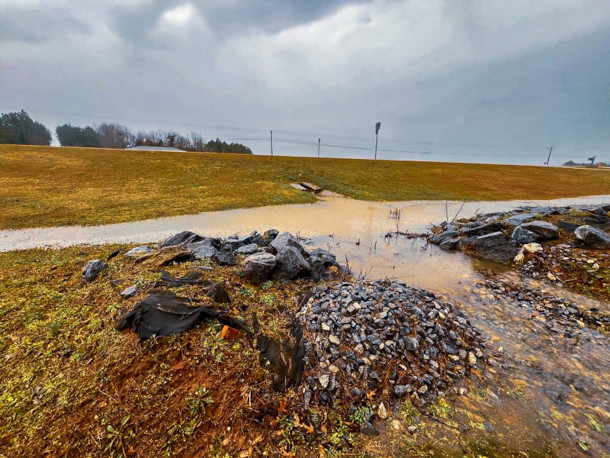
Heavy rainfall in Shiloh, Alabama, is usually followed by flooding as runoff rushes down from the widened and elevated Highway 84. Residents say flooding has eroded their yards, cracked their foundations and caused septic tanks to overflow into their yards. (Photo: Bullard Center for Environmental and Climate Justice)
For black history month we bring you a cautionary tale brought to us by the Center for Climate and Environmental Justice Media or CEJM. CEJM helps people of color learn how to tell their own stories in the face of environmental injustice and the climate emergency. Melissa Williams is a storyteller for CEJM and she shares her community’s efforts and concerns as they seek justice from the State of Alabama after highway construction flooded their homes in Shiloh Alabama.
Transcript
CURWOOD: It’s Living on Earth, I’m Steve Curwood.
BELTRAN: And I’m Paloma Beltran.
For Black History Month we bring you a cautionary tale brought to us by the Center for Climate and Environmental Justice Media or CEJM. CEJM helps people of color learn how to tell their own stories in the face of environmental injustice and the climate emergency. It is a collaboration between Living on Earth and the UMass Boston School for the Environment with support from the Waverley Street Foundation. Nana Mohammed and Andrew Skerrit trained Shiloh, Alabama storyteller Melissa Williams to interview community members about their efforts and concerns as they seek justice from the State of Alabama after highway construction flooded their homes. With the help from the father of environmental justice Dr. Robert Bullard, Shiloh residents looked to the highest levels of government to be made whole.
WILLIAMS: Here in Shiloh, our community has been affected by flood damage due to the expansion of highway 84 by the Alabama Department of Transportation six years ago, and we face choices of what is to be done. My name is Melissa Williams, and I'm talking to people here in Shiloh so we can hear each other, understanding we are not alone with these challenges. Many other communities of color are facing issues of what some call environmental justice.
[SFX highway]
[Music: TAOUDELLA AZALAI, CHOARCOAL LINE]
WILLIAMS M: When I was 16, coming back from the church, one Sunday afternoon, we found our home flooded. Water was running through our living room, bedroom and kitchen.
[SFX highway]
WILLIAMS M: The damage was caused by the rainwater runoff from the widening of highway 84 an expressway that passes through the heart of our community, Shiloh, which is located in our small town of Elba, Alabama. At the time, it was very confusing. Our friends and neighbors were also affected. Yards kept flooding. Septic tanks overflowed. Our house foundation began to show cracks. Water moccasins made it dangerous to go outside after a heavy rain. At 22, I began to reflect on what had happened that day and the troubles that followed in the years afterwards. My name is Melissa Williams, and I'm here today with my father, Timothy Williams, seated in our living room to start a conversation about the struggles of the last six years.
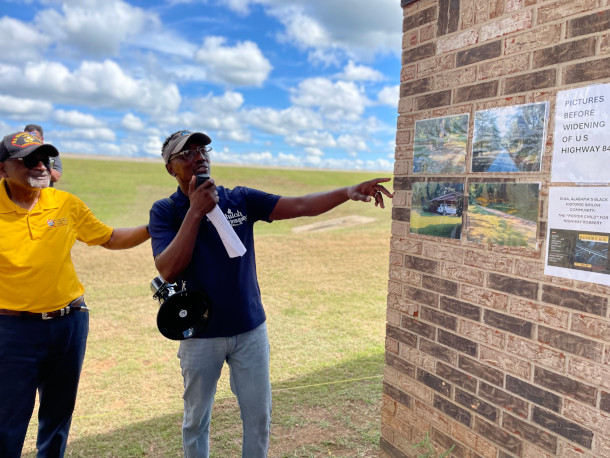
Shiloh resident Rev. Timothy Williams (right) shows pictures of the damage caused by flooding from runoff on Highway 84. Dr. Bob Bullard (left), who grew up in nearby Elba, Alabama, looks on. Bullard, a pioneer in the environmental justice movement, has worked with Shiloh residents in search of justice. (Photo: Andrew J. Skerritt)
[Music]
WILLIAMS M: Shiloh is a historical Black community where land has been passed down from generation to generation. I want to talk about this unique story that has to do with environmental injustice, because I'm sure there are others that are going through the same thing that Shiloh is going through. So me talking about what we're going through, I'm sure this could help someone today, tomorrow, in the future. To better understand the history of this historical community, I'm going to turn it to my father to speak about his upbringing and how he was raised here in Shiloh. Okay, Dad, can you tell me about your upbringing and the history behind Shiloh?
WILLIAMS T: When I was about probably 14 or 15, I would come to the Shiloh community. My grandparents were here. This is where my mom, she was raised, here in the Shiloh. Everybody in the Shiloh community, here is family. Land has been passed down in our family from generation to generation. It has been in our family since Reconstruction. We were all taught to keep the property in, you know, in the family, you know, pass it down from one generation to the next. So I was the third generation, and so you're the fourth generation, where the land will be passed down to you. The Shiloh community is rich in generational wealth. Back in the days, they did a lot of things here, this property was farmland. Back in 1960s homes were beginning to be built. In the 1970s here, the land here was flat. We never had any flooding. We didn't have to deal with forced storm waters onto the community. It was just a normal life. And then years later, in 2004 I was inherited this house, we began to occupy the place. And so it's been 20 years.
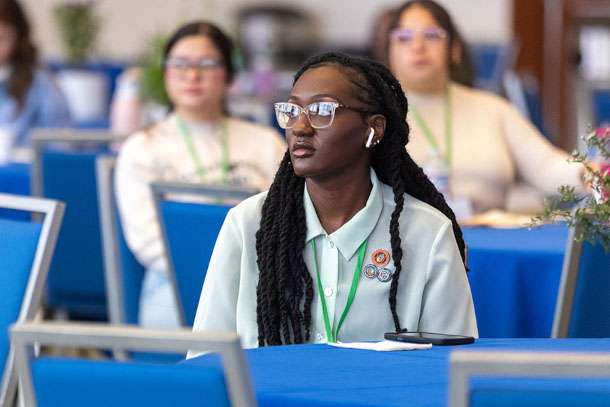
Shiloh Storyteller Melissa Williams listens to speakers during the Center for Climate and Environmental Justice Media (CEJM) Conference at UMass Boston in September 2025. Williams has interviewed about half a dozen of her Shiloh neighbors as part of the Shiloh CEJM project. (Photo: CEJM)
WILLIAMS M: For me, I can share my little memories of me living here, being raised here, about how we would just be able to go outside. Like you said, we didn't have any problems that we're having now, just dealing with the water, frogs, snakes, all that stuff. We didn't have to experience any of those things. We will be able to go outside, ride bicycles, play in the mud, make like, you know, little dirt pies, all of that stuff.
[SFX kids playing]
WILLIAMS M: Yeah, we just lived normal lives. I mean, what little kids would do outside.
Could you tell me about how this affected you, with the Highway coming through here?
WILLIAMS T: Going from a normal situation to now, where it's horrific, where they have forced the waters on to us. It was devastating. I mean, it changed a lot of things for us. We started experiencing so much things like home sinking and flooding in the yards and where we couldn't even get in, or we couldn't even get out. We kept complaining about it to the state and everything. And this thing has became horrific because they didn't want to do anything. And so here it is. Here comes the mud, even during Reconstruction, can't even leave out to drive.
WILLIAMS M: I know I can remember coming from church on Sundays, and this is when it first started flooding. Sunday afternoon at the church, came home, it had rained, and literally, the car porch was filled with water. The basement was filled with water. We had to go take towels to try to soak up all the water.
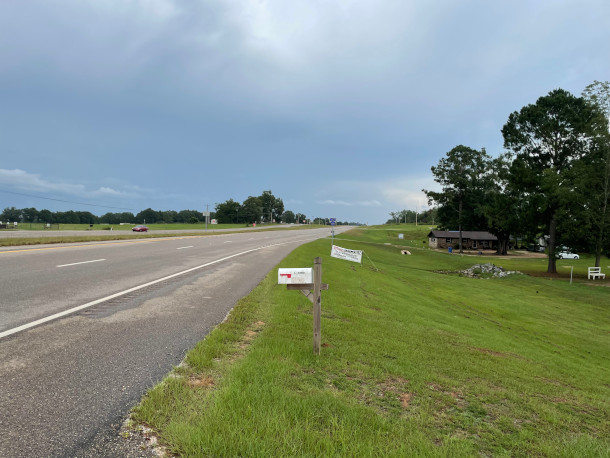
The Shiloh neighborhood sits along the east bound lane of Highway 84. Since the roadway was widened from two lanes to four and raised, residents say they feel as if they live in a bowl that fills up with rainwater runoff following heavy downpours. (Photo: Andrew J. Skerritt)
[SFX water sloshing]
WILLIAMS M: I mean, that didn't really too much help, but we did everything that we could to get the water. And it just kept happening over and over again every time that it would rain. It was crazy. After the first flooding situation, and after we had to, you know, get, use the towels to clean the water, what did you do for us to take action?
WILLIAMS T: I contacted the state of Alabama, told them what was going on, but then they turned a deaf ear to us. Didn't want to hear it. And so after that, you know, we had some, you know, backlash again. And then—
WILLIAMS M: What do you mean by backlash?
WILLIAMS T: The backlash came from the state of Alabama, you know, because now here is we got an attorney involved. We're trying to alleviate the situation, because they never listen to us. Every time we complain, even in notes, we kept complaining and talking about how they forced the water, even during construction, they flooded us out, and they kept on, the water kept coming, and it was like though they weren't hearing us.
WILLIAMS M: How would you describe the frustration when you would ask for help, and these people, they wouldn't help you, especially with the lawyer, thinking that you're going to get help with your lawyer, and there's no help.
[MUSIC: TAOUDELLA, AZALAI, BLUEDOTSESSIONS]
WILLIAM T: It was sad, because here it is. You thinking, people will have your best interest. Because first lawyer I talked with, he says, we cannot help you, because there's a conflict of interest, because they represent the state of Alabama, we were misled. It was bigger than us, and they want our property, and they want us out of here, and they don't want us to talk. So it was a frustrating situation.
[MUSIC: TAOUDELLA, AZALAI, BLUEDOTSESSIONS]
WILLIAMS M: Well, how did your life or your perspective changed when you were able to get in contact with Dr. Bullard?
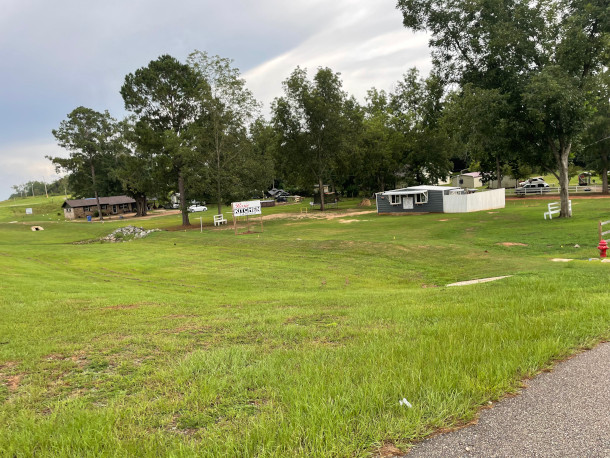
The section of Shiloh, Alabama affected by flooding from Highway 84. Most of the local residents can trace their family’s connection to the area to the Reconstruction era and have vowed to remain, despite flooding problems caused by the elevation of four-lane highway. (Photo: Andrew J. Skerritt)
WILLIAMS T: It changed dramatically, because it was five years and four months we were dealing with this situation. And so here it is, when FHWA came, they saw the situation, but then they told people, Hey, y'all got to stay quiet. You can't get other folks involved. You can't go back on the media. I was told Dr. Bullard the father of environmental justice. And I asked a question to a lot of people that was telling us, you need to get in touch with your cousin. You need to call Dr. Bullard. That man is all over the world. He's a father of environmental justice. How is that gonna be? I'll never forget one day I left from the restaurant. It was on my birthday, on June the first, and I'll never forget this. On my way back from up Alabama, the Lord spoke to me and said, go by Dr. Bullard's brother's house. And so I obey God. And I went by there, and I knocked on the door. Then here come Leon, his brother. He said, What you doing here? You supposed to be at that restaurant, right? I said, Yeah. I said, but I had to stop by here. I got to get in touch with Dr. Bullard. And I said, let's call your brother. Do all of that. He didn't pick up the phone. I said, I tell you what. Let's text this video to him and let him see this video. Between one and two o'clock that afternoon, we get some phone call from Dr Bullard, and the first thing he says is, this is horrific. And he says, I tell you what, so I need you to gather the people together. And it was less than 24 hours. We're in a zoom call with Dr. Bullard, and he assured us. He said, if I cannot fight for my community and for my city and for my family, I don't need the name father of environmental justice, he said because I'm fighting everywhere else and I can't come back home? He says, I want to assure y'all that I'm gonna be with you and I'm gonna help you, and we're gonna get victory on this situation. And that's when he came and it changed the whole dynamic of everything.
[MUSIC: STUFFLED MONSTER, BLUEDOT]
WILLIAMS M: I can remember when Dr. Bullard told us that we're going to Washington, DC, and he said that we're going to go to US DLT to share our stories about this situation that's going on in Shiloh. What was your experience when you were in the room?
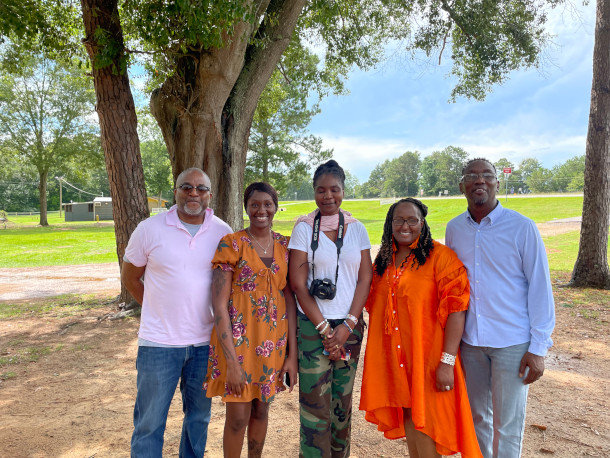
The CEJM Shiloh team wraps up a weekend of interviews in summer 2024. From left to right: Andrew Skerritt (CEJM storyteller), Melissa Williams, Nana Mohammed (CEJM field producer), and Melissa’s parents, Monica and Timothy Williams. (Photo: Andrew J. Skerritt)
WILLIAMS T: Never been to DC, sitting at tables that we never would have known of. And the first thing was like people saying, we don't want no false hope and everything.
[music]
WILLIAMS T: 2018 I was fired from my job at the school, and then didn't have no work. And so that's when Destiny came about, and that first year is when the construction ended, even though we were fighting that I took my kids and I began to put them into, allowed them to work with the cleaning business, to alleviate a lot of the frustration, a lot of the things that we were going because if we dwelled on what we were going through, people would lose their mind, go crazy, the kids would be so frustrated they couldn't even function.
WILLIAMS M: I can say that before Dr Bullard had came into helping us, it was a very frustrating situation to see that we couldn't get through no doors, false hope. It was just a lot of, dang what can I help do? Can I do this, like…
WILLIAMS T: I kept grinding, I kept moving, I kept contacting people. Doors kept being closed. It became frustrating, but we didn't give up.
WILLIAMS M: [pauses] Sorry, my emotion.
WILLIAMS T: Melissa, what made you so emotional now, you know, talking about the five and a half years?
WILLIAMS M: I feel like it's just the fact that at the time when this was going on I was 16. So in your head, as a 16-year-old, you're like, what, the financial problems and all of that? You're trying to figure out, what can I do to help at the age of 16? So it's triggering for me, and it's—emotional. It's something not really too much like talking about. It's just the fact that there's a lot that's going on, and you're 16, so at the age of 16, you don't, you don't, your average 16-year-old is not thinking about ways to help their parents, like…
WILLIAMS T: When I got the call from Secretary Pete Buttigieg, it was a week before, they were on the plane headed to Maryland, and then Secretary Pete Buttigieg and Christopher Cole, Assistant Secretary, called and said, Pastor, we want to let you know that I would be in Shiloh next Wednesday.
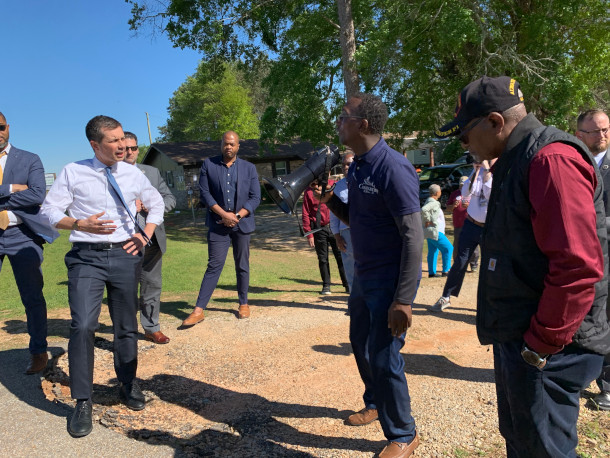
In 2024, U.S. Secretary of Transportation Pete Buttigieg visited Shiloh along with Highway Administration officials to see the Shiloh damage for himself. As a result of the visit, the Alabama Department of Transportation and federal officials reached an agreement to address the drainage issues. ALDOT announced that the work will be completed this year. (Photo: Andrew J. Skerritt)
WILLIAMS M: I can remember my dad coming to the restaurant telling us that Pete Buttigieg had just called him. He just got off the phone with Pete Buttigieg, and he was saying that he was going to come here to Shiloh and walk the grounds with us to listen to what other residents have to say about their homes, their experience. It was an amazing feeling. It made you feel like, okay, they were listening. They heard everything that we were saying. They actually do care, because we received false hope previous, before. So it was a, it was a good feeling. What it was like for you getting the call from Pete Buttigieg to him telling you that he was coming here to Shiloh?
WILLIAMS T: It was a prayer answered, because now you see that that trip DC, it wasn't in vain. It triggered some things in there. I could remember everybody around the table when we was telling our story. They were crying and even talking with Secretary Pete Buttigieg, he even assured me. He says, I'm not going off what people are saying. You know, I want to come and hear this for myself and see it for myself. People think this is fabricated.
BUTTIGIEG: I don't claim to have a magic wand on me, but I got a lot of tools because, as both Reverend and Dr. Bullard said, one thing I'm sure of is that nobody in this community is responsible for what you all are going through, and nobody should have to live with what you all are going through right now.
[music]
WILLIAMS T: You know, going to DC was not in vain. Somebody heard us, you know I'm saying, and that means a lot. It changed the whole dynamic.
WILLIAMS M: Where would you say you find strength?
WILLIAM T: This is nothing to do with Williams, you know I'm saying, that's where I find the strength. Because after losing everything you know, sorry, man, you know you got to have strength of the Lord, because everything has been taken. You know, my business, my cleaning business, boycott at my restaurant, is nobody but God. Injustice anywhere is a threat to justice everywhere. And that's the key, and so you got to have a servant mentality if you're going to do what we're doing in the Shiloh community.
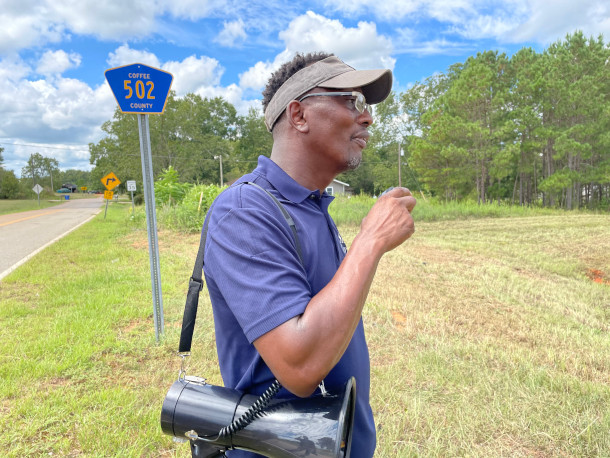
The Rev. Timothy Williams, a leader in the Shiloh community, conducts a media tour in 2024 to show the damage caused by flooding from Highway 84. Williams said his activism has hurt his family financially with lost contracts and a boycott of the family’s restaurant. (Photo: Andrew J. Skerritt)
WILLIAMS M: What is something that other communities that are going through environmental injustice learn from this situation in Shiloh?
WILLIAMS T: And a lot of people are afraid of what what backlash they're going to get, and what's going to happen to them if they speak up. If it's wrong, speak up and speak out. A lot of communities can learn from us. From the Shiloh community is because we're a community that refused to shut up. We're community that refused to sit back and just let them take our property, because that's what they want. They want your property. They want to destroy your livelihood.
WILLIAMS M: I just want to say thank you to my dad for being a role model in my life.
WILLIAMS T: Well, thank you too, Melissa, you know, thank you all for hanging in there, even when you lost. You still fighting, and that's what it's about. And I believe that means more you know, you.
BELTRAN: The Biden administration did not deliver the promises made to the Shiloh community before the Trump White House took over. On January 8 the Alabama Department of Transportation presented plans to improve drainage along highway 84 in the Shiloh Community, but with no mention of compensation for the damages residents have suffered.
Links
Learn more about the Center for Climate and Environmental Justice Media (CEJM)
Living on Earth wants to hear from you!
Living on Earth
62 Calef Highway, Suite 212
Lee, NH 03861
Telephone: 617-287-4121
E-mail: comments@loe.org
Newsletter [Click here]
Donate to Living on Earth!
Living on Earth is an independent media program and relies entirely on contributions from listeners and institutions supporting public service. Please donate now to preserve an independent environmental voice.
NewsletterLiving on Earth offers a weekly delivery of the show's rundown to your mailbox. Sign up for our newsletter today!
 Sailors For The Sea: Be the change you want to sea.
 The Grantham Foundation for the Protection of the Environment: Committed to protecting and improving the health of the global environment.
 Contribute to Living on Earth and receive, as our gift to you, an archival print of one of Mark Seth Lender's extraordinary wildlife photographs. Follow the link to see Mark's current collection of photographs.
 Buy a signed copy of Mark Seth Lender's book Smeagull the Seagull & support Living on Earth
© Copyright World Media Foundation. All Rights Reserved
Home | Contact | RSS | Donate | Newsletter