

The Law and Environmental Justice
Air Date: Week of February 6, 2026
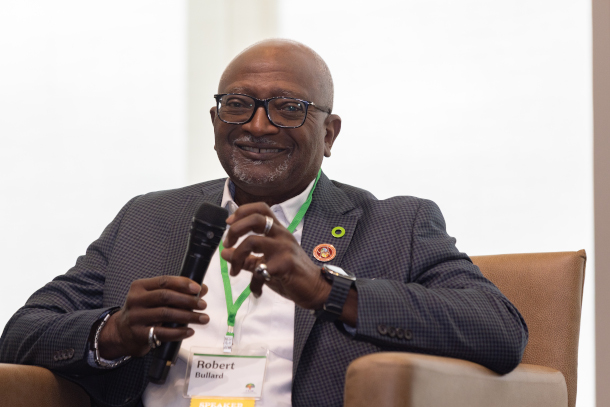
Dr. Robert Bullard, a pioneer in the movement for environmental justice, speaks at the Center for Climate and Environmental Justice Media (CEJM) Conference at UMass Boston in September 2025. Dr. Bullard is founder of the Bullard Center for Environmental and Climate Justice at Texas Southern University in Houston, and author of Dumping In Dixie, (1982) the first of more than sixteen books he has published about environmental racism. His most recent is The Wrong Complexion for Protection (2018). (Photo: CEJM)
The National Academy of Sciences has found black people are exposed to 66 percent more pollution than they produce, while white people are exposed to 17 percent less pollution than they create. In honor of Black History Month Special we highlight some of the voices that stood up against environmental injustice including Civil rights activist the Rev. Dr. Ben Chavis, and Dr. Robert Bullard who’s been deemed the “Father of Environmental Justice,” And in a conversation with Living on Earth’s Paloma Beltran we also look back and look forward at prospects for breaking the chains of environmental racism with long time environmental lawyer and activist Monique Harden. a trail blazer in addressing problems of people and pollution in Louisiana’s “Cancer Alley”.
Transcript
CURWOOD: From PRX and the Jennifer and Ted Stanley Studios at the University of Massachusetts Boston, this is Living on Earth. I’m Steve Curwood.
BELTRAN: And I’m Paloma Beltran.
Today our program is a special for Black History month, and the theme is environmental justice. Just to be clear, you don’t have to be African American to suffer from environmental injustice.
CURWOOD: In fact the majority of the 300,000 or more Americans who die every year from burning gas, oil and coal are white, and few argue it is fair for anyone to die from pollution. But the National Academy of Sciences has found Black people are exposed to 66 percent more pollution than they produce, while white people are exposed to 17 percent less pollution than they create. Here's sociologist Dr. Robert Bullard, one of the architects of the environmental justice movement.
BULLARD: America is segregated and so is pollution. There’s no reason why the asthma death rate for Black children is eight times that of white children. And a lot of it has to do with what’s in those neighborhoods, and the extent to which people have access to healthcare, and in terms of polluting facilities and all of that coming together. When we talk about environmental justice and the birth of our movement, it’s always been about health. Physical health but also mental health.
BELTRAN: For generations, African American and other communities of color have been exposed to higher levels of pollution from landfills, chemical plants, and highways. Back in 1979 Robert Bullard started to document this history of contamination and the placement of especially dirty dumps and industry closer to brown people and further from white people as facts for lawsuits. And in 1982 Civil rights activist the Rev. Dr. Ben Chavis led the fight against the dumping of PCBs near the Black neighborhoods in Warren County, North Carolina.
CURWOOD: By the way, PCBs are in the same family of chemicals as dioxins, which can be persistent and highly toxic, causing cancer and other diseases. Rev. Chavis is credited with first coining the term “environmental racism” during those North Carolina protests.
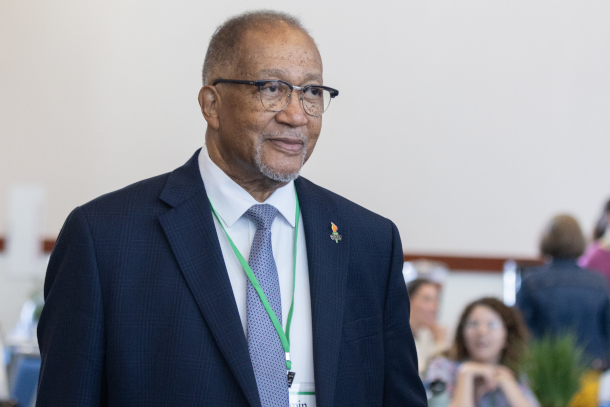
Rev. Dr. Benjamin Chavis, who served as North Carolina’s statewide youth director for Rev. Dr. Martin Luther King, Jr. and the Southern Christian Leadership Conference is a journalist, author, civil rights activist and president and CEO of the National Newspaper Publishers Association. He spoke at the Center for Climate and Environmental Justice Media (CEJM) Conference at UMass Boston in September 2025.(Photo: CEJM)
CHAVIS: I've seen communities organize, resist and rise up from the Amazon to the Arctic, from the Pacific Islands to the inner cities of America, people are declaring with one voice, environmental justice is not only a civil right, environmental justice is a human right. So we are called to action for the next generation.
BELTRAN: For years research has documented the disproportionate impact on people of color of environmental risks such as toxic exposure, the urban heat island effect and other dangers from the climate emergency. In 2021 protests and social concerns finally spurred action by the Biden Administration and Congress to allocate billions of dollars to remediate the short-changing of environmental protections in under-served communities.
CURWOOD: But that ended under the Trump administration. Likening the Biden-era environmental justice policies to reverse discrimination, the Environmental Protection Agency has now cut grants and rolled back regulations designed to improve environmental quality in both white and Black communities.
BELTRAN: And among the hardest hit are African American enclaves, like those along the highly industrialized Cancer Alley in Louisiana. As part of Living on Earth’s Black History Month Special we are looking back and looking forward at prospects for breaking the chains of environmental racism. Joining us from New Orleans is environmental justice lawyer and advocate Monique Harden. Monique, Welcome back to Living on Earth!
HARDEN: Thanks. It's great being here again.
BELTRAN: The environment, environmental justice is facing a tough time right now across the United States. How can people in the US hold polluters accountable at a time when the federal government is dismantling Environmental Enforcement regulations?
HARDEN: Sure. So I think one of the things people should first take a breath that you can have some really positive outcomes in terms of community health, in terms of environmental justice, with this current administration that is really ripping some of the guardrails that were expected for environmental consideration. One area to then bring focus to is what can be done at those local, county, and, perhaps, state levels of government. You can have a state issue a pollution standard that's more stringent, more protective than a federal standard. You can have a land use decision from a parish government to deny turning a residential or an agricultural zone into one for heavy industrial development, you know, polluting facilities. And so, bringing the fight to areas of government where there might be opportunities to achieve environmentally just results is an important thing to do because each victory that can be achieved can be looked at when the opportunity comes again for new federal standard setting.
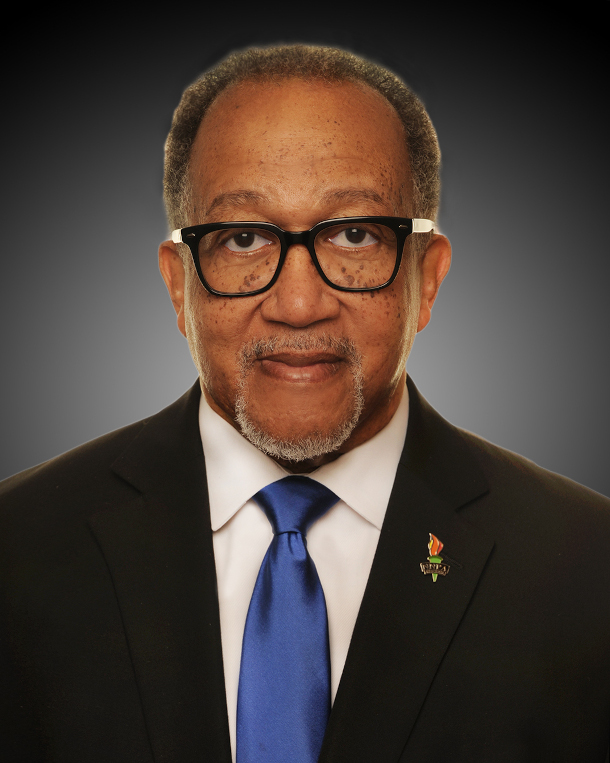
The Rev. Dr. Benjamin Chavis is credited with coining the phrase “environmental racism” during protests over PCB dumping in Black communities in Warren County, North Carolina in 1982. (Photo: CEJM)
BELTRAN: Now President Trump has called environmental justice “reverse discrimination.” What's your take on that issue?
HARDEN: This is an administration that wants to promote racism. People around the country have and are rejecting that, whether it's environmental justice or other issues, the way in which people are organizing and making a difference with their local leaders together.
BELTRAN: And you're an attorney, and a lot of your career has focused on environmental justice. How did you get involved in this work?
HARDEN: I always saw communities as a place for enjoyment of where, you know, people coming together, sharing experiences, stories, looking out for each other, and as I grew into adulthood, I knew that I wanted to be a lawyer. I wanted to work for justice. Having an opportunity as a law student to work in, on environmental issues and seeing the racial disparities that were just blatant, and it was just jarring to see, you know, folks trying to make a way and suffering every day from pollution and having no voice in the decision that placed that toxic smokestack, toxic industrial facility in their midst. It was very easy connection, you know, seeing the thing that I love about communities really being attacked by decisions that allowed this kind of heavy toxic industrial growth and pollution to be present in a way that is life destroying. One of my first cases was in 1996. It was a proposal by a Japanese-owned petrochemical company called Shin-Etsu to build what they were touting to be the world's largest polyvinyl chloride complex, and the name that they gave it was Shintech. And it was planned for the town of Convent, Louisiana, which is in St. James Parish. Folks outside of Louisiana may not know that we don't use the word "county," we use the word "parish." They mean the same thing in terms of a governing seat. And so fighting that proposal was something that I learned the importance of community organizing, the way in which my skill as a lawyer could be applied in a way that strengthened the voice of people to have a decision-making role in what would affect their lives and their futures and generations to come, and being able to use the law in a way that it may not have been designed, which is recognizing the right of Black people to live in a healthy environment.
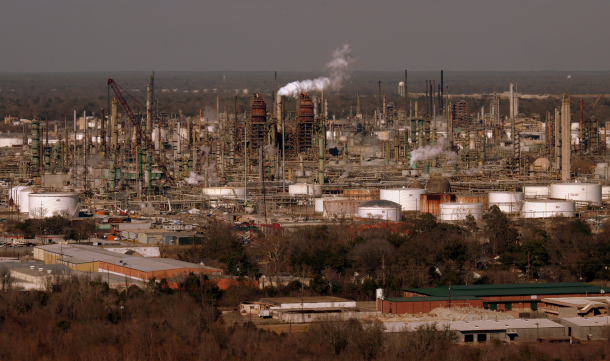
The landscape in the corridor along the Mississippi River known as “Cancer Alley” is dominated by petrochemical and other plants. Many Black residents in fence line communities suffer from various respiratory and other ailments as a result of the pollution being emitted next door. Advocate and attorney Monique Harden says in light of the federal retreat from environmental justice residents have to use local land use regulations in their fight against polluters. (Photo: Jim Bowen, Flickr CC BY 2.0)
BELTRAN: So Monique, you live in Louisiana, not far from what is known as Cancer Alley. What is Cancer Alley, and why is it considered ground zero in the fight for environmental justice in the United States?
HARDEN: So where I live is in the city of New Orleans, which is in Cancer Alley. It's a section of the Mississippi River chemical corridor that begins just north of Baton Rouge and tracks the Mississippi River down to where it flows out into the Gulf of Mexico. Along this stretch of the river, on the land that abuts it, you'll find over 200 petrochemical industrial facilities. And in the midst of those towering smokestacks, are historic African American communities that were founded, some before the Civil War, many soon after the war, as safe havens for Black families to live and have a place that they could call home. This is with federal and state and local government decisions, our communities have become the targets of industrial development, beginning in the late 1930s and continuing to this day. So Cancer Alley is the name that communities that organize themselves around environmental justice have put a name to it because of the health damaging effects of this huge amounts of toxic pollution that's spewed from these industries.
BELTRAN: And there is a case involving the parish of St. James, which is being sued because an overwhelming number of the petrochemical facilities in St. James are located in majority Black districts. Tell us how that land use decision can be a friend or foe of environmental justice communities.
HARDEN: The case is an extremely important one that brings the attention to environmental justice arena. Before there's a permit issued, there has to be a land use approved for that industrial facility. If you don't have a sense of local governance that regards all communities fairly and with dignity, you can best believe that communities of color will be on the menu for toxic industrial development. And so what the Center for Constitutional Rights, Tulane Environmental Law Clinic, representing the community groups of Rise St. James and Inclusive Louisiana have done is looked at decades of decisions by the St. James Parish government that have approved and land use that may have been residential at one point, but now they've been designated as heavy industrial, where the neighbors are residents living in homes. And time and time again, those neighbors are Black residents, Black families. Holding the St. James Parish government to account on using constitutional protections is you know where that lawsuit is. So it's really looking at whether or not Black communities have the right to not be discriminated against in land use decisions.
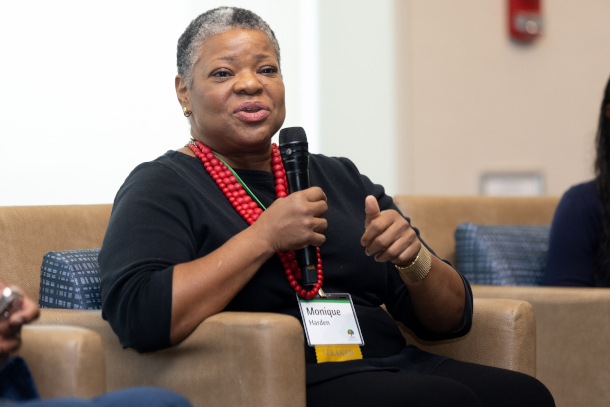
Environmental advocate and attorney Monique Harden speaks about the long history of the environmental justice movement during the 2025 CEJM Conference at UMass Boston. Harden urges residents to use local land use and zoning regulations as a tool to prevent potentially harmful operations from operating in their communities. Harden worked as the head of Law and Public Policy and Community Engagement at the Deep South Center for Environmental Justice before her retirement. (Photo: CEJM)
BELTRAN: And there are, of course, a number of other lawsuits filed across Cancer Alley. What are some of those lawsuits? And what are they fighting against?
HARDEN: It's really what they're fighting for. And they're fighting for a healthy future, health and safety. And human dignity is central to that, and freedom from racial discrimination, because there's such a disparity in terms of who bears the severest burden of pollution in Louisiana's Cancer Alley. Like much of the United States and other parts of the world, it's people of color. It's African American, African descendant, folks, other people of color, Indigenous people, who are bearing these serious environmental burdens and climate impacts.
BELTRAN: That's a struggle. They've definitely taken this all the way to federal court. So that's a huge struggle.
HARDEN: It's a huge struggle, but it's an important one to have. Victory in that lawsuit would mean victory for a lot of communities where land use decisions are made without regard to their health and safety and their wellness. So the precedent setting effect of that can have national importance for everyone.
BELTRAN: Why is it important for Black Americans to understand and protect their history here in the United States, and how can that be a tool for healing?
HARDEN: I think it's important to understand history because it means that you have a sense of what your future could be, knowing the history around environmental justice, because I think it really does and is moving us toward, I think, with some urgency, climate solutions. Or if environmental justice was taken seriously 50 years ago, would we have this climate crisis today? The decisions that got us into this were decisions that did not value people, did not respect human dignity or human rights. And so that means our solutions have to be really wrapped around human rights and dignity and a sense of how special future generations are and that there's something we do today that affects them forever. Black history, I think, is extremely important, because it gives you a guidebook, if you will, around how to do things better today. Maybe it was a childhood asthma or maybe it could have been a climate disaster and a slow recovery that forced, or was a factor in moving away from a neighborhood or a place where that disaster happened. These are all signs of environmental injustice, and so it's about our survival to be able to, number one, be aware of this, and number two, organize to change it.
BELTRAN: Monique Harden is a longtime environmental justice advocate and attorney. Thanks for joining us.
HARDEN: Thank you.
BELTRAN: And Happy Black History Month.
HARDEN: Happy Black History Month. Thank you, Paloma.
Links
Center for Constitutional Rights | “Lawsuit vs Formosa Plastic”
Living on Earth wants to hear from you!
Living on Earth
62 Calef Highway, Suite 212
Lee, NH 03861
Telephone: 617-287-4121
E-mail: comments@loe.org
Newsletter [Click here]
Donate to Living on Earth!
Living on Earth is an independent media program and relies entirely on contributions from listeners and institutions supporting public service. Please donate now to preserve an independent environmental voice.
NewsletterLiving on Earth offers a weekly delivery of the show's rundown to your mailbox. Sign up for our newsletter today!
 Sailors For The Sea: Be the change you want to sea.
 The Grantham Foundation for the Protection of the Environment: Committed to protecting and improving the health of the global environment.
 Contribute to Living on Earth and receive, as our gift to you, an archival print of one of Mark Seth Lender's extraordinary wildlife photographs. Follow the link to see Mark's current collection of photographs.
 Buy a signed copy of Mark Seth Lender's book Smeagull the Seagull & support Living on Earth
© Copyright World Media Foundation. All Rights Reserved
Home | Contact | RSS | Donate | Newsletter